









October 3, 2018:
On Tuesday, Ministers of Worker-starved Germany said that it will ease Immigration Rules to attract foreign job-seekers, including giving well-integrated Irregular Migrants in employment a shot at staying.
Chancellor Angela Merkel's centre-right CDU & their Bavarian allies CSU & the centre-left SPD agreed on a New Strategy to combat fast-ageing Germany's worker shortage as decided in a deal hammered out after marathon talks deep into the night.
Migrants without Residency Permits who are awaiting decisions on their Asylum Applications or their deportation may get to stay if they are gainfully employed and can show they have joined the fabric of German Society.
Job seekers from outside the EU -- including, for example, Cooks, Metallury Workers or IT technicians -- can also come to Germany for 6 Months to try & find employment, conditioned they speak German.
Manpower from the bloc of around 500 million people would not suffice to keep the German Economy ticking, the coalition noted.
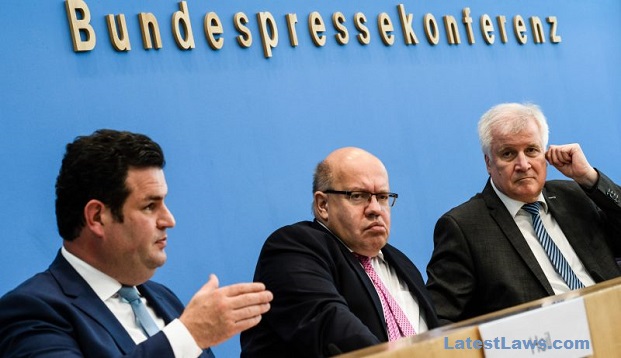
Interior Minister Horst Seehofer told a Press Conference about the strategy that has yet to become a Law & be passed by Parliament.
He said, "That's why we need workers from third countries."
At the same time, the Ministers were at pains to stress the continued "separation of asylum and employment migration", mindful that Germany has been deeply polarized by the arrival of more than a million asylum seekers since 2015.
Immigration has become a concerning issue in recent years over the record influx of mostly Muslim Migrants, many fleeing war in Iraq or Syria.
Railing against the newcomers, the far-right AfD has become Germany's biggest opposition party with more than 90 seats in the Bundestag.
The Government Ministers stressed that the new immigration rules are not designed to allow failed Asylum Applicants to win residency in Germany by switching over to become Employment Migrants.
Rather the new rules are aimed at providing a "pragmatic solution" for migrants who, for instance, have been in Germany for a protracted period because they cannot be deported if they face the risk of torture in their country of origin.
A list of criteria would be drawn up for such cases, said the ministers.
Employment Minister Hubertus Heil said, "It is a Pragmatic Solution that reflects reality." He added that it would avoid cases of Germany "sending the wrong people back".
With unemployment at a record low since reunification, Companies in Europe's biggest Economy have been complaining that a Chronic Shortage in workers is threatening growth.
On Tuesday, Business Weekly Handelsblatt in the areas of Mathematics, computing, natural Sciences & Technology, a record 338,200 jobs went unfilled in September, quoting data from the Cologne-based German Economic Institute.
Economy Minister Peter Altmaier said the new rules will be of particular help to Germany's small-and-medium sized companies, "which in the past have suffered as they are in competition with big companies that have poached the well-trained people".
Source : PTI
Picture Source :



















