









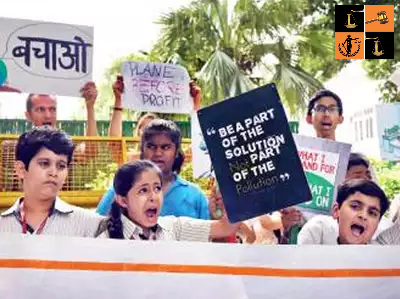
When 16-year old Zeba Khatoon, a resident of a slum cluster in Sundar Nagri in northeast Delhi, deposed before a jury of former Top Court & HC judges & other prominent citizens on the occasion of 30 years of United Nations Convention on the Rights of the Child, she shared her worries over mounting homework due to “pollution” holidays, the trauma of children living around “kudey ke pahaar” (landfill sites) & dangers of water pollution & climate change.
Zeba asserted in her deposition at the public hearing that focus on safe surroundings & clean environment should be central to policy-making.
Stirred by her deposition, the jury in its statement emphasised on the need to focus on “emerging new challenges — climate change, air & other kinds of pollution” that impact children & their overall development.
The public hearing saw 13 children in the age group of 12 to 17 years sharing their concerns on diverse issues that impact children. Organised by HAQ Centre for Child Rights along with other civil society organisations, the function saw children speak on a wide range of subjects from right to education, drug abuse, child labour, impact of National Register of Citizens (NRC) in Assam & concerns of children in Kashmir.
The jury included former Top Court judge Justice Madan B Lokur, Justice Amar Saran, former judge, Allahabad HC; Dr Syeda Hameed, former member of the erstwhile Planning Commission; Faroogh Foyouzat, deputy country representative of United Nations International Children's Emergency Fund (UNICEF)- India; & Namita Bhandare, journalist & writer on gender & social issues.
When jury members asked Zeba for her views on what she thought about loss of livelihood that would follow if factories, one of the sources of pollution, are removed from the outskirts of city, the teenager said, “Employment is important, but then rising pollution will kill us all.”
A class XI student, Zeba quoted AQI updates from her area to stress on the severity of the problem. “The AQI in my area hit 900 after Diwali,” she said, adding that she had been using the mask given to her in the govt school.
In their statement, the jury noted that “several new challenges have emerged. These include climate change, air & other kinds of pollution, increasing migration, impact of conditions of conflict, the question of identity &and citizenship (such as statelessness, implementation of National Register of Citizens (NRC) & concerns of refugee children). The prevailing situation of the children in Kashmir was duly noted with concern where children’s access to education & psycho-social health has been impacted”.
A 12-year-old Class VII student from Pulwama in Kashmir said she hasn't been to school in over 100 days now & was promoted to Class VII after the school decided to allow them to give exams from home. Sharing that children like her live in fear due to the uncertainties, she urged the govt to ease restrictions & restore normalcy.
“Through the testimonies of the children, it is evident that denial of rights & entitlements is increasing,” the jury stated. The jury concluded that there is an urgent need for the govt & civil society to undertake awareness campaigns to address the issues.
Source Link
Picture Source :



















