









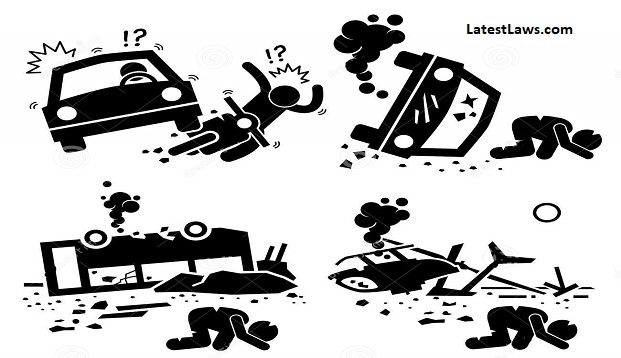
The hospitalisation samples of road crash victims from 54 hospitals across twenty cities show that 34 per cent of them had no income & another 28 per cent had monthly earnings between Rs 10,000 & Rs 20,000. This data collected during a study to work out the socio-economic cost of road accidents for the road transport ministry has revealed how it’s the poor who are the worst impacted in road crashes.
The data show that hardly 3 per cent of the crash victims had monthly earnings of more than Rs 50,000. It was also found that nearly 59 per cent of the accident victims who were hospitalised were twowheeler riders and another 15.5 per cent were pedestrians. Pedestrians, 2-wheeler riders & cyclists are categorised as the most vulnerable road users (VRUs) across the globe considering that they hardly have any protection in case of a crash & hence there is a high chance of these road users getting killed in such incidents.
Sources said about 6,600 samples were collected from 31 Govt & 21 private hospitals. Nearly 10.7 per cent of the accident victims admitted in hospitals were car, SUV & taxi occupants.
The study conducted by a consortium of TRIPP of IIT (Delhi) & DIMTS also collected 6,400 FIRs spanning over 2 years from police stations across 14 cities. It found that in 7 per cent cases, the crashes were fatal & in 66 per cent cases the victims were left with grievous injuries. The analysis of the FIRs also brought to light that nearly 40 per cent victims were twowheeler riders & about 39 per cent victims were pedestrians. The share of car, SUV & taxi occupants was around 8.8 per cent.
The age-wise distribution of data showed that about 67 per cent of the victims were in the age bracket of 18 to 45 years, which is the most productive age group.
The report submitted to the ministry, which is yet to be made public, has concluded that since more than 3/4 of the road crash victims are the two-wheeler riders & pedestrians, there is an urgent need to address the vulnerability of these road users by taking measures with regard to improving enforcement, infrastructure & healthcare services.
Source Link
Picture Source :




















