









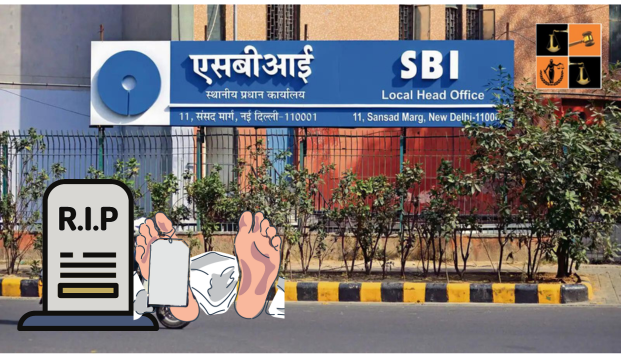
Recently, Delhi's Karkardooma Court Judge, Shri. Surinder S. Rathi. District Judge (Commercial Court), advised the State Bank of India (SBI) to access the database of the Chief Registrar of Births and Deaths, Government of India, through the National API Exchange Platform, Napix, emphasizing the need for real-time verification to prevent the erroneous suing of deceased individuals.
The Court's directive came after SBI's admission of mistakenly filing a lawsuit against a dead man, prompting the Court to discharge a Section 340 Cr.PC notice to the bank official and reject the said lawsuit.
Brief Facts of the Case:
The SBI had filed a suit seeking the recovery of Rs. 13,51,953 along with interest against the defendant, Siya Nand. However, since neither the bank nor the defendant was within the territorial jurisdiction of the Court, during the Court's investigation, it was discovered that Siya Nand had passed away approximately two years before the suit was filed. The Court issued a notice under Section 340 Cr.PC against the Branch Manager for submitting a false affidavit claiming that Siya Nand was still serving under East MCD.
Contentions of the Parties:
The bank acknowledged its mistake and assured corrective action. The Branch Manager of the bank also tendered an unconditional apology for his failure to ascertain whether the defendant who was sued before filing the suit was alive or not.
Observations by the Court:
Learned District Judge Surinder S. Rathi, Karkardooma Commercial Court, scrutinized the bank's Standard Operating Procedures (SOP) for filing suits, emphasizing the necessity of ascertaining the status of individuals, whether dead or alive, before initiating legal proceedings. Amendments were suggested to the SOP, explicitly mandating that the Branch Manager must confirm the status of parties before filing a civil suit and take steps to implead legal representatives in case of the death of a borrower/guarantor.
The Court criticized the bank for attempting to sue a deceased person, highlighting the violation of legal principles, stating that "any Bank especially SBI being leading Bank of our Country, is expected to take proactive steps to ascertain the people being sought to be sued by it are dead or alive."
The bank was questioned about the false affidavit submitted by the Branch Manager and was asked to explain why proceedings for perjury and other offences should not be initiated.
Decision of the Court:
The Court discharged the Section 340 Cr.PC notice after the bank submitted an unconditional apology, acknowledged the bank's positive response to rectify their mistake. However, it held that the suit was liable to be rejected under Order 7 Rule 11 CPC as a dead person cannot be sued and such a suit is nonest. The Court granted the benefit of Section 14 of the Limitation Act to the plaintiff bank, considering the corrective measures taken by SBI. No additional costs were imposed, except for the forfeiture of Court fees, and the order was sent to relevant authorities for information and corrective action.
Case Name: State Bank of India vs. Siya Nand
Coram: Learned Mr. Surinder S. Rathi, District Judge (Commercial Court), Karkadooma,Delhi
Case No.: CS (Comm) No.352/2023
Advocates of the Petitioner: R.K. Sinha, Biplab Mukherjee, and Vaishali
Read Judgment @LatestLaws.com
Picture Source :




















