









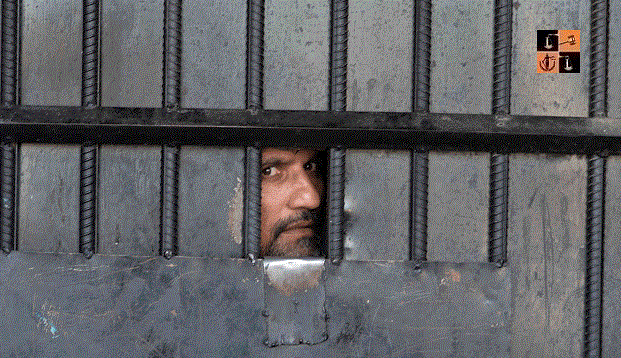
The Delhi High Court recently comprising of a bench of Justice Swarana Kanta Sharma granting parole of 45 days to a man serving a life term for murder, held that courts must balance sensitivity with the law while dealing with such cases. (Kundan Singh V. The State (Govt. Of NCT) Delhi)
Facts of the case
The bench was hearing the plea of Uttarakhand native Kundan Singh, who is serving a life term in a murder case, seeking parole for two months to “settle the partition of undivided property of joint Hindu family, to maintain social ties and family relations and to curb inner stress”. The man’s parole was rejected by the deputy secretary (home), Government of Delhi, on July 27 as his jail conduct was “unsatisfactory” and multiple punishments were awarded to him for breach of prison rules.
The instant petition has been filed for issuance of a writ of certiorari for quashing the order dated 27.07.2022 by the GNCTD rejecting the application of the petitioner and to issue a Writ of Mandamus or any other Writ, directing the respondent to release the petitioner on parole for a period of two (02) months.
Contention of the Patties
Learned counsel for the petitioner argued that the reasons mentioned by the respondent for rejecting the application for the petitioner was that he had not completed two years since his last punishment was awarded on 05.01.2022. It is argued that this matter is pending inquiry before learned District & Sessions Judge concerned, and he has already been punished for the same by the jail authorities. It is also pointed out that the petitioner has been granted parole 07 times in the past including emergency parole which was granted on 23.04.2022 to 02.05.2022 on account of his mother’s barsi.
Learned APP for the State on the other hand stated that as per the Rules, parole could not have been granted to the petitioner and was declined by the concerned authority since his jail conduct was unsatisfactory and multiple punishments were awarded to him for breach of Prison Rules. In this regard, a reference was made to the nominal roll dated 21.08.2022. It was pointed out that it is clear from the nominal roll that the petitioner has been awarded punishments for prison offences on 17 occasions between 2013 and January, 2022.
Courts observation and order
The bench taking note of the contention of the learned counsel for the petitioner as well as learned APP for the State noted, “this Court is of the view that in the last two (02) years, the petitioner has not been involved in any offence involving violence, last two punishments in any case are still a matter of inquiry before the learned District & Sessions Judge, therefore, it is yet not clear whether they will be found to be liable for major punishment or not. It is also clear from the nominal roll that the petitioner was awarded punishment as was deemed appropriate by the jail authorities for the breach of Prison Rules which are clearly mentioned in the nominal roll.”
The bench further noted, “It is not disputed that the petitioner was granted parole on 07 occasions including one emergency parole and he had not misused the liberty of parole granted to him. The petitioner has been in custody for more than 14 years. It is also not disputed that it will be 06 months since he was granted emergency parole on 02.11.2022. While considering grant of parole, the court also has to remain conscious of the fact that the petitioner has been awarded life imprisonment and circumstances have arisen in the last 14 years which he needs to attend to family exigencies.
Sensitivity and compassion balanced with rules, regulations and law needs to be maintained by any Court as one is dealing with humans and not mere files and orders.”
The bench granting him parole for a period of 45 days remarked, “Considering that the petitioner has spent 14 long years in jail, has been granted parole on 07 occasions, has lost his mother while he was in judicial custody and now after death of his mother such exigencies have arisen which he needs to attend to, this Court is inclined to grant him parole for a period of 45 days from the date of his release.”
Read Judgment @Latestlaws.com:
Picture Source :



















