









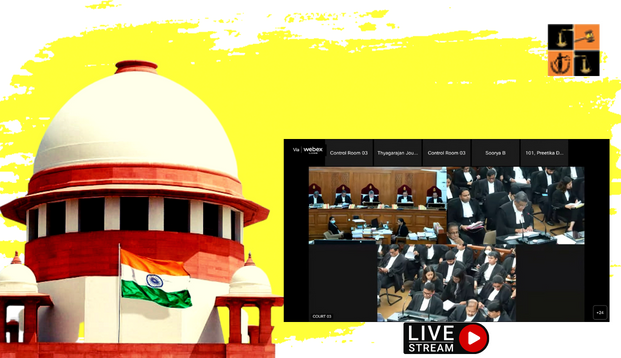
In the backdrop of remarks of the High Court Judge, during the live-streamed bail hearing, causing damage to the repute of the parties, the Supreme Court has observed that it is essential for the courts to be extremely cautious while passing adverse remarks against the parties involved and must do so with proper justification, in the right forum, and only if it is necessary to meet the ends of justice.
A division bench of Justice Krishna Murari and Justice Ahsanuddin Amanullah was adjudicating upon the appeal filed by the aggrieved party seeking expunging of the remarks made during the hearing which were widely reported in the media and caused injury to the reputation of the Appellants.
Brief Facts of the Case
The Karnataka High Court Judge, Justice Justice HP Sandesh had on two separate occasions, during the bail proceedings of appellants, made adverse remarks against them herein, which is said to have caused great harm to their reputation. Due to the proceedings being broadcasted on the High Court’s YouTube channel, the said comments have received wide publicity, and several media and news outlets have picked up on those comments and reported the same.
Supreme Court's Observation
The Court at the outset noted that bail proceedings, unlike a full criminal trial, are burdened with the task of only forming a prima facie view on the merits of the case and in such a circumstance when the evidence is not fully analyzed, and a presumption of innocence is still operational in favour of the accused, the courts must then be extremely cautious in passing adverse remarks against the accused.
This becomes especially important in cases where the party against whom the remarks are passed do not have a lis in the said proceedings, for such comments, especially if passed by constitutional courts, can cause great injury to the reputation of the parties at the receiving end of such remarks, the court added.
It cited Niranjan Patnaik Vs. Sashibhusan Kar & ANR [1986] INSC 73 (11 April 1986), State of Madhya Pradesh & Ors Vs. Nandlal Jaiswal & Ors [1986] INSC 218 (24 October 1986), The Chief Election Commissioner of India Vs. M.R Vijayabhaskar
The Court was of the view that as far as Appellant No.2 is concerned, the remarks made by the High Court against him seem to be unreasonable and without justification as he is merely a government employee of the department that is conducting the investigation and has no personal involvement with the case and not an accused and has nothing to do with the transaction of the crime, let alone the bail proceedings.
"No evidence against him has been analyzed by the court and no opportunity has been given to him to explain himself, however, scathing and egregious remarks have still been passed against him. In such a scenario, we find the remarks passed by the High Court to be unfair and not in the interest of justice," the Court stated.
Noting that all of this had happened within Section 439 Cr.PC proceedings, and that too against a person unconnected to the accused, the Court cited Specified Bank Notes (Deposit by Banks, Post Offices and District Central Cooperative Banks) Rules, 2017, Murugesan (A-5) S/o Muthu Vs. State through Inspector of Police [October 12, 2012], State of Punjab Vs. Davinder Pal Singh Bhullar & Ors. Etc.,
In so far as the Appellant No. 3 is concerned, the Court opined that even though he is an accused in the alleged crime, however, what must not be forgotten is the fact that he does not have any lis in the bail proceedings, as the same was exclusive to Respondent No.1 and thus it was extremely unreasonable on part of the High Court to pass such radverse remarks against him.
"When no allegations were made against Appellant No.3, and the presumption of innocence is still functional in the favor of the Appellant No.3, we find it to be a gross abuse of the process of law to pass such adverse remarks against him, as such remarks do not just cause injury to his reputation, but also has the potential to cause great prejudice to his actual trial," the Court went on to observe after further analysis.
Placing reliance on a slew of judgments passed by it, the Court opined that the actions of the High Court during the bail proceedings of a third party are manifestly arbitrary and unjust, and the High Court must have confined itself to the issues relevant to it for the purposes of deciding the bail of the Respondent No.1. A court of bail, especially in cases where the bail is sought for by a third party, is not a court that has all the relevant information to pass an order on the merits of an unconnected party, and such an order, if passed, has the potential to cause great harm to the said party without them being afforded an actual and meaningful opportunity to defend themselves
"It is a well-settled principle of law that any party, when being accused of an illegal act, must be given an opportunity be fairly heard. This opportunity to be meaningfully heard however has not been afforded to Appellant No.2, and hence we hold issue 2 in favour of the Appellant No.2," the Court remarked.
The Court further commented that the legal system in general, and the judicial system in particular, has ushered into a new age of accessibility and transparency due to the adoption of virtual hearings and live telecasting of open court proceedings.
"These changes in the judiciary have ensured that the courts as redressal mechanisms have become more accessible to the common man than ever before. The limitations of physical infrastructure, that has constrained the courts to a physical location, has often been cited as one of the main roadblocks in the path towards access to justice. This roadblock, however, has now been cleared due to the availability of technology and the adoption of the same."
Stating that this is never before seen transparency in the judicial system, the Court remarked that while it brings with it great benefits, it also attaches with it a stricter standard of responsibility on judges while conducting such court proceedings.
"Remarks passed in court, due to the live broadcasting of court proceedings, now have ramifications that are far reaching, and as can be seen in the present case, can cause great injury to the reputation of the parties involved. In such a circumstance, it is essential for the courts to be extremely cautious while passing adverse remarks against the parties involved, and must do so with proper justification, in the right forum, and only if it is necessary to meet the ends of justice."
The Court concluded that the impugned remarks are liable to be expunged and accordingly allowed the appeals.
CASE TITLE: Seemant Kumar Singh Vs. Mahesh P.S. & Ors. 2023 Latest Caselaw 232 SC
CASE DETAILS: CRIMINAL APPEAL NO. OF 2023
CORAM: Justice Krishna Murari and Justice Ahsanuddin Amanullah
CITATION: 2023 Latest Caselaw 232 SC
Read Judgement @LatestLaws.com
Picture Source :




















