









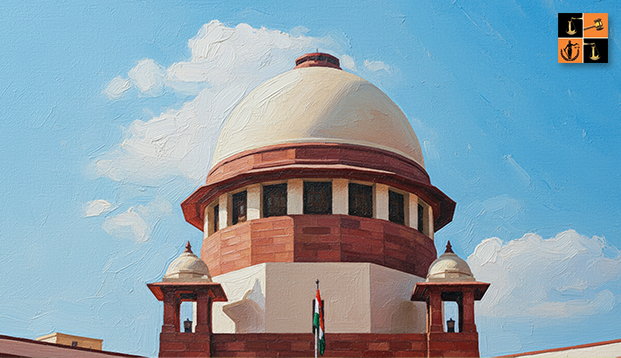
Recently, the Supreme Court heard a civil appeal concerning a dispute over ownership and possession of agricultural land. The case arose from conflicting claims between the plaintiff, who alleged ownership based on an oral gift from her mother, and the defendants, who claimed to have purchased the land through registered sale deeds from the lawful heir. The appeal involved examination of the validity of the alleged oral gift, the authenticity of supporting documents, and questions of limitation and inheritance under Mohammedan Law.
Brief Facts:
The case arose from a dispute over ownership and possession of agricultural land measuring 24 acres and 28 guntas . The Respondent claimed ownership based on an alleged oral gift (hiba) from her mother, while the Appellants asserted title as bona fide purchasers through registered sale deeds executed by the Respondent’s father. The land originally belonged to the Respondent’s mother, who had acquired it through a partition decree and later made mutation entries in her name. After her death, her husband transferred the property to the appellants, prompting the Respondent to file a suit seeking a declaration of title and a perpetual injunction, alleging attempts at dispossession.
Contentions of the Appellants:
The counsel for Appellants argued that the lower courts erred in appreciating the facts and evidence. They claimed to have lawfully purchased the land from the rightful heir through registered sale deeds and that their names were continuously recorded in revenue records while they paid land taxes and took crop loans. They questioned the Respondent’s claim of being the owner’s daughter, noting the absence of documentary proof and the reliance on related witnesses under Section 50 of the Evidence Act. They also contended that the alleged oral gift and memorandum were fabricated, citing inconsistencies in signatures. Additionally, they maintained that the suit was barred by limitation and that the High Court exceeded its jurisdiction by recognising the oral gift despite no cross-appeal being filed.
Contentions of the Respondent:
The counsel for the Respondent argued that the concurrent findings of fact by both the trial court and the High Court should not be interfered with under Article 136 of the Constitution. It was contended that the original owner had made an oral gift of 10 acres to her only daughter and later executed a memorandum confirming the transaction. After the owner’s death, the property devolved upon her husband and the Respondent under Mohammedan Law, and upon the husband’s death, the plaintiff became the sole owner. The Respondent submitted that the oral gift met all essential conditions of a valid hiba, including declaration, acceptance, and delivery of possession, supported by witness testimonies. It was further argued that the suit was filed within the limitation period, arising only when the Appellant attempted to forcibly dispossess her. The counsel for Respondent contended that the alleged sale deeds were invalid and, even if executed by the husband, could only cover his one-fourth share, thus not conferring any right or title on the Appellant.
Observations of the Court:
The Court undertook a limited reappreciation of evidence, holding that though such review is ordinarily avoided under Article 136 of the Constitution, it is justified when findings are “manifestly perverse and unsupportable from the evidence on record,” as laid down in Mahesh Dattaray Thirthakar v. State of Maharashtra.
The Court found that the High Court had exceeded its jurisdiction by modifying the trial court’s decree and recognising the oral gift without any cross-appeal. Citing Banarsi v. Ram Phal, it reiterated that “in the absence of a cross appeal preferred or cross objection taken by the plaintiff-respondent, the First Appellate Court did not have jurisdiction to modify the decree in the manner in which it has done.”
On the issue of lineage, the Court held that the Respondent failed to prove she was the daughter of the original owner. Referring to Dolgobinda Paricha v. Nimai Charan Misra, it noted that opinion evidence must be supported by credible conduct and proof. The oral evidence of PW, being interested witnesses, lacked documentary corroboration. The Trial Court’s reliance on its own comparison of signatures under Section 73 of the Evidence Act was termed “illegal and unsafe.”
On the alleged hiba, the Court reiterated that declaration, acceptance, and delivery of possession are essential. Citing Hafeeza Bibi v. Sk. Farid and Rasheeda Khatoon v. Ashiq Ali, it held that possession was never proved. The Bench remarked, “The Plaintiff places oral evidence, and the circumstances summed up above do not inspire confidence for accepting that there has been a valid oral gift in any capacity, i.e., as a daughter or otherwise, in favour of Plaintiff. The impugned judgments presume possession in favour of Plaintiff on ipse dixit statements.”
Lastly, the Court ruled that the suit was barred by limitation. Referring to Articles 58 and 59 of the Limitation Act, it held that the cause of action arose long ago, as the sale deeds were executed. The Court observed, “The conduct for over a period of 23 years cannot be appreciated as the conduct of a passive observer,” and applied the doctrine of constructive notice, concluding that the plaintiff’s claim was time-barred.
The decision of the Court:
The Court held that the findings of both the trial court and the High Court were perverse and contrary to law. It ruled that the plaintiff failed to establish her relationship with the original owner, prove possession under the alleged oral gift, and file the suit beyond the limitation period. The Court set aside the impugned judgments, dismissed the suit, and allowed the civil appeal. All pending applications were disposed of with no order as to costs.
Case Title: Dharmrao Sharanappa Shabadi and Others versus Syeda Arifa Parveen
Case No.: Special Leave Petition (C) No. 16996 OF 2022
Citation: 2025 Latest Caselaw 942 SC
Coram: Hon’ble Mr Justice S.V.N. Bhatti and Hon’ble Mr Justice Ahsanuddin Amanullah
Counsel for the Appellant: Sr. Adv. Rauf Rahim, Adv. Yash Prashant Sonavane, Adv. Gopal Bhosale, Adv. Sangita Bhosale, Adv. Ali Rauf Rahim, and AOR Ravindra Keshavrao Adsure.
Counsel for the Respondent: Sr. Adv. Ameet Kr Deshpande, AOR Akshat Shrivastava, Adv. Vibhor Jain, and Adv. Pooja Shrivastava
Read Judgement @Latestlaws.com
Picture Source :




















