









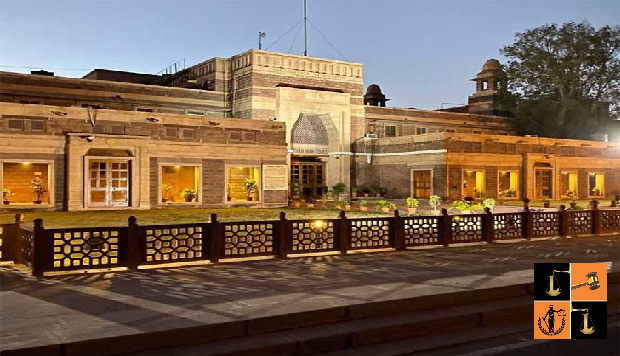
Recently, the Rajasthan High Court held that insisting on surety bonds from an indigent life convict as a precondition for parole, despite proven inability to furnish the same, amounts to constitutional impropriety. Declaring such insistence violative of Article 14 and Article 21 of the Constitution, the Court remarked that “Parole, once granted by the competent committee, cannot be rendered meaningless or illusory by superimposing conditions which the authority itself knows the prisoner is unable to fulfill.”
Brief Facts:
The case arose from an undated communication sent by the petitioner, a life convict lodged in Central Jail, Jodhpur, which was treated as a criminal writ petition. The petitioner was convicted under Sections 302/34 of the Indian Penal Code and is undergoing life imprisonment, having completed over fourteen years of incarceration, including remission.
The grievance stemmed from the petitioner’s fourth application for regular parole, sanctioned for forty days, subject to furnishing two sureties of Rs. 25,000 each and a personal bond of Rs. 50,000. Despite identical surety conditions having been waived on three earlier occasions owing to his indigence, the authority re-imposed the same requirement, rendering the parole illusory and compelling the petitioner, unable to afford legal representation, to once again approach the Court through correspondence.
Contentions of the Petitioner:
The Petitioner contended that, owing to his financial incapacity, compliance with the condition of furnishing sureties was beyond his means. He sought modification of the parole order to permit his release on execution of a personal bond alone, submitting that on all three earlier occasions, the Court had waived the requirement of surety after taking note of his indigent condition.
Contentions of the Respondent:
The Respondent, on the other hand, opposed the petition and sought dismissal, contending that the parole conditions were imposed in accordance with the Rajasthan Prisoners Release on Parole Rules, 2021. The State relied upon the petitioner’s own admission regarding his inability to furnish sureties but maintained that the conditions imposed by the Parole Committee were within its discretion.
Observation of the Court:
The Division Bench of Justice Arun Monga and Justice Farjand Ali held, upon examining the Rajasthan Prisoners Release on Parole Rules, 2021, particularly Rules 4 and 8, that the stipulation of furnishing surety is directory and discretionary in nature, and not a mandatory or punitive precondition for release on parole. The Court noted a “persistent and deeply troubling pattern” of mechanical insistence on sureties, despite repeated judicial waivers, describing it as “a disturbing institutional apathy to the rule of law.”
The Bench observed that “The law does not, and constitutionally cannot, countenance a situation where the means defeat the end. Furnishing of surety is only means to secure the prisoner’s surrender after completion of parole and not an end in itself.”
It further held that where indigence is established and undisputed, insistence on sureties becomes “an instrument of oppression and exclusion” and results in “constructive denial of parole, notwithstanding its formal grant.”
The Court stated that “a prisoner does not cease to be a rights-bearing individual merely because he is incarcerated” and that economic incapacity cannot justify differential treatment between prisoners. Reiterating the reformative and humanitarian object of parole, the Bench warned that parole cannot degenerate into “a selective indulgence reserved for those with means or social capital.”
To ensure uniformity, fairness, and constitutional compliance, the Court laid down structured guidelines for parole authorities. It directed that the amount of personal bond must be commensurate with the prisoner’s economic background and should not be exorbitant or oppressive. While an appropriate surety may ordinarily be imposed at the stage of first parole, the Court clarified that no such condition should be imposed where indigence is established, even at the initial stage. It further mandated that where a surety condition has been imposed, but the prisoner demonstrates an inability to comply due to poverty, the requirement must be waived.
Significantly, the Bench held that once a prisoner has previously been released on parole without furnishing surety, whether by order of the Parole Committee or a constitutional court, the requirement must ordinarily be dispensed with for subsequent paroles, unless the authority records reasons to show that the prisoner has since become financially capable. These directions, the Court clarified, would also apply to paroles granted on humanitarian grounds under Rule 4(3) of the 2021 Rules.
To prevent recurrence of such hardship, the Court further directed that once a waiver of surety is granted, immediate intimation must be sent to the Rajasthan State Legal Services Authority for entry into a digital database, enabling facilitation of future parole through legal aid. The Bench concluded that these guidelines shall operate as binding directions, ensuring that parole does not remain inaccessible to prisoners merely because of poverty.
The decision of the Court:
In light of the foregoing discussion, the Court allowed the writ petition, waived the condition of furnishing two sureties of Rs. 25,000 each, and directed the petitioner’s release on parole upon execution of a personal bond of Rs. 50,000. In addition, the Court framed detailed guidelines to ensure that in future cases involving indigent prisoners, discretion under the Parole Rules is exercised “in a humane, rational and constitutionally compliant manner.”
Case Title: Khartaram Vs. State of Rajasthan
Case No.: D.B. Criminal Writ Petition No. 3130/2025
Coram: Hon’ble Mr. Justice Arun Monga , Hon’ble Mr. Justice Farjand Ali
Advocate for the Petitioner: By Post
Advocate for the Respondent: Mr. Deepak Choudhary, AAG
Read Judgment@ Latestlaws.com
Picture Source :




















