









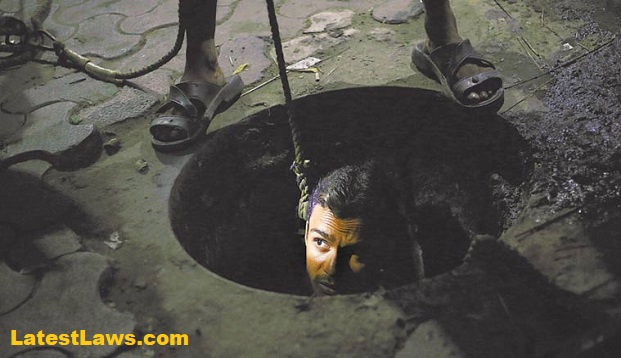
The Himachal Pradesh High Court ordered Chief Secretary to pay two lakhs to a school sweeper for manual scavenging, stating that it was a gross violation of the individual's fundamental right.
Facts:
The Petitioner was employed as a sweeper in the Government Polytechnic College. He was appointed under the Student Welfare Fund. From 5th December 2017 to 5th January 2018, the Institute conducted the students' examinations. The examination centre was set up on the 4th floor where there was no public toilet. The Petitioner was instructed by the college administration to bring a drum and keep it outside the testing area so that students might use it for defecation.
The Petitioner was asked to empty the drum outside the centre on the first floor. Although the Petitioner declined, the college administration made him perform manual scavenging. Due to these circumstances, the Petitioner moved to the High Court, alleging a violation of his fundamental rights under Articles 14, 17, and 21 of the Constitution of India.
Contentions of the Petitioner:
It was argued that the Petitioner was made to perform the inhuman act continuously for a year. While performing the manual scavenging work, the Petitioner had a fall on the staircase and suffered injuries.
Contentions of the Respondents:
It was contended that the Petitioner was assigned the duty of Sweeper during the entire tenure of the examination in lieu of payment of extra remuneration of 55 rupees per shift. The Petitioner had voluntarily agreed to perform the duty. The Respondent further submitted that the disposal of collected urine was not being made on the first floor as alleged by the Petitioner but was being done on the third floor in the toilets, which were still not fully operational.
Observation of the Court:
After hearing both parties, the Court was of the opinion that the Respondent's conduct was a clear violation of Section 5 of the Prohibition of Employment as Manual Scavengers and their Rehabilitation Act, 2013 (“2013 Act”) which specifically prohibits the employment and engagement of manual scavengers. It was observed that Article 21 of the Constitution of India also covers the right to reputation within its ambit. The State is dutybound to protect citizens against violations of fundamental, legal, and human rights.
The Bench further stated that the Respondent’s contention alleging that the Petitioner was getting extra remuneration and was voluntarily performing his duty is an absurd plea as the Petitioner belongs to that stratum of society where it is difficult to meet two ends meet, and under such circumstances, the consent becomes irrelevant.
The High Court noted that the Respondents violated both the fundamental and legal rights of the Petitioner.
The decision of the Court:
The Court stated that it is unfortunate that the Respondents, instead of reminding themselves about their constitutional and adversarial legal obligations, have taken just to defeat the claim of the Petitioner here. The Himachal Pradesh High Court ordered the Respondents to pay Rs. 2,00,000 to the Petitioner. The Court further directed the State Government and the Union of India to implement the provisions contained in the 2013 Act fully.
Case Title: Charno Ram v. Union of India and others
Coram: Hon’ble Justice Satyen Vaidya
Case No: CWP No. 84 of 2019
Advocate for the Petitioner: Adv. Mr. Jeevan Kumar
Advocates for the Respondents: Mr. Virbahadur Verma, CGC; Mr. Desh Raj Thakur, Addl. A.G. with Mr. Narinder Thakur, Dy.A.G.
Read Judgement @LatestLaws.com
Picture Source :



















