









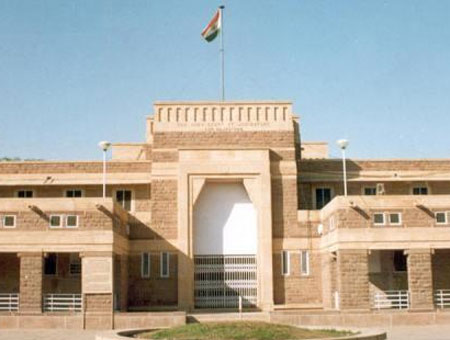
The Rajasthan High Court recently comprising of a bench of Justice Dinesh Mehtabdirected that English, as a medium of instruction, cannot be thrust upon a child even by a legislation of the state government. (School Development Management Committee v. the State of Rajasthan)
This direction was given while revoking the decision to convert Shri Hari Singh Senior Secondary School in Jodhpur district to English medium school in the middle of the ongoing academic year.
The court termed the decision to convert the school with immediate effect during the 2021-22 academic session violative of Article 14 and 19 of the Constitution.
Facts of the case
The present petition, filed by the School Development Management Committee of Shri Hari Singh Senior Secondary School, Pilwa Panchayat Samiti Dechu, Jodhpur, challenging the decisions of Sept 2021 taken by the state government which converted petitioners' Hindi Medium school to an English Medium School - Mahatma Gandhi Government School (English Medium).
Contention of the parties
The counsel for the petitioner at the outset clarified that they were not opposed to English as a medium of instruction, but were aggrieved by the overnight conversion and resultant ouster of students.
It was submitted that if the State wished to open more English-medium schools, then it must allocate funds and create new infrastructure for the same since the conversion of the existing schools was an arbitrary exercise.
It was brought to the Court’s attention that the Right of Children to Free and Compulsory Education Act of 2009 mandate the medium of instruction to be the students' mother tongue.
The State on the other hand informed the Court that there were as many as nine government schools within 5 kms of the same school imparting education in Hindi and thus, the petitioners’ stance that their fundamental rights were violated was baseless.
The counsel for the State contented that the establishment of a school, including conversion of schools to English medium, was a policy decision, better left to its discretion.
Courts observation & Judgment
The bench noted that Article 19(1)(a) of the Constitution applied to the right to receive education in a particular language, “A child or on his behalf, his parent(s) have the right to choose the language in which his/their child should be imparted education,” the Court concluded.
The Court stated that because the State’s decision was essentially administrative in character and did not constitute as “law,” it was not protected under paragraph (2) [reasonable restriction] of Article 19.
The removal of 601 students “with one stroke of a pen” with the guarantee that they would be accommodated in surrounding schools, according to Justice Mehta, was a violation of their fundamental rights.
The Court remarked, “The same is likely to affect their emotional quotient as well. Because, for children, their school is not only a structure made of stones, cement and concrete – it is a second home or sort of a temple, where they flock to learn; to play and to grow.”
The Court slammed the State’s guarantee, stating that removing 601 seedlings (children) from their current school to be transplanted into surrounding schools was not an acceptable rationale, especially in the middle of the academic year.
The Court granted the petition, holding that the State’s decision will only be implemented if a majority of the members of the School Development Management Committee vote to convert the school to an English-medium school.
Read Order @Latestlaws.com
Picture Source :



















