









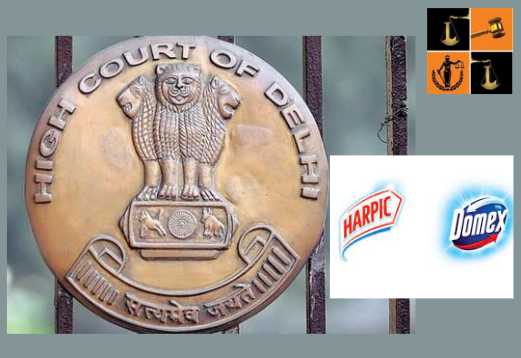
The High Court of Delhi in a false advertising dispute that had arisen between Reckitt Benckiser (India) Pvt. Ltd. (hereinafter referred to as “Reckitt”), and Hindustan Unilever Limited (hereinafter referred to as “HUL”), examined the boundaries of commercial speech and upheld the decision of Single Judge bench which stated that promoting a product cannot be permitted to denigrate or disparage the product of a rival. The division bench held that the Single Bench had not interdicted the Petitioner from broadcasting the advertisement but only directed to remove the reference which is identifiable as the Respondent's product.
Brief Facts:
HUL is a company incorporated in India and engaged in the manufacturing, marketing, and selling of various consumer products including food and refreshments, cosmetics, toiletries, floor cleaners, toilet cleaners, toilet soaps, washing soaps, and detergents. On the other hand, Reckitt is a company involved in producing, packaging, selling, and distributing various fast-moving consumer goods (“FMCG”) such as antiseptic liquid, toilet care products, surface care pharmaceuticals, insecticides, and food products.
Hindustan Unilever Limited (hereinafter referred to as the “HUL/Appellant”) also manufactured and marketed a toilet cleaner sold under the trademark 'Domex'. The Appellant had been granted a patent for using a technology that enhanced the malodor fighting capabilities by extending the period of its effectiveness.
Reckitt Benckiser (India) Pvt. Ltd. (hereinafter referred to as the “Reckitt/Respondent”) has been manufacturing a well-known toilet cleaner under the trademark 'Harpic' in India since 2001. The Respondent had obtained trademark registrations for the word mark 'HARPIC' and the shape of the bottle used for packaging 'Harpic' products in India.
Procedural History:
The Respondent filed a suit against the Appellant because the TV commercial, impugned advertisement, and impugned videos were disparaging its product sold under the brand name 'Harpic'. The Respondent sought an interim relief restraining the Appellant from publishing or telecasting the impugned advertisement and impugned videos, and the Single Judge bench granted the same.
Both the parties assailed the impugned judgment, and the Respondent filed an appeal to the limited extent that the Single Judge bench had not interdicted broadcast of the TV Commercial. The Court found that the learned Single Judge had erred in drawing a prima facie conclusion that the TV Commercial did not denigrate the Respondent's product, and accordingly restrained the Appellant from airing the TV Commercial.
The appeal that was considered only pertained to the disputed advertisement, which was published in a newspaper, and the disputed videos, which were three videos that had been broadcasted on the internet platform, YouTube.
Issue:
- Whether a company can launch a campaign claiming the superiority of its product over its competitors?
- If issue 1 is answered positively, whether the company must prove the truthfulness of its superiority claims?
Contentions of the Appellant:
The counsel representing the Appellant argued that the Single Judge bench had made an error by assuming that the videos in question denigrated any product. He stated that there was no basis for this assumption and that the videos only promoted the Appellant’s product ‘Domex’ without disparaging any other product. He also contended that the Single Judge was wrong in assuming that the toilet cleaner bottle shown in the videos was identical to the Respondent's product 'Harpic', as a comparison between the two would reveal differences.
He pointed out that the videos had a disclaimer stating that the ordinary toilet cleaner did not use water-repellent technology. Additionally, he disputed the Respondent's claim that they had a registration for the shape of the bottle, citing documents that showed that the registration was for the device marks on the bottle and not its shape.
Contentions of the Respondent (Reckitt):
The counsel representing the Respondent argued that the impugned advertisement was disparaging as it portrayed the part of the toilet bowl cleaned by Harpic as smelly and emitting a bad odour. He stated that the Appellant's claim that their product was superior was untrue, as it was based solely on the use of a chemical compound called 'Saline' which made the surface hydrophobic, but overlooked the fact that toilet bowls were made of ceramic and already had a smooth surface that repelled water. He also claimed that the Appellant's product did not have any additional advantage over Harpic in terms of reducing the odour.
He claimed that the tests conducted by the Respondent’s third-party laboratories showed that there was no difference in effectiveness between the Appellant's product (Domex) and The Respondent's product (Harpic) and that both products were effective in cleaning germs at the time of usage but were ineffective after subsequent wash cycles.
Observations of the Court:
The Court remarked that while commercial speech is protected under Article 19(1)(a) of the Indian Constitution, protection cannot extend to misrepresentation or advertisements that are contrary to law (Tata Press Ltd. v. Mahanagar Telephone Nigam Limited & Ors. (1995) 5 SCC 139). The Court in the case of Reckitt Benckiser (India) Pvt. Ltd. v. Hindustan Unilever Limited FAO(OS)(COMM) 149/2021 & Colgate Palmolive Company v Hindustan Unilever Limited (2013) SCC Online Del 4986, clarified that puffery and hyperbole, which are exaggerated statements made in advertisements to attract customers, do not have any binding effect as representations or warranties. The Court also stated that such statements do not hold good in situations where they are made as representations of fact.
The Court also noted that while comparative advertisements that involve some amount of disparagement are permissible, it is not permissible to denigrate or disparage the goods of another person. The Court also stated that honest comparative advertisements are permissible as long as the statements of fact made in the advertisements are accurate and true, and the overall message delivered by the said statements of fact is not misleading.
The High Court directed the Appellant to remove all references to The Respondent’s products. The Court found no flaw in the impugned verdict and hence the current appeal was dismissed.
Case Title: Hindustan Unilever Ltd. v Reckitt Benckiser (India) Pvt. Ltd.
Case No.: FAO(OS)(COMM) No. 157 of 2021
Coram: Hon’ble Mr. Justice Vibhu Bakhru and Hon’ble Mr. Justice Amit Mahajan
Advocates for Appellant: Mr. Amit Sibal, Senior Advocate with Mr. Ankur Sangal, Ms. Pragya Mishra, Mr. Kiratraj Sadana, Ms. Trisha Nag, and Mr. Rishabh Sharma, Advocates.
Advocates for Respondent: Mr. Chander M. Lall, Senior Advocate with Ms. Nancy Roy, Mr. Prakriti Varshney, Ms. Annanya Chugh, and Ms. Aashta Kakkar, Advocates.
Read Judgement @LatestLaws.com
Picture Source :



















