









July 22, 2018:
The Author, Jigyasa Agrawal is a 2nd year student of Banasthali Vidyapith University, Rajasthan.
Acid Attacks Scarring Indian Souls: A Legal Overview By: Jigyasa Agrawal
“He changed my face,not my heart. He threw acid on my face, not on my dreams”.
-Laxmi Agrawal, Acid Attack Victim
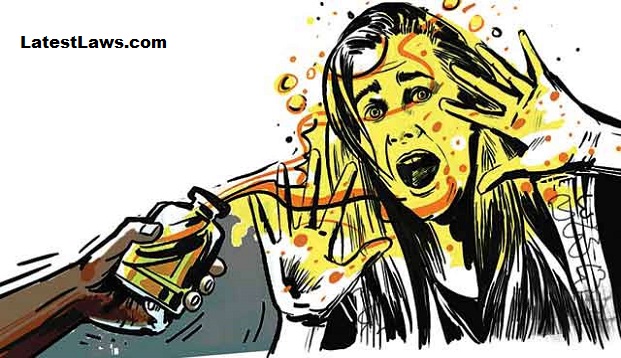
Crime, Crime, Crime ,everywhere the word crime has been fascinated . A small word ‘crime’ has created so much significance in the life of others that everyone has only word in their mouth. Who are responsible for such crime ? To whom we can blame? The simple answer we the people .Crime is not something which has been created by god ,it is the creature of a human being.Human beings are only responsible for heinous crime which we face today. Crime is not new for us but it’s just the way of doing crime has been reformed. In urban areas, there was a time when people use acid for household purposes but now the scenario was changed and people use acid for destroying the life of people.Acid attack is not something unheard of in India. It has shocked the conscience of people again and again. The Indian Penal Code was modified in 2013 for the first time to add rules for acid attackers. But have we done enough? Do enough of us care? Why should we care? Why should we care anymore than we do for general fight for women’s rights and safety in India about acid attacks?
Acid attack just spoil the life of the people, their family , loss of income and opportunity. It can happen to anyone , at anytime. The factors for acid attack is uncounseled anger and frustration behind the crimes.
Man who cannot face rejection take their ‘revenge’ by throwing acid in victim face so that the life of the person get destroy. Men throw acid on us with the intention of injuring or disfiguring our bodies, burn our faces, smash our noses, melt our eyes, and walk away as happy men. Men throw acid on us for taking revenge from us. Men emotions get hurted for ending relationships and for refusing sexual harassment, sexual exploitation, proposals of marriage and demands for dowry. Since acid is so readily available across the market in medical shops, acid attacks become a relatively cheap and effective way of committing acts of violence against women. Acid attack is common in Pakistan, Bangladesh, India, Afghanistan, Nepal, Cambodia, and a few other countries. As acid is used right from toilet cleaning, to jewellery making and in battery shops, car and auto service garages, it continues to be easily available. Only a cup of acid is sufficient to disfigure a person .
The Piyali Dutta-who got caught in a crossfire and now is an acid survivor for life. Sonali Mukherjee’s story –attacked while sleeping in her own house for standing up to harassment –is one that should keep all of us awake as it could have been , or still can be , anyone. 85% of victim are women, so acid attack can be classified as gender violence. For the 15% male victims, the primary cause of attack is property dispute.
As the crime of acid attack has increased from past, so to put a stop to the growing number of acid attacks the Supreme Court has put ban on selling acid.
After the leading case of Laxmi v. UOI , the Supreme Court passed an order to put ban on selling of acid in shops. For preventing acid attacks, the SC has completely prohibited the counter sale of the chemical unless the seller maintains a recording of the address and other details of the buyer, and the quantum. Dealers can now only sell the chemical after the buyer showed a government issued photo identity card and after specifying the purpose of purpose . The seller should submit the details of sale to the local police within three days of the transactions. Acid should not be sold to any person under 18 and all stocks must be declared with the local sub-divisional magistrate within 15 days. Undeclared stocks could be confiscated and the defaulter fined up to Rs. 50,000. Acid attack is now a non-bailable and cognizance offence.
Laxmi of 22 years old, who was an acid attacker survivor was waiting for a bus in Delhi’s tony khan Market in 2005, when two men poured acid on her after she refused to marry one of them, leaving her disfigured. Though the victims and her parents were poor they were fortunately helped by a benefactor who bore the medical expenses approximating to Rs. 2.5 lakhs. However, even after 4 plastic surgeries the victim’s physical appearance remains horrific and many more surgeries would be required to make her physical appearance a semblance of what it was. The victim can of course never look as she did before the attack.
The Supreme Court directed all states to pay acid attack victim Rs.3 lakh towards medical treatment and aftercare rehabilitation and Rs.1 lakh within 15 days of an incident and the balance within two months thereafter. Alok Dixit, Founder of Stop Acid Attack says that the good thing that has come out of it is the compensation but that is for the girls who will be attacked in the future.
In Devanand v. The State a man threw acid on his estranged wife because she refused to cohabit with him. The wife suffered permanent disfigurement and loss of one eye. The accused was convicted under Section 307 and was imprisoned for 7 years.
There are no official figures available but it is estimated there are 1,000 acid attacks a year in india. The people of India has become so hardened heart that they didn’t even think before pouring acid on the face of innocent women. The heart of Indian people has become black, they even didn’t think about their family members as they can also be the victim of same heinous crime, what they will do if their family members will suffer the same . The best punishment is tit for tat, the same should be done be the person who do with innocent women. They didn’t have any right to spoil the life of others. They will not get the lesson until and unless they will be placed in same pathetic condition.
Legal Effect of Acid Attack
Till recently there was not any specific law in india to deal with the cases of acid attack. The Section 326 of the Indian Penal Code which deals with voluntarily. Causing Grievous hurt by Dangerous Weapons or Means was not so effective in dealing with this heinous form of crime
Because it does not include acid attack. The eighteenth law commission of India which was headed by Justice A.R. Lakshmanan then proposed a new section 326A and 326B in the Indian Penal Code and section 114B in the Indian Evidence Act.
The scope of the definition of section 326 is very narrow but it does not deal adequately with the issue of acid attack because: It does not cover the various kinds of injuries inflicted because of an acid attack. The section does not cover the act of administering acid attack ,i. e, planning it. The section also does not specify who the fine should be awarded to the section does not punish the intentional act of throwing of acid if no injuries occur.
Presumtion as to acid attack –If a person has thrown acid on, or administered acid to, another person the court shall presume that such an act has been done with the intention of causing, or with the knowledge that such an act is likely to cause hurt or injury as is mentioned in section 326A of the Indian Penal Code .This section was introduced to give wide perspective to acid attack. Acid attack was recently introduced as a separate offence under the Indian Penal Code through Criminal (Amendment) Act,2013.
According to the Section 326A of Indian Penal Code “ACID” includes any substance which has acidic or corrosive character or burning nature that is capable of causing bodily injury leading to scars or disfigurement or temporary or permanent disability. The long term consequences of these attacks may include blindness, as well as permanent scarring of face and body, along with far –reaching social, psychological, and economic difficulties. Section 326A and Section 326B of Indian Penal Code includes punishment which is given to an accused which read as follow:
Section 326A lays down the punishment for acid throwing. The minimum punishment is 10 years imprisonment . It can extend up to life imprisonment with fine.
Section 326B lays down the punishment for attempted acid throwing. The minimum punishment is 5 years imprisonment . It can extend up to 7 years imprisonment with fine.
This amendment included punishment for those people who practice this heinous form of crime but the amendment was useless because after also people use to practice. So the best punishment will be tit for tat i.e, same thing should be done with those people who practice this crime. They should give realization by throwing acid on their face and on their family members. These will be the best punishment which can be awarded to them.
Unlike other weapons such as guns, knives that are illegal, hard to find, or too much expressive, acid is easy to acquire. There are main four reasons behind attacks:
CULTURAL: Cultural attacks stem from gender,economic, or class inequalities, the culture of revenge ,to calm misogyny.
SOCIETAL: It stem from impunity toward perpetrators, social permissiveness, history of punishment towards women, male dominated resources.
SITUATIONAL: Situational attacks are seen with family conflicts, low family education, geographic situation , the emotional state of individuals, peer association ,cost of acid.
PERSONAL: It start from interpersonal feelings like male shame , powerlessness, the age of the perpetrator or victim, poor anger management skills, childhood neglect, antisocial behavior.
So, how can we fight this crime? We can learn from Bangladesh, which had an extremely high number of cases and has been able to combat the problem to a great extent. First, an acid attack case in the country has to be tried speedily. Investigations must be completed within 30 days . If the investigating officer needs more time, she or he has to inform the court and only two extensions of 15 days are given. If the officer fails to complete the investigations, or is found to be corrupt, she or he is liable for punishment. The case has to be decided within 90 days. Second, Bangladesh has severe punishments for the crime-upto capital punishment. Third, unlicensed production, import, transportation, storage , sale and use of acid can attract a jail term from three to ten years. The stringent laws and their implementation have seen the number of attacks fall from 500 during 2002 to 71 in 2012.
The good news is that of late, courts in India have started to give enhanced punishments in older cases where judgements were pending.
Awareness campaigns appealing to public to not to sell, distribute, or use- especially with listed consequences of high profile convictions and warning women to be aware of the signs and to take threats seriously need to have central government allocated funding. Same is needed for widely publishing immediate first aid steps( acid burns need to be treated fast and right to minimize damage)
News paper reports from January 2009 to December 2013 have been the source of the study. Thus the method of content analysis was adopted for this purpose. The findings reveal that total 58 cases have been reported during this period. Of these 65.49% cases were found under the age of 27 years. This problem has also been reported from rural areas(15.51%) cases. The result also shows that most of the girls were suffering from psychological trauma and expenses of reconstructive surgery. To put a stop to the growing number of acid attacks the Supreme Court clamped down on the sale of the toxic liquid and also ordered higher compensation to acid attack victims. Iilegal sale and purchase of acid to be consider as non-bailable offence. The most notable effects of an acid attack are the lifelong bodily disfigurement. According to the Acid Survivors Foundation in Pakistan, there is a high survival rate amongst victims of acid attacks.
Acid assault survivors face many mental health issues upon recovery. Acid attack victims reported higher levels of anxiety, depression, due to their appearance. Additionally, the women reported lowered self esteem.
Delhi govt. finally announced that acid attack victims will get cashless treatment and govt. will bear all the expenses finally a great move by the delhi government.
Supreme Court has directed all public and private hospitals to provide first aid treatment free of cost to the survivor.
As Alok Dixit of the Stop Acid Attacks Campaign pointed out, it is difficult for a person in a village or a town to access a hospital with a burns ward. Such hospitals are only in big cities. The survivor, therefore, rarely gets immediate medical attention which can reduce disfigurement, pain and suffering greatly . while some hospitals are providing the initial treatment free, the woman may need to stay on for weeks or months, and hospitals are reluctant to keep her that long. Survivors are supposed to get about Rs 3 lakh as compensation from the state. But this amount is not enough as the cost of reconstructive surgeries often runs over Rs 30 lakh. A woman who has had acid thrown on her face may need 40 to 50 reconstructive surgeries if not more. States need to set up mechanisms and funds to provide for these surgeries as well as cover the victim’s travel costs to hospitals that provide them.
Then there is the issue of education and employment . girls are forced to drop out of school and women are unable to carry on with their jobs because of disfigurement and loss of sight. They need to be trained for suitable jobs through which they can support themselves. No importance has been given to this and the victim is left to fend for herself.
Five acid attack victims joined their jobs in the Delhi High Court, which, in a unique gesture, gave them employment after their plight was brought to the notice of Acting Chief Justice Gita Mittal. This was a “path breaking initiative” by the high court, which could be an example for other institutions in the country to follow.
India has the highest number of acid attacks in the world, but the worst conviction rates. As is often the case with other crimes against women, acid attacks are treated with official pathy and social indifference.
India has made international headlines for horrific rape cases in recent years, but acid attacks are common , too, although they receive less attention. There are 250 to 300 acid attacks reported in india every year, despite laws restricting the sale of acid or other deadly chemicals, according to Stop Acid Attacks, a non profit group.
A ban on the sale of acid in the retail market is the only solution to stop acid attacks. “Acid violence is a crime of vengeance. The change in the law will be effective only when implemented properly. There is also a need to build awareness among people who sell acid.” Making a law is useless until and unless people change their mind. Instead of implementing new laws mind of people should change first. India is trying to grapple with the problem of acid attack but there attempt will be failure unless no awareness has been raised among them.
Conclusion
An acid attack has long lasting consequences on the life of the victim who faces perpetual torture, permanent damage and other problems for the rest of her life. Their living life becomes like a gutter; they become too traumatized and embarrassed to walk out of their house and carry out simple tasks let alone get married, have children, get a job, go to school, etc. Even if they are willing to pursue a normal life, there is no guarantee that society itself will treat them as normal human beings. Given their appearance and disabilities after an attack . They may not be able to work, or be able to find a job, and thus perpetually struggle to survive. Therefore, to curb attacks on women harsh punishment should be given to person so that they feel the same as the victim feels.
The crime of an acid attack is not on a small range, day by day the crime of acid attack is increasing so instead of making such useless law the government should take appropriate action which actual will help the victim.
Picture Source :



















