









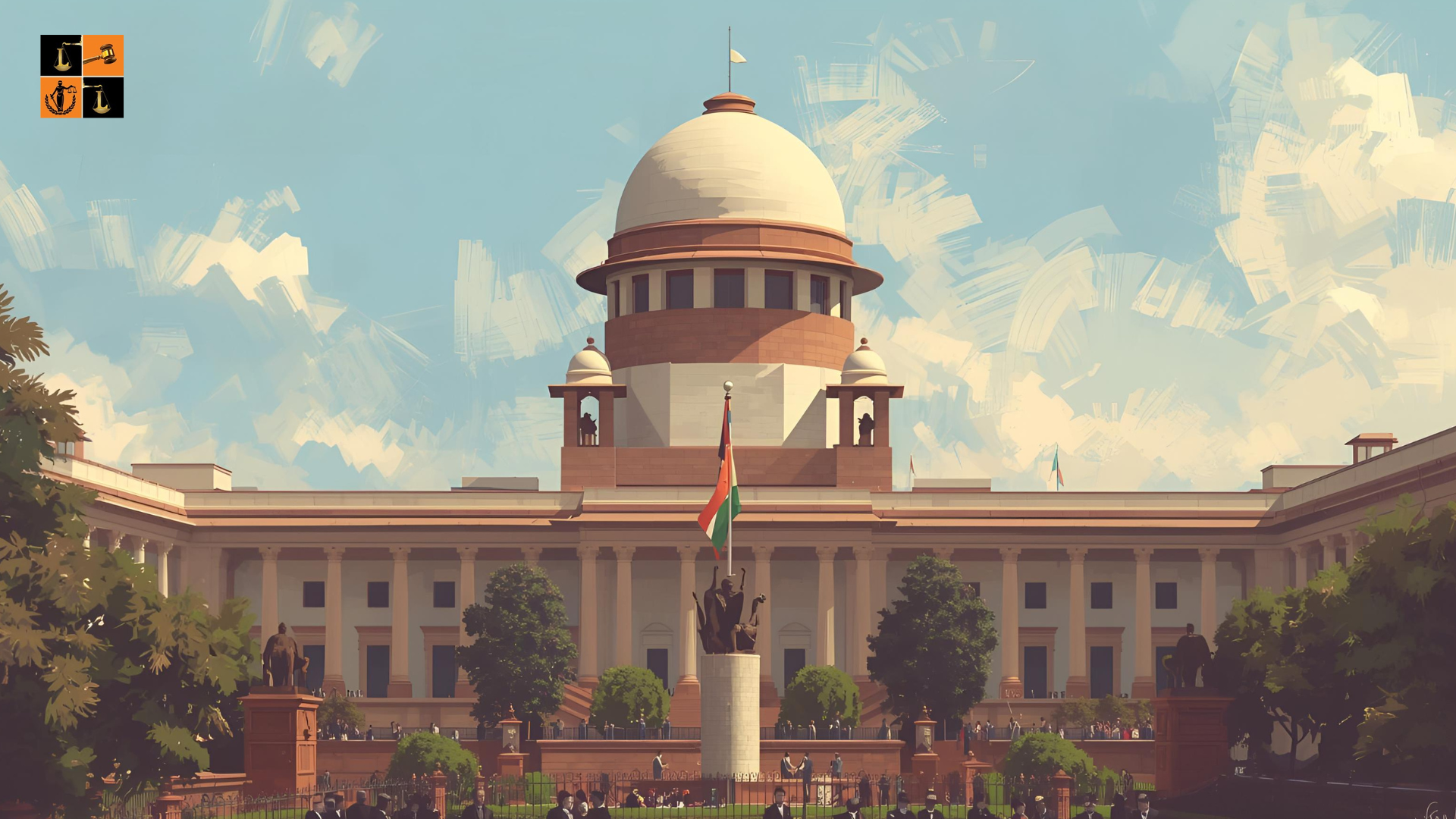
Recently, the Supreme Court drew a firm line around judicial interference in arbitration, holding that High Courts cannot use their writ powers to revisit an arbitral tribunal’s determination under Section 16 of the Arbitration and Conciliation Act, 1996, while the proceedings are still underway. Upholding the Orissa High Court Division Bench's judgment and rejecting the mine owner's challenge, the Court made it clear that disputes over the correctness of an arbitrator’s decision must ordinarily await the statutory remedy provided under the Act. The Bench emphasised that writ jurisdiction cannot be invoked merely because a party perceives the tribunal’s decision to be erroneous or labels the circumstances as “exceptional.”
Brief facts:
The case stemmed from an arbitration dispute arising out of an agreement for the sale of iron ore and certain supplementary agreements between the parties. During the arbitral proceedings, an objection was raised under Section 16 of the Arbitration and Conciliation Act, 1996, contending that the agreements were insufficiently stamped and ought to be treated as a “conveyance” liable to stamp duty under Article 23 of Schedule I of the Indian Stamp Act, 1899, rather than as a mere agreement attracting duty under Article 5(c). The Arbitral Tribunal rejected the objection and held that the documents were properly stamped, allowing the arbitration to proceed. Aggrieved, the objecting party invoked the High Court's writ jurisdiction under Articles 226 and 227 of the Constitution, where a Single Judge interfered with the tribunal's decision and directed impounding of the agreements. However, the Division Bench reversed that decision, holding that such interference with an order passed under Section 16 was impermissible in writ jurisdiction. The matter thereafter reached the Apex Court for consideration.
Contentions of the Appellant:
The Appellant contended that the writ petition was essentially one under Article 227 of the Constitution and therefore the writ appeal before the Division Bench was not maintainable. The Counsel argued that interference with an order passed under Section 16 of the Arbitration Act was permissible in exceptional cases involving patent perversity or jurisdictional error. According to the Appellant, the Arbitrator had failed to appreciate the true nature of the agreement and supplementary agreements, which, when read as a whole, amounted to a “conveyance” rather than a mere agreement to sell. The Counsel further argued that failure to impound insufficiently stamped documents deprived the Arbitrator of jurisdiction to continue the proceedings, and that postponing such scrutiny until a challenge under Section 34 would inadequately protect public revenue interests.
Contentions of the Respondent:
The Respondent argued that the writ appeal was maintainable because the original writ petition had expressly invoked both Articles 226 and 227 of the Constitution and had sought substantive writ reliefs. On merits, it was submitted that the Arbitrator was fully competent to decide objections relating to stamping under Section 16 of the Arbitration Act, particularly in view of the Constitution Bench decision in Re: Interplay Between Arbitration Agreements Under the Arbitration and Conciliation Act, 1996 and the Indian Stamp Act, 1899. The Respondent contended that any alleged legal error committed by the Arbitrator could be challenged only after the award through the statutory mechanism under Section 34. The Counsel further submitted that determining whether the agreements amounted to a conveyance required interpretation of contractual clauses and appreciation of evidence, which could not be undertaken in writ proceedings. The Respondent therefore supported the Division Bench’s view that the Single Judge had exceeded the permissible limits of writ jurisdiction.
Observation of the Court:
The Division Bench of Justice J. K. Maheshwari and Justice Atul S. Chandurkar observed, “It may be noted that the Constitution Bench in Re: Interplay (supra) has held in clear terms that any objection in relation to stamping of an agreement falls within the ambit of the Arbitral Tribunal. It would, thus, be clear that the learned Arbitrator was duly empowered to decide the objection raised by the mine owner as regards insufficient stamping of the agreement. The jurisdiction to decide cannot mean to decide in a particular manner. While exercising such power, one may err on merits. Such error may not be one beyond jurisdiction.”
“The learned Arbitrator was, thus, within his jurisdiction in not upholding the objection raised by the mine owner. It therefore cannot be said that there was any inherent lack of jurisdiction with the learned Arbitrator. Once it is found that the learned Arbitrator had the jurisdiction to decide the objection in relation to stamping of the agreements, in our view, it was impermissible for the learned Single Judge to undertake the exercise of entertaining a challenge to the said adjudication by proceeding to interpret the agreements”, added the Bench.
The Court held that the writ appeal was maintainable since the original writ petition had invoked both Articles 226 and 227 of the Constitution. The Bench found that the Arbitrator had examined the agreements and, after considering their terms, concluded that they were “agreements to sell” and not “conveyances.” Since this determination was made in exercise of powers under Section 16 of the Arbitration and Conciliation Act, 1996, the Arbitrator was acting within his jurisdiction. The Court observed that the Single Judge exceeded the permissible limits of writ review by re-examining the agreements and effectively adjudicating the dispute afresh.
The Bench emphasised that the Arbitration Act is founded on the principle of minimal judicial intervention. Referring to settled precedents and the Constitution Bench decision in Re: Interplay Between Arbitration Agreements Under the Arbitration and Conciliation Act, 1996 and the Indian Stamp Act, 1899, the Court reiterated that objections relating to stamping fall within the domain of the arbitral tribunal and that any challenge to a rejection of such objections must ordinarily await the remedy available under Section 34 after the arbitral award. The Court further noted that insufficient stamping is a curable defect and not a jurisdictional infirmity that renders an agreement void.
The Court further observed that while exercising powers under Articles 226 and 227, High Courts must remain mindful of both the statutory remedy provided under the Arbitration Act and the legislative intent to minimise interference during ongoing arbitral proceedings. The Bench stressed that the availability of a remedy under Section 34 raises the threshold for writ intervention and that such jurisdiction can be exercised only in truly exceptional cases. Significantly, the Court clarified, “The jurisdiction to decide cannot mean to decide in a particular manner. While exercising such power, one may err on merits. Such error may not be one beyond jurisdiction.” Thus, even an allegedly erroneous decision of the Arbitrator could not justify writ interference when the tribunal was competent to decide the issue.
The Court ultimately held that the Single Judge was not justified in entering into the merits of the dispute or independently interpreting the agreements while the arbitration proceedings were still pending. Such an exercise, the Bench observed, risked prejudicing the arbitral process and encroaching upon matters that ought to be decided by the tribunal after evidence is led. Upholding the Division Bench's judgment, the Court concluded that the challenge to the Arbitrator’s order under Section 16 could not be entertained in writ jurisdiction and that any grievance regarding stamping could be raised at the post-award stage under Section 34 of the Arbitration and Conciliation Act.
The decision of the Court:
The Apex Court dismissed the Civil Appeal and affirmed the judgment of the High Court Division Bench. It held that the Single Judge was not justified in exercising writ jurisdiction under Articles 226 and 227 to set aside the Arbitrator’s order passed under Section 16 of the Arbitration and Conciliation Act. The Court clarified that all objections relating to the stamping of the agreements remain open to be raised, if necessary, in proceedings under Section 34 after the arbitral award is rendered.
Case Title: M/S Tarini Prasad Mohanty Vs. M/S Sunflag Iron And Steel Company Limited
Case No.: SLP (C) No.27534 of 2025
Coram: Hon’ble Justice J. K. Maheshwari, Hon’ble Justice Atul S. Chandurkar
Advocate for the Petitioner: Sr. Adv. Shashank Garg, AOR Divyakant Lahoti, Adv. Praveena Bisht, Adv. Siddharth Tripathi, Adv. Aaradhya Chaturvedi, Adv. Prithviraj Oberoi, Adv. Kartik Lahoti, Adv. Vindhya Mehra, Adv. K Vinayakam Gupta, Adv. Samridhi Bhatt, Adv. Shreya Gokel, Adv. Akanksha Soni, Adv. Shubheksha Dwivedi
Advocate for the Respondent: Sr. Adv. Gopal Subramanium, Sr. Adv. N K Mody, Sr. Adv. Malvika Trivedi, Adv. Gaurav Juneja, Adv. Swastika Chakravarti, Adv. Mimansha Durgapal, Adv. Vasant Rajasekaran, Adv. Dhananjay Mishra, Adv. Harshvardhan Korada, Adv. Sidhanth Juyal, Adv. Gauri Subramanium, Adv. Ankit Malhotra, Adv. Joel S George, Adv. Shailendra Slaria, Adv. Ishita, AOR Khaitan & Co.
Read Judgment @Latestlaws.com
Picture Source :



















