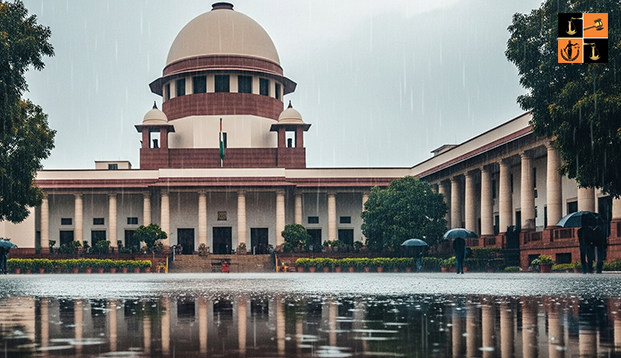
Recently, the Supreme Court held that courts have no discretion to impose a penalty lower than ten times the deficient stamp duty under the Karnataka Stamp Act, 1957. The Court clarified the rigid statutory scheme governing admissibility of insufficiently stamped documents and emphasised that judicial discretion cannot override express legislative mandates, firmly observing that the penalty framework is “not open to dilution by courts.”
Brief Facts:
The case stemmed from a long-pending partition dispute where the admissibility of certain lease documents became contentious due to insufficient stamp duty under the Karnataka Stamp Act, 1957. During the trial, the plaintiffs sought to rely on these documents, which were immediately objected to by the defendant, invoking Section 33 of the Karnataka Stamp Act, 1957 and seeking their impounding. While the Trial Court declined to act on this objection, the High Court, in exercise of its powers under Article 227 of the Constitution, directed payment of the deficient duty but waived the statutory penalty. This departure from the mandate of Section 34 of the Karnataka Stamp Act, 1957, led to the matter being brought before the Apex Court.
Contentions of the Appellant:
The Appellant contended that the High Court had fundamentally misconstrued the statutory scheme of the Karnataka Stamp Act by waiving a penalty that is explicitly mandatory. The Counsel argued that under the first proviso to Section 34 of the Karnataka Stamp Act, 1957, once a court opts to admit an insufficiently stamped document, it must impose a penalty equivalent to ten times the deficient duty. The Appellant asserted that courts lack discretion in determining the quantum of penalty in such cases, and that such discretion lies only with the Deputy Commissioner under Sections 37 and 39 of the Karnataka Stamp Act, 1957.
Contentions of the Respondent:
On the other hand, counsel for the Respondents argued that the objection to admissibility was belated and barred under Section 35 of the Karnataka Stamp Act, 1957, as the documents had already been introduced during trial. The Counsel further submitted that the suit had been pending since 2008 and should not be stalled on technical grounds. The Respondents urged that procedural flexibility should be adopted to ensure expeditious adjudication, and defended the High Court’s approach as a pragmatic solution to balance procedural compliance with substantive justice.
Observation of the Court:
The Division Bench of Justice Sanjay Kumar and Justice K. Vinod Chandran observed that “there is no discretion insofar as the quantum of penalty is concerned when the instrument is sought to be admitted in evidence before the court without transmitting it to the District Commissioner.” The Court observed that the scheme of the Karnataka Stamp Act draws a clear distinction between the admissibility of documents and the procedure for curing defects arising from insufficient stamping. It held that once an instrument is produced before a court or authority competent to receive evidence, impounding under Section 33 becomes mandatory.
The Court clarified that this obligation is not discretionary but flows directly from the statutory mandate, thereby ensuring that revenue laws are strictly enforced. It further emphasised that procedural shortcuts cannot be adopted to bypass this requirement, even in the interest of expediting trial proceedings. The Bench held that the first proviso to Section 34 creates a rigid framework when a party chooses to have the document admitted in evidence through the court itself. In such cases, the Court underscored that the deficient stamp duty must necessarily be accompanied by a penalty equivalent to ten times the deficit.
The Bench emphasised that the statutory mechanism provides an alternative route wherein the document may be transmitted to the Deputy Commissioner under Section 37. In such a scenario, the discretion to determine the quantum of penalty is vested exclusively with the Deputy Commissioner under Section 39. The Court explained that this bifurcation ensures both strict compliance with revenue laws and flexibility in appropriate cases, but only within the boundaries set by the statute. It made it clear that courts cannot assume this discretionary role, as doing so would amount to rewriting the legislative framework.
The Court further observed that insufficiency of stamp duty is a curable defect, but its cure is strictly regulated by the statutory process. While recognising that such defects should not permanently shut out evidence, the Court stressed that admissibility can only follow after compliance with the prescribed conditions, including payment of duty and penalty. The judgment harmonises prior precedents and reinforces that procedural compliance is integral to maintaining the sanctity of fiscal statutes.
The decision of the Court:
The Court partly set aside the High Court’s order to the extent it exempted the statutory penalty and disposed of the appeal by granting the plaintiffs an option: either pay the deficient stamp duty along with the mandatory ten-times penalty before the trial court, or seek transmission of the documents to the Deputy Commissioner for determination of duty and discretionary penalty.
Case Title: Krishnavathi Sharma Vs. Bhagwandas Sharma and Ors
Case No.: Civil Appeal No.3476 of 2026
Coram: Hon'ble Mr. Justice Sanjay Kumar, Hon'ble Mr. Justice K. Vinod Chandran
Advocate for the Petitioner: Adv. Ayush Negi
Advocate for the Respondent: Adv. Balaji Srinivasan, Adv. Chandra Prakash
Read Judgment @Latestlaws.com