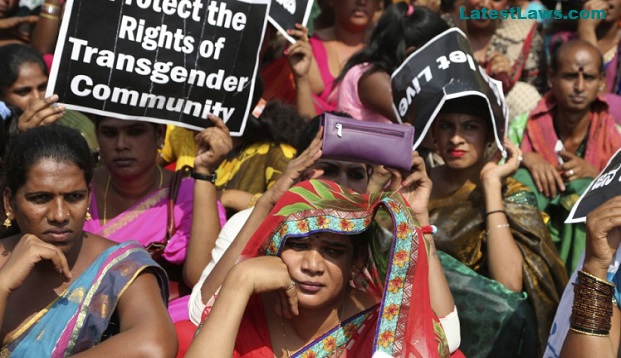
The FAQs have been prepared by Aayushi Kiran, a 2nd year, BBA.LLB student at The ICFAI University, Dehradun. She is currently interning with LatestLaws.com.
INTRODUCTION
The Transgender Persons (Protection of Rights) Act, 2019 is an act of the Parliament of India enacted with the main purpose of safeguarding the rights of transgender people, their welfare, and other matters related to them. This Act was introduced in the Lok Sabha on 19 July 2019 by the Minister of Social Justice and Empowerment, Mr. Thaawarch and Gehlot. The Transgender Persons (Protection of Rights) 2019 was enacted after analyzing all the drawbacks and the reason for the lapse of the Transgender Persons (Protection of Rights) Bill, 2018 and, Transgender Persons (Protection of Rights) Bill, 2016. The bill was passed by the Lok Sabha on 5th August 2019 and by the Rajya Sabha on 26th November 2019. The President gave his assent on 5th December and then the Act was published in the Gazette of India. Since 10th January, this Act has been in effect.
1. What is the definition of a transgender person according to the transgender persons (Protection of Rights) Act, 2019?
According to this Bill, a transgender person is one whose gender does not match the gender of a person assigned at birth. Trans-men and trans-women, persons with intersex variations, gender-queers, and persons with socio-cultural identities, such as kinnar and hijra is included in this Bill. Terminology Intersex variations are defined to refer that person who at birth shows the variation in his or her primary sexual characteristics, external genitalia, chromosomes, or hormones from the normative standard of the male or female body.
2. On what grounds a transgender person can’t be discriminated from others?
No person or establishment shall discriminate against a transgender person, including denial of service or unfair treatment in relation to:
- Education
- Employment or occupation
- Healthcare
- Access to, or enjoyment of goods and services, facilities, or opportunity which is made available to the general public
- Right to movement
- Right to reside, rent, or otherwise occupy the property,
- Opportunity to stand for or hold public or private office
- Access to a government or private establishment in whose care or custody a transgender person is.
3. Can a transgender person apply for a certificate of identity?
Yes, a transgender person can apply for a certificate of identity by writing an application to the District Magistrate for issuing a certificate of identity as a transgender person, in any form and manner accompanied by required documents, as may be prescribed. In the case of a minor child, the application may be made by a parent or guardian of such child.
4. Can a transgender person undergo surgery to change gender either as male or female?
If a transgender person undergoes surgery to change gender either as a male or female, such person has to make an application, besides a certificate issued by the Medical Superintendent or Chief Medical Officer of the medical institution in which that person has undergone surgery. The application along with the certificate issued is presented to the District Magistrate for a revised certificate.
On being satisfied with the receipt of the application and with the certificate issued by the Medical Superintendent or Chief Medical Officer, the District Magistrate may issue a certificate indicating the change in gender.
The person to whom the revised certificate has been issued shall be entitled to change the first name in the birth certificate and all other official documents relating to the identity of such person according to the gender issued in the revised certificate.
5. What are the welfare measures taken by the government for transgender persons?
The government takes measures to:
- ensure the full inclusion and participation of transgender persons in society
- protect the rights and interests of transgender persons,
- facilitate their access to welfare schemes framed,
- steps to rescue, protect, and provide rehabilitation centers for transgender persons,
- Encourage and promote methods for vocational training and self-employment,
- Create schemes that promote their participation in cultural activities.
6. What are the rights of residence provided to transgender persons under this Act?
- No child should be separated from their parents or close family on the ground of being a transgender, exception being, any order of a competent court which in the interest of such a child.
-
- Every transgender person shall have a right to reside in the household with the parent or immediate family members, a right not to be excluded from the household or any part of it, a right to enjoy and use the all facilities of the household in a non-discriminatory manner.
- In the case where any parent or a member of his immediate family is unable to take care of a transgender person, the person is to be placed in a rehabilitation center, on the orders given by the competent court.
7. Can a transgender person be discriminated at the workplace or in acquiring employment?
Neither government nor any private employment establishment can discriminate against a transgender person in employment matters which includes recruitments as well as promotion. Every establishment is ought to designate a person to be a complaint officer to deal with complaints in relation to the Act.
8. What are the special measures taken by the government in the field of education and health care for transgender persons under this Act?
- Education: Educational institutions recognized by the appropriate government shall provide inclusive education, sports and recreational facilities for transgender persons, without discriminating them (transgender persons) on the basis of their gender.
- Health care: The Government should ensure to provide adequate steps to provide health facilities to transgender persons including separate HIV surveillance centers, and sex reassignment surgeries. The government, on a regular basis, should review the medical curriculum to address the health issues of transgender persons, and provide comprehensive medical insurance schemes for them.
9. What is NCT?
NCT stands for National Council for Transgender persons. It was set up with the purpose to advise the central government on policies, and legislation related to transgender persons.
The NCT consist of representatives from:
- Ministries such as social justice and empowerment, health, minority affairs,
- NITI Aayog,
- National Human Rights Commission and National Commission for Women
- State governments
- Nominated members from the transgender community; and
- Experts from non-governmental organizations.
10. What are the functions of National Council for Transgender?
NCT performs the following functions:
- advise the Central Government about the formulation of policies, programs, legislation and projects with respect to transgender persons;
- monitors and evaluates the impact formulated policies and programmes designed for achieving equality and full participation of transgender persons;
- reviews and coordinates the activities of all the departments of Government and non-Governmental Organisations dealing with matters relating to transgender persons
- redresses the grievances of transgender persons
- Performs all other functions as assigned and prescribed by the Central Government.
11. What are the offenses and penalties recognized against transgender persons?
The following offenses and penalties are recognized against transgender persons:
- Compelling transgender persons to indulge in forced or bonded labor (excluding compulsory government service for public purposes),
- denial of use of public places,
- removal from the household, and village,
- Physical, sexual, verbal, emotional or economic abuse.
Penalties for these offenses vary between six months and two years, and a fine.
12. Is the transgender persons (Protection of Rights) Act, 2019 is in derogation of any other law?
The provisions of this Act shall be in addition to, and not in derogation of any other law for the time being in force.
13. Does any legal proceeding lie against the appropriate Government with respect to anything done in good faith?
No suit neither any prosecution nor any legal proceeding lies against the appropriate Government, any local authority or any officer of the Government if the act is done with respect to in good faith or with an intention to be in pursuance of the provisions of this Act and any rules made there under.
14. What are the powers under this Act to remove difficulties for transgender persons?
In case any difficulty arises in giving effect to the provisions of this Act, the Central Government orders to publish in the Official Gazette to make provisions, not inconsistent with the provisions of this Act as appear to it to be necessary or convenient for removing the difficulty. The condition being no such order shall be made after the expiry of the period of two years from the date of commencement of this Act. Each and every order made under this section must be laid before each House of Parliament.