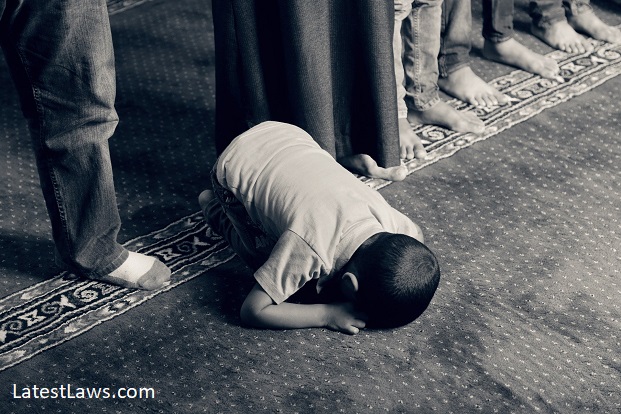
In the judgment titled Najeem vs Kerala State Waqf Board in Case No. : WP(C) No. 18703 of 2020 authored by Justice TR Ravi for himself and Justice K Vinod Chandran, the Kerala High Court explicitly, laid down that, “Waqf Board cannot decide disputes relating to right to offer worship in mosque.”
The Kerala High Court also observed that, “There is no doubt that generally, every Mohammedan is entitled to enter a Mosque dedicated to God.” This was so held by the Kerala High Court while considering the writ petition filed by Najeem who was removed from the membership of the Jamaath and who wanted his membership to be restored.
Kerala High Court Bench also made it amply clear in its verdict that, “The petitioner is entitled to approach a court of law if there is a disturbance to his legal right of offering prayers in a Mosque.” The Bench also observed expressly that the Section 12 of the Act does not confer any power on the Waqf Board to decide on the question of entitlement of a person to be a member of a Jamaath and the contention that he has a right to offer worship in a Mosque will have to be considered in a properly instituted civil suit. It was also made clear that there is no doubt that generally every Mohammedan is entitled to enter a Mosque dedicated to God.
While elaborating on the facts of the case, it is then observed in para 3 that, “Ext.P1 is a communication from the 4th respondent Jama-ath to the petitioner whereby he has been informed that he is removed from the membership of the Jama-ath for a period of two years from 24.01.2020 to 23.01.2022 and that if he makes a fresh application after the said period of two years, he will be given membership in the Jama-ath, if approved by the Jama-ath. Ext.P2 is an application submitted by the petitioner to the 4th respondent praying to reconsider the decision and to restore his membership in the Jama-ath. Exts.P3 and P4 are petitions said to have been filed before the Kerala Waqf Board and the Kerala Waqf Board Divisional Office, Thiruvananthapuram, respectively, wherein the prayer is to restore his membership. When the writ petition was taken up for hearing, the counsel for the petitioner submitted that his limited prayer is for a direction to the 1st respondent Board to consider and pass orders on Ext.P3.”
While dwelling on the petitioner’s version, it is then envisaged in para 4 that, “According to the petitioner, it is the bounden duty of the 1st respondent Board, under Section 32 of the Waqf Act, to consider and pass orders on petitions in the nature of Ext.P3. In support of the contention that the waqf Board has the power to consider and pass orders on such issues, the counsel for the petitioner relies on the decisions of this Court in Basheer Haji v. Kerala Waqf Board reported in [2017 (1) KLT 1039], Attakkoya Thangal v. Union Territory of Lakshadweep reported in [1987 (1) KLT 762] and Rasheed A.P.A. v. N.N. Khalid Haji and another reported in [2011 (3) KLT 421].
To put things in perspective, it is then pointed out in para 6 that, “In the case on hand, Ext.P1 would disclose that Jama-ath had taken the decision to remove the petitioner from membership for the reason that he had entered the Mosque in an inebriated condition and abused the Ustad in the Mosque. Ext.P1 does not speak of any ex-communication as sought to be made out by the petitioner. In our opinion, the issue complained of by the petitioner is more in the nature of a civil dispute for which the remedy available to the petitioner is to approach the Waqf Tribunal and not the Waqf Board.”
Finally and far most importantly, it is then very rightly held by the Kerala High Court Bench in para 10 that, “The contention raised in the writ petition that the petitioner has a right to offer worship in a Mosque will have to be considered in a properly instituted civil suit. Since the Tribunal constituted under the Waqf Act has powers to deal with any disputes relating to Waqf, we are of the considered opinion that such disputes should necessarily be determined in an adjudicatory process before the Waqf Tribunal. There is no doubt that generally, every Mohammedan is entitled to enter a Mosque dedicated to God. This Court in the decision in Pathanamthitta Majillissae Islamiya v. Shaik Mohammed reported in [AIR 1963 Kerala 49] has held that the right to offer prayers in a Mosque is a legal right for the disturbance for which a Muslim is entitled to seek relief in a court of law. The above decision has been cited with approval by a Division Bench of the Allahabad High Court in the decision in Shah Abdu Bagi and others v. State of Uttar Pradesh and others reported in [AIR 1988 Allahabad 1]. As such, there can be no doubt regarding the proposition that the petitioner is entitled to approach a court of law if there is a disturbance to his legal right of offering prayers in a Mosque. It would be then open to the said court of law to consider whether the disturbance is legally justifiable. We do not think that the petitioner should be allowed to bye-pass a court of law and approach the Waqf Board for a decision on such a dispute. The writ petition is hence dismissed. The dismissal of the writ petition will not in any way prejudice the right of the petitioner to approach the Waqf Tribunal for appropriate reliefs.”
Read Judgment @LatestLaws.com: