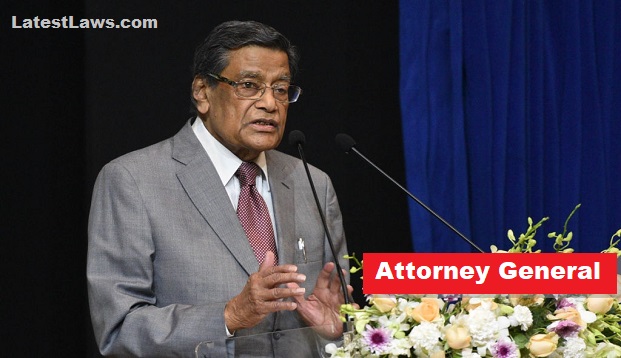
Attorney General KK Venugopal Advocated video-streaming of Court proceedings across India so that Court hearings anywhere in India are accessible, & “capacity” of Advocates & Judges can be ascertained.
Mr Venugopal said one silver lining of Coronavirus & the lockdown of Courts was that it compelled the legal fraternity to adopt e-filing of cases & hearing through video conferencing.
He said that “I would suggest that we go one step further & have video streaming as well so that the entire population of lawyers will be able to listen to any case which is going on in any court in this country. We would be able to judge the capacity of judges & lawyers, & the nature of cases which are being handled in courts including lower courts, district courts, high courts & the Supreme Court".
AG was speaking at the launch of a district-level awareness programme in regional languages on e-court services by the SC e-committee.
“I never believed that we could have progressed to this extent. Now I am optimistic that in due course, all courts in the country will be e-courts. I am sure that in the next one year, the whole of this country will be familiar with e-courts. We should congratulate the e-committee for what they have achieved,” he said at the inaugural function held via video conference on July 25.
The work of the SC E-Committee has been on an overdrive after the COVID-19-induced lockdown. The e-committee is proposing to introduce radical changes to filing of cases across the nation by introduction & operationalisation of e-filing to replace physical filing of cases.
After the lockdown imposed on March 25, Courts in India had to adopt video conference & e-filing, albeit as an ad-hoc measure to tide over the shutdown of courts due to pandemic. But e-filing is likely to be made a permanent fixture of our court system in the coming years.
The work towards this end as far as the Apex Court is concerned is at an advanced stage & a new e-filing module is expected to be rolled out soon. The e-committee is also in constant touch with high courts for digitization of records, & a standard operating procedure will be drawn up for HC's & District Judiciary across India for digitization.
Apex Court Judge Justice DY Chandrachud, who is the chairperson of the e-committee, released a training manual, video tutorials & brochures in regional languages with regard to e-court services on July 25.
The training manual, which is a step by step guide for e-filing of cases, was released in eleven regional languages — Assamese, Bengali, Nepali, Urdu, Mizo, Tamil, Hindi, Hindi-UP, Garo, Khasi, Pnar. Brochures, which would assist lawyers to familiarise themselves on e-filing, were released in 14 regional languages.
Speaking on the necessity of such a step, justice Chandrachud highlighted that there is a technological divide between metropolitan cities & rural areas in India, & on several occasions, lawyers at the district & taluka level do not have access to information technology (IT).
“There is a technological divide in India. Those who work & live in metros have the best facilities at their command in terms of IT. But the backbone of the judicial administration in the country is provided by advocates who work at taluka & district levels. The first interface of citizens with justice & his or her attempt to remedy injustice is when they contact an advocate at the taluka & district level & go to their chambers for remedying their problems”, he pointed out.
Therefore, unless the lawyers at taluka & district level are also carried along & made part of the e-courts project, the mission will not succeed, he said.
As part of the first stage of the awareness programme, the e-committee trained 25 master trainers on June 20 through video conferencing — one for each high court in the country.
In the second stage, the 25 master trainers, in turn, trained 461 master trainers across the country in their respective states & respective regional languages through video conference.
In third phase, these 461 master trainers will be conducting the training programme in every district of the country for the advocates.
Justice Chandrachud added that “This project we have conceived is an attempt to spread knowledge of Information & Communication technology initiatives among the members of the bar. Our target is to attain 100% computer literacy among members of Indian bar".
Source Link