The 1st session is scheduled to take place next week with Corey Lewandowski, Trump’s former campaign manager & an important witness to the special counsel’s obstruction of justice investigation.
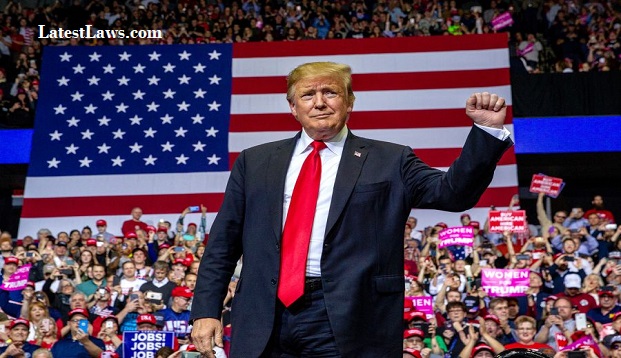
The House Judiciary Committee on Thursday took its 1st recorded vote to press forward with a possible impeachment of U.S President Donald Trump, putting aside Democrats’ internal divisions for the time being in a bid to strengthen its hand in investigating whether he committed high crimes & misdemeanors.
Voting along party lines, the panel approved rules for a continuing “investigation to determine whether to recommend articles of impeachment with regard to President Donald J. Trump,” which clarified new authorities for lawmakers & laid out a process, albeit limited, for the president to respond.
Speaking after the vote, the committee’s chairman, Rep. Jerrold Nadler of New York, also promised a series of hearings expanding the inquiry beyond the findings of Robert Mueller, the former special counsel, to consider other potentially impeachable offenses. The 1st session is scheduled to take place next week with Corey Lewandowski, Trump’s former campaign manager & an important witness to the special counsel’s obstruction of justice investigation.
But Thursday’s action was as much a symbolic display as it was a practical exercise of constitutional powers, aimed at showing federal courts & impatient Democrats that the House is, in fact, serious about building an impeachment case, even if it isn't yet taking the politically loaded step of filing charges.
“This committee is engaged in an investigation that will allow us to determine whether to recommend articles of impeachment with respect to President Trump,” Nadler said. “Some call this process an impeachment inquiry. Some call it an impeachment investigation. There is no legal difference between these terms, & I no longer care to argue about the nomenclature.”
The vote punctuated a legislative week in which Democrats appeared at times to be in deep disagreement about exactly what the Judiciary Committee is up to, how it fits together with other continuing investigations of Trump’s finances & policies by different panels, & how far they are willing to go toward impeaching Trump.
Shortly after the vote, Speaker Nancy Pelosi became exasperated as she swatted away questions from reporters about why there appeared to be a discrepancy between the way she & Nadler were describing what was happening.
“Why is it that you are hung up on a word?” she asked, urging reporters to instead look at the House’s investigative actions.
The questions go beyond mere semantics, however. Senior Democrats & the lawyers advising them have a strong interest in demonstrating that the House is carrying out an impeachment inquiry, which maximizes their leverage in lawsuits to compel the cooperation of witnesses & secure grand jury testimony. In at least one instance this week, lawyers for the Judiciary Committee privately reached out to a lawmaker who had publicly suggested otherwise & warned that inconsistencies could hurt their case in court, according to people familiar with the exchange.
At the same time, Pelosi, D-Calif., has toiled to avoid plunging the House into an all-consuming impeachment & shied away from the phrase “impeachment inquiry.” Her concern is that the process would be divisive & ultimately fail to result in Trump’s removal, while potentially costing Democrats in conservative-leaning districts their jobs.
On Thursday, Pelosi portrayed the actions as a continuation of a Democratic strategy to methodically obtain facts about potential presidential wrongdoing through legislation, investigation & litigation that would proceed at the same pace it has for months. An impeachment vote may be the ultimate result of that process, she said, but the facts weren't yet there.
“I stand by what we have been doing all along,” she told reporters. “I support what is happening in the Judiciary Committee, because that enables them to do their process of interrogation in their investigation, & I salute them.”
The strategy will be put to the test in the coming weeks, when the Judiciary Committee plans to convene hearings related to Trump’s role in hush payments to 2 women who said they had affairs with him, reports that he dangled pardons to immigration officials, & whether foreign & domestic government spending at Trump properties has violated the Constitution’s ban on profiting from the presidency. The committee will also continue to look at Russian election interference & possible obstruction of justice by Trump.
Democrats’ competing imperatives have so far led to an investigative process that has differed in pace & appearance from past impeachment inquiries. Republicans pounced on the inconsistency on Thursday, arguing that no matter what Democrats on the panel contended, they simply hadn't crossed the threshold into impeachment territory.
“As we say in Texas, this is fixing to be an impeachment,” said Rep. Louie Gohmert, a Republican. “It’s n't now, but it’s fixing to be.”
Republicans repeatedly pointed out that the panel had neither sought nor received a House vote authorizing an impeachment inquiry, as had been the case in the 2 modern presidential impeachments. Without it, they argued, the panel was still engaged in regular oversight. & some lawmakers suggested that the only reason Democrats hadn't pursued such a vote was that they lacked the necessary support in their caucus to clear the floor.
“The Judiciary Committee has become a giant Instagram filter,” said Rep. Doug Collins of Georgia, the top Republican on the panel, “to make it appear that something’s happening that isn't.”
At other points, though, Republicans appeared to accept that an impeachment inquiry was underway in order to suggest changes to the resolution & accuse the Democrats of pursuing the president out of political spite. & Republicans’ campaign arm quickly hit vulnerable Democratic lawmakers on the panel from swing districts for “jumping on the impeachment train.”
Trump responded to the developments only indirectly, sharing a series of quotes on Twitter from lawmakers & a Fox News contributor suggesting that Democrats were motivated purely by politics.
Republicans on the panel were correct about the precedent, but Democrats argue that no vote is actually necessary given the modern rules of the House. Few fixed directives govern the impeachment process, & they contend that the committee need only be considering impeachment articles to stand up an inquiry of that name.
Still, some Democrats also have their doubts. There is significant lingering confusion surrounding the inquiry among both moderate lawmakers, who are wary of impeachment, & other rank-and-file lawmakers eager to begin the process who have been frustrated with the mixed signals sent by House leaders.
Though Pelosi has blessed the committee’s moves, she & other top Democratic leaders have declined to use the phrase “impeachment inquiry.” Things were muddled further on Wednesday when the 2nd-ranking House Democrat, Rep. Steny H. Hoyer of Maryland, told reporters that the committee was not engaged in an impeachment investigation, then later had to backtrack in a written statement that echoed language Nadler has used in court.
The resolution approved Thursday defines four authorities for the inquiry.
It allows Nadler to designate any hearing of the full Judiciary Committee or its subcommittees as part of the investigation. Under the new procedures, staff lawyers are afforded time at the end of each hearing to directly question witnesses.
The resolution also includes rules for how information collected by the committee — including classified material & grand jury secrets — will be handled.
And for the 1st time, the committee’s vote grants Trump & his legal team specific due process rights, by allowing his lawyers to respond to committee proceedings in writing in real time.
Nadler framed that as a matter of fairness, but Republicans pointed out that the language fell well short of the privileges extended to the president’s legal teams in impeachment inquiries of Presidents Richard M. Nixon & Bill Clinton, where the defense was allowed to participate in all committee hearings, cross-examine witnesses & recommend witnesses for hearings.
“Not allowing the president’s counsel the same kind of rights as was done in the 2 previous presidential impeachments that have been put before this committee is a gross denial of due process,” said Rep. Jim Sensenbrenner, R-Wis., a former chairman of the judiciary panel. “We are the committee that is supposed to stand up & protect the constitutional rights of everybody.”
Source Link