ABOUT RAJIV GANDHI NATIONAL UNIVERSITY OF L AW
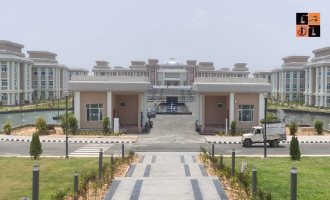
Rajiv Gandhi National University of Law (RGNUL), Punjab, was established by the State Legislature of Punjab by passing the Rajiv Gandhi National University of Law, Punjab Act, 2006 (Punjab Act No. 12 of 2006). The Act established a national-level University of Law in the State of Punjab, thereby fulfilling the need for a Centre of Excellence in Legal Education in the modern era of globalisation and liberalisation. The University acquired approval from the Bar Council of India (BCI) in July 2006. The University is also registered with the University Grants Commission (UGC), New Delhi, under Section 2(f) of the University Grants Commission Act, 1956. It has been declared fit to obtain a grant from the UGC under Section 12-B of the UGC Act, 1956. The University has been accredited with an ‘A’ grade by NAAC. RGNUL, Punjab, was granted autonomy under UGC Regulations, Clause 5 Dimensions of Autonomy for Category-II Universities in April 2018. The Ministry of Human Resource Development, Government of India, ranked RGNUL first amongst the cleanest Higher Educational Institutions in the Swachh Campus (2019) category of Government Residential Universities. RGNUL, Punjab, in recent years, has earned a coveted status as one of the top-ranking law teaching institutions in the Country. RGNUL, Punjab, offers a Five-year Integrated Course/Programme, an intensive LL.M., and an advanced PhD. Programme in the University. Over 1000 students receive state-of-the-art legal education in a well-furnished, fully developed residential campus that boasts all necessary infrastructure and human resources for the allaround growth of students.
The University is dedicated to providing holistic legal education and promoting quality research in law and allied disciplines. Over the years, it has addressed a wide range of contemporary social issues and has invested significant innovative thinking in its instructional and research programmes. Towards this, it always welcomes collaboration with reputable institutions and organisations to build a platform for the exchange of ideas on vexed social issues and problems confronting society.
The Centre for Advanced Studies in Labour Welfare (CASLW) was established by Rajiv Gandhi National University of Law, Punjab, in association with the International Justice Mission (IJM), an International Non-Governmental Organisation based in Washington, D.C., United States of America, on 1 September 2012. The Centre for Advanced Studies in Labour Welfare has been established to improve and strengthen the Labour Justice System in India. It strives to uphold and protect the rights of the labourers and their families, thereby ensuring them a life of human dignity.
A B O U T CA SLW
The Centre for Advanced Studies in Labour Welfare (CASLW) was established by Rajiv Gandhi National University of Law, Punjab, in association with the International Justice Mission (IJM), an International Non-Governmental Organisation based in Washington, D.C., United States of America, on 1 September 2012. The Centre for Advanced Studies in Labour Welfare has been established to improve and strengthen the Labour Justice System in India. It strives to uphold and protect the rights of the labourers and their families, thereby ensuring them a life of human dignity.
A B O U T CA S I H R
The Centre for Advanced Studies in Human Rights (‘CASIHR’) is a research centre under the aegis of RGNUL, Punjab. The Centre’s primary objective is to undertake, support and promote advanced study and interdisciplinary research on the emerging trends in human rights and its allied fields. It endeavours to encourage debates and discussions on the matters that gyrate around human rights at regional, national and international level so as to contribute to paradigm shift in the cognitive understanding of these issues.
A B O U T T H E C O N FE R E N CE
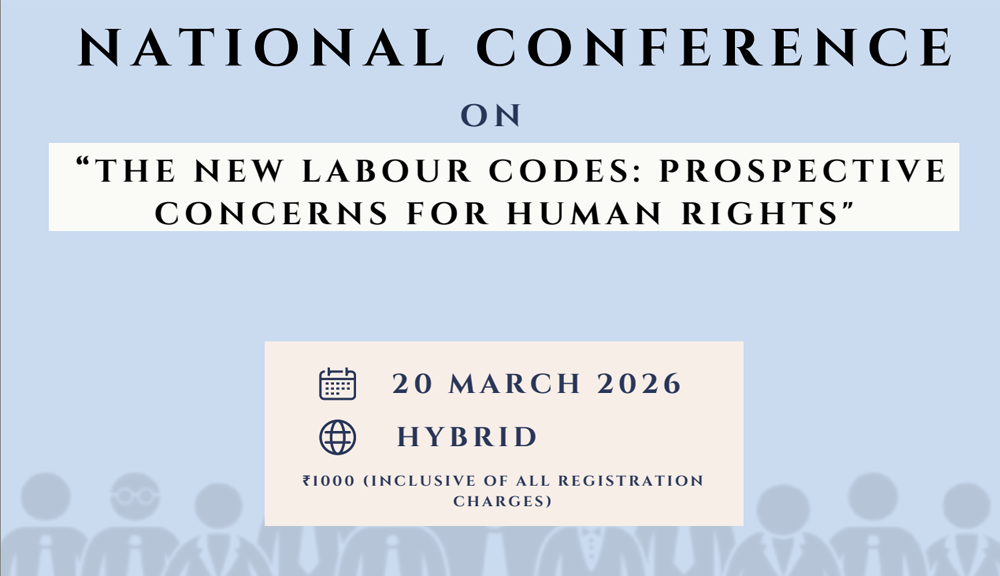
Rajiv Gandhi National University of Law, Punjab, through its Centre for Advanced Studies in Labour Welfare (CASLW) and Centre for Advanced Studies in Human Rights (CASIHR), is organising a OneDay National Conference on “The New Labour Codes: Prospective Concerns for Human Rights” in hybrid mode. The introduction of the four new Labour Codes marks a significant transformation in India’s labour law regime, aiming to consolidate and modernise existing labour legislations. However, this shift also raises critical questions concerning labour welfare, social security, collective bargaining, and the broader human rights implications for workers across formal and informal sectors. This conference seeks to provide an interdisciplinary platform for academicians, practitioners, researchers, policymakers, and students to critically analyse the prospective impact of the new labour codes on human rights, labour justice, and access to dignified working conditions. Through scholarly discussions and expert deliberations, the conference aims to assess whether the new framework strengthens or dilutes labour protections in India.
O BJECTI V ES O F C O N FE R E N CE
To critically examine the framework and implementation of the new labour codes in India
To analyse the human rights implications arising from labour law reforms
To evaluate the impact of the labour codes on vulnerable and informal sector workers
To foster academic discourse on labour welfare, dignity of labour, and social justice
To encourage interdisciplinary engagement between labour law and human rights scholarship
P R O P O SE D T H EMES / S U B T H EMES
- (Indicative and not exhaustive)
- Labour Codes and the Right to Dignified Work
- The Code on Wages and the Right to Livelihood
- Industrial Relations Code and the Freedom of Association
- Occupational Safety, Health, and Working Conditions as Human Rights
- Social Security Universalization and State Accountability
- Migrant Workers’ Rights and Crisis Management Frameworks
- Gig Economy Regulation and Worker Status Classification
- Fixed-Term Employment and Security of Tenure
- Gender Equality and Non-Discrimination in Employment
- International Labour Organization Standards and Indian Reforms
- Judicial Interpretation of Labour Rights under the New Codes
- Dispute Resolution Mechanisms and Access to Labour Justice
- Corporate Accountability and Human Rights in Labour Practices
- Child and Adolescent Labour Regulation and Education Rights
- The Changing Role of Labour Inspection and Enforcement
- Globalisation, Economic Liberalisation, and Labour Standards
- Impact of Labour Reforms on Informal Sector Workers
- Social Security and Labour Welfare under the New Codes
- Collective Bargaining, Trade Unions, and Worker Representation
- Human Rights Obligations of the State in Labour Regulation
S U BMI S S ION GU I DELI NES
ABSTRACT SUBMISSION:
Abstract submission must be strictly in MS Word format only.(Submission made in any other format shall not be considered)
1. The MS Word file must mention names and title etc. in Bold letter and in this order:
2. Name of the Author and co-author (if any) Designation and Affiliation in the footnote Title of the work Keywords Abstract
3.Co-authorship is limited to the maximum of two authors. All submissions must be made in the English language only. Abstract shall not exceed more than 250-300 words including keywords (maximum 4). Author(s) names, designation and their affiliations are not included.
4. Format: All submissions must be in Times New Roman, font size 12, justified and with 1.5 line spacing, Paper size: A4 Sheet with margin of 1 cm.
5. Abstract is to be accompanied by a Cover page which must include the details in the following order:
- Title of the Paper
- Name of the Author and Co-author (if any)
- Designation
- Affiliation
- Contact details of Author and Co-author (e-mail IDs/contact or mobile numbers etc.)
F U LL PA PE R S U BMI S S ION
1. Full paper submission must be strictly in MS Word format only. Submission made in any other format shall not be considered.
2. The MS Word file must mention names and title etc. in Bold letter and in this order:
- Name of the Author and co-author (if any)
- Designation and Affiliation in the footnote
- Title of the work
- Keywords
- Abstract
3.Co-authorship is limited to the maximum of two authors.
4. All submissions must be made in the English language only. Chapter should be original and unpublished work of the author(s) and any form of plagiarism is strictly prohibited.
5. Plagiarism criteria: 10 percent, excluding footnotes and bibliography.
6. The word limit of the final full submitted paper should not be more than 5000 words
7. The author(s) must give a declaration of the originality of the work. The UGC Anti- plagiarism guidelines shall be adhered to. Author(s) shall solely be responsible for the accuracy of statements, opinion and view presented in the paper.
8. Format for main body: All submissions must be in Times New Roman, font size 12, justified and with 1.5 line spacing, Paper size: A4 Sheet with margin of 1 cm.
9. For citation of the full paper, use BLUEBOOK 21st edition
10. Submission Link : LINK
IMP ORTA N T DATES / DE A DLI NES
Registration & Abstract Submission: 25th February, 2026
Intimation of Acceptance of selected abstracts: 1st March, 2026
Payment & Full Paper Submission: 5th March, 2026
Link to submit abstract: LINK
Link to submit full paper: LINK
The best 15 papers shall be published in the edited book.
₹1000 ( INCLUSIVE OF ALL REGISTRATION CHARGES )