The author, Diti Sharma, is a 2nd-year law student at the University School of Law and Legal Studies, GGSIPU. This article has been written under the guidance of Advocate Ritu Rajkumari.
When thinking about getting a tattoo, one is often apprehensive and has a range of questions including – Is the tattoo artist a registered practitioner? Is there any legal mandate for standard safety protocols to be followed? Will the Individual be denied any employment opportunities in the future? If so, are there any legal remedies available? Unfortunately, in the absence of both a Legal statute and a Judicial precedent in India, most of these questions go unanswered. Hence, leaving the Individual uncertain and vulnerable.
In India, there is no Statute either defining or regulating the practice of tattooing. While most of the legal discussion is centred around Intellectual property rights vis-à-vis a tattoo, equally important agendas and issues pertaining to the qualification and credibility of the tattoo artist, essential safety protocols and potential disadvantages in seeking employment opportunities and donating blood are often overlooked.
Equally important to recognize is that there are multiple stakeholders involved when considering tattoo regulation in India. Beyond customers and tattoo artists, blood and organ donors, dermatologists, as well as those aspiring for careers in defence and employment, are also affected. It’s important to keep in mind that there are more stakeholders in this matter than one may initially think.
Licensing and Safety Standards
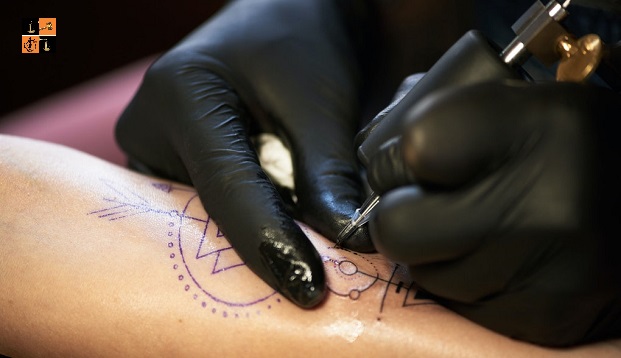
Tattooing is a part of the unorganized service sector in India and hence, license requirements in India are quite lax and not very strict. Additionally, they differ from state to state across India. So far, Kerala[1] is the only state that has regulated licensing requirements for tattoo artists through the intervention of local self-authorities and medical officers. The reason why strict standard safety protocols are essential is because tattooing as an act involves a needle that comes in contact with a person’s skin, blood and plasma, which drops the ink inside the middle layer of the skin called the dermis, where it stays forever. In the absence of measures such as standardized health regulations & regular visits, the risk of spreading skin-borne diseases such as MRSA, hepatitis B and hepatitis C runs high. Additionally, It is imperative that the manufacturing and distribution of inks and other equipments used in the procedure of tattooing be appropriately regulated. Such intervention can only be executed with the cooperation and willingness of the appropriate Health authorities.
Disadvantages in seeking Employment opportunities
While the Constitution of India vide articles 15 and 16 prohibits discrimination in matters of public employment. However, it is observed that an Individual with tattoos may face certain disadvantages, particularly if the tattoo covers a significant part of their body. Such a disadvantage is further accentuated if there is an Interview round involved in the recruitment process. It is pertinent to mention that in the recruitment process for defence services, there exist specific restrictions on tattoos[2], the only exception to this general rule is candidates belonging to tribal communities/from tribal areas, they are permitted to have permanent body tattoos on any part of the body, as per existing customs and traditions of the said tribe to which the candidate belongs.
While there is no Judgment of the Apex Court on the issue of restriction on public employment owing to tattoos, It has been deliberated upon by several High Courts, each arriving at distinct conclusions based on the particular facts of the case such as in Shridhar Mahadeo Pakhare v. Union of India[3], The Hon’ble Bombay High Court granted relief to a man who was declared unfit for constable post as he had a tattoo while in case of Vikash Kumar v. Indo-Tibetan Boarder Police Force[4], The Hon’ble High Court of Delhi upheld the rejection of a man from ITBP recruitment as he had a tattoo on his right saluting arm. Consequently, this exacerbates the confusion of affected individuals, as there exist no certain remedies that can be relied upon by them.
Disadvantages faced while donating blood
The National Blood Transfusion Council prohibits individuals who have received tattoos (or acupuncture) within the past 12 months from donating blood[5]. Notably, this period is longer than the duration prescribed by the World Health Organisation (WHO), which recommends a waiting period of 6 months from the date of procedure before donating blood[6]. These wait-time requirements are laid down by authorities because of concerns related to the transmission of hepatitis and other blood-borne diseases from donors to patients through blood transfusion. However, if Pre-emptive actions such as mandating licensed establishments to use only sterile needles and ink that is not reused, the wait-time can be reduced to as low as 3 months from the date of the procedure[7]. Hence, as a result of the regulatory authority's passivity, an individual is compelled to wait for a period of one year to effectuate even the smallest of social good. Such delay invariably constitutes a restriction of an individual's right to life and personal liberty enshrined under article 21 of the Indian Constitution.
In conclusion, both policymakers and legal academia need to work together to ensure a more organized, safer, and reliable tattoo industry in India. The demand for tattoos is rapidly increasing and is expected to significantly contribute to the economy in the future[8]. This mandates that when discussing tattoos, the legal discourse shouldn’t just limit itself to the Copyright Act of 1957, but also safety standards, regulations of tattoo ink and its manufacturing and distribution, sterilization of tattoo needles and discrimination while seeking employment, among other crucial aspects.
References:
[1] “Kerala: Now, licence must for tattoo artists”, The Times of India, June 6, 2021
[3] SCC 2018 OnLine Bom 170
[4] SCC 2021 OnLine Del 5130
[8] Prabhjote Gill, “India's ₹20,000 crore tattoo industry's lax standards are putting lives at risk”, Business Insider, August 26, 2019