The author, Ms. Preeti Agarwala, is presently presiding as Principal Magistrate, Juvenile Justice Board-IV (East) Delhi.
Sandra Day O'Connor, The first and most celebrated woman justice of the American Supreme Court has famously stated that for a woman getting power, the first step is to become visible to others, and then to put on an impressive show... and thus, the barriers will fall and we shall move towards a more progressive and egalitarian society.
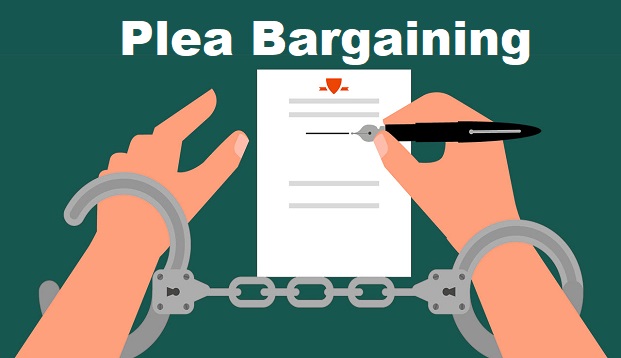
This article is a humble attempt in understanding as well as underlining the problem area that has struck the undersigned in every reading as well as interpretation of the text pertaining to plea–bargaining in our Indian Law as enumerated in chapter XXIA, Sections 265A to Section 265L. It is already coded and recorded in various deliberations of the Law Commission's 142nd, 154th, and 177th reports, the importance and the urgency of the requirement of this chapter in the context of the Indian Justice System and finally after the recommendation of Dr. Justice Malimath Committee, the Criminal Procedure Code, 1973 was amended and the above chapter was incorporated and successfully so, despite all the pros and cons and a lot of debates on both sides.
The nascent concept of pleabargaining even before it was encoded in the Law books by the legislature is evident if we travel back in the history of most nations including India. Not only the famous scientist Galileo was given a sentence of house arrest in exchange for his reciting and recanting Copernican “heresies” but also similar bargains have been enacted and reenacted in the various courtroom procedures across the states. Very recently, many members of the Tablighi Jamaat belonging to different countries, accused of violating Visa conditions by attending a religious congregation in Delhi, have walked free after pleading guilty for minor offences under the pleabargaining process. Given the enormous pendencies in the present time, the Kafkaesque ordeal of the poor litigants, the “waiting for Godot” predicament highlighted by “tareekh pe tareekh” caused by undue delays by various factors and stakeholders in the criminal justice system, to ameliorate the pain of the languishing undertrial prisoners in jail and also the victims of crime by providing them some balm by the provisions of compensation, undoubtedly, the concept of pleabargaining has by and large helped in reducing not only the pendencies but have also come to the rescue of both the offenders and victims of crime in appropriate cases by resolving the disputes by way of some kind of amicable settlement and negotiation between both the parties where in exchange for the sentence or reduction of sentence after a plea of guilt, an attempt is made to compensate the victim adequately after taking the willingness of both the parties.
The process of plea-bargaining is widely of three types namely charge bargaining, sentence bargaining, and fact bargaining, but in India, primarily, recourse is taken only to sentence bargaining unlike in the US. Though the concept has been problematised by various schools of thought as it sets a criminal record often for an accused even if he could be an innocent person without going through the rightful process of trial, at the pretrial stage itself, yet justice delayed is also justice denied. Stephanos Bibas, a Professor of Law and Criminology at the University of Pennsylvania Law School has stated that the criminal justice system has become a “capacious, onerous machinery that sweeps everyone in”, and plea bargains, with their swift finality, are what keep that machinery running smoothly.
Without going into every detail of chapter XXIA of Cr.PC, 1973, where already adequately and in detail the procedure of the entire pleabargaining process has been laid down, my case today is a re-reading and reading down of one specific provision of Section 265A of Cr.PC which according to the writer of this paper is a little problematic and needs a relooking.
The entire purpose and object of the pleabargaining procedure is beneficial in nature where in exchange for the confession of crime by the accused i.e. after his plea of guilt is recorded, he is let off by the beneficial provisions of this chapter by a very minimum punishment or by granting him the benefit of Probation of Offenders Act, 1958 and the victim in return is awarded compensation by the Court in terms of the mutually satisfactory disposition arrived at voluntarily by both the parties.
Now, Section 265A is headed as “Application of the Chapter” and lays down the offences for which these beneficial provisions can be attracted in negation by excluding the offences for which the above procedure and provisions cannot be attracted. Pithily, the types of offences that have been excluded from the benefits of these provisions are as follows:
- Offences for which punishment of death or imprisonment for life or imprisonment for a term exceeding seven years has been provided under the Law for the time being in force i.e. it shall be available for offences which are punishable for a term up to seven years of imprisonment.
- It shall not apply to offences affecting the socio-economic condition of the country and as per Section 265A Sub Section (2), it is the Central Government that shall decide and determine by way of notification the offences that shall affect the socioeconomic condition of the country.
- Children below the age of 14 years. As the legislature in its wisdom has already used the word “child” which is gender neutral, it already covers the children of both genders, and given their age and perhaps lack of maturity and knowledge about legal algebra at that age, they too have been excluded and again perhaps rightly so.
- What is problematic or bothersome is this specific exclusion, which is or are the offences committed against “woman”. As already discussed above, children or girls below the age of 14 have already been excluded. So these are offences committed against women from the age of 14 and above and this is interestingly a blanket exclusion from all kinds of offences be it petty or serious. The above chapter as is already well settled serves a beneficial purpose for both the offender and the victim and not only the offender but also the victim is provided with respite from a prolonged trial, litigation costs, repeated appearances before the Court, mental stigma, and suffering apart from the monetary compensation which cannot be completely discounted and disregarded especially in case of very petty, minor or appropriate non- compoundable cases arising out of familial or other disputes. Thus, in an attempt of protecting or preventing offences against women, it leads to a kind of negative discrimination against women victims, who are prevented from availing the beneficial provisions of this Law.
It is pertinent to note that in the United States, plea bargains are available for all kinds of offences against a woman including offences as grave as rape cases. The legislature in India in its wisdom and thankfully so, especially in the context of the scenario of the Indian Sub- Continent have already bracketed away the serious offences punishable with more than seven years of imprisonment that impliedly excludes all the offences of serious nature against woman from the processes of plea- bargaining including specific offences under the special Acts. Ergo, what remains are only minor offences punishable with less than seven years of imprisonment and there too, adequate precautions have already been provided by the legislature in this chapter which excludes cases of “forced consent” as the pleabargaining Magistrate is duty bound to ensure the willingness and voluntariness of both offender and the victim before initializing the process. The fact that most of the offences against women are provided with a prescription of a minimum sentence, even by way of pleabargaining sentences cannot be reduced too much and the deterrent effect as envisaged by the legislature will remain. The long drawn, arduous process of a criminal trial can be extremely painful for the victims, plus the factor of evidentiary issues like availability of witnesses after a long time, memory loss, etc. risking acquittal can lead to a double or a revictimization of the women victims.
Simone De Beavoir in her famous work “The Second Sex”, has famously stated that “One is not born, but rather becomes a woman”. The sociocultural milieu and the patriarchal setup have often silenced the voice of a woman, reducing her to a silent spectator with not much role to play even in the Law enforcement and justice delivery system. Even in the criminal trial process, woman's role has been minimal and therefore, it is important not to underestimate the role and decision-making power of a woman to my mind, they should be allowed to take a call for themselves and decide for minor offences, being victims already, if they wish to partake of the benefits of the pleabargaining process where for very minor offences, they can “choose” to opt for a faster remedy and seek the benefits of compensation, the importance of which has already been exemplified by the legislature while drafting the Victims Compensation Act and similar other provisions. In cases of minor offences which are followed by remorse, even the accused gets an opportunity for reformation which ultimately justifies the aim and philosophy of the entire criminal justice and prison system. The approach of excluding women to my mind is too “paternal” as it takes away the right of a woman to “think” and “decide” for herself, as to not only what is good for her, but also all the benefits of this Law as already enlisted and discussed in the aforementioned provisions. It is therefore not too late perhaps to relook and reenact this specific clause.