The Authors are Mohit Parihar, Advocate & Cyber Law Expert, Rajasthan High Court, Jaipur and Yamini Atreya, Research Scholar, Department of Law, University of Rajasthan, Jaipur
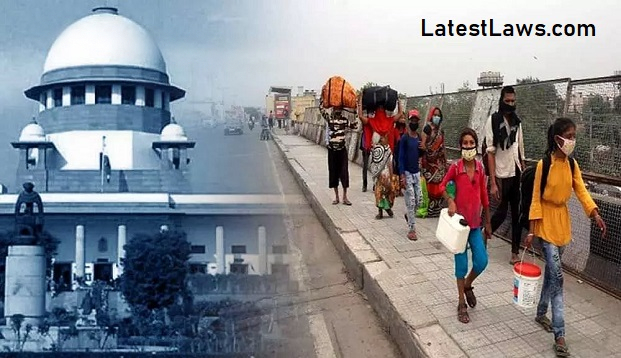
The Supreme Court of India took Suo moto cognizance on Tuesday, May 26, 2020, after the two months of horrifying desolations caused to millions of Migrants, poor class in the country, due to national lockdown which has triggered loss of hundred lives. Until now, the Supreme Court had been in the state of repudiation, believing that ‘all is well’. There were multiple petitions, PIL’s filed relating to migrant worker’s issues, from wages to food, and access of trains, but Supreme Court availed of no retort.
Due to Supreme Court’s passive response, during an unprecedented humanitarian crisis, received a wide spread disparagement from ex-judges, senior advocates and members of legal fraternity. Everyone was anguished, a wide spread social media stumped against the procrastination of the Apex Court of India.
In one of the sternest lockdowns in Modern India, the Centre and States issued many directives, to tackle the Corona pandemic issues. But various questions remained unfathomable relating to safe transport, sustenance allowance to migrants, and basic needs. The Indian Constitution provides an authority to Supreme Court, to enforce the accountability of the Centre-States, in these matters. But Court has made several questionable observations, in rejecting or adjourning petitions relating to Migrants Crises amidst Corona pandemic and National Lockdown. Indian Constitution inscribed Supreme Court as ‘Guarantor of Fundamental rights, Protector of Indian Constitution, but it has despondently failed to protect the millions of migrants, which led to hundreds of deaths. The Supreme Court of India, failed to effectuate the principles of ‘Natural Law” and “Natural Justice”, which is central to the Indian constitution’s standpoint on morality, politics and law.
A ‘Natural law theory’ emphasize on inherent natural human rights, which are inalienable. The idea of ‘Natural Rights’ has its origin in Natural law, an offshore of the doctrine of Natural Law. Great philosophers like Socrates, Aristotle, Plato, Cicero, advocated the ‘theory of natural law and rights”.
The revival of natural rights took place, towards the end of 19th century, and by the beginning of 20th century, a growing uncertainty and ambiguity due to World wars, and decline of colonialism, enthused a new quest for moral order, afforded by natural law. The doctrine of natural rights, had been acknowledged in Constitutional laws across the globe, in America as ‘Bill of Rights’, in England, as ‘Civil Liberties’ and in India, as ‘Fundamental rights”.
India being the world’s largest written Constitution, the theory of natural law and natural rights inscribed in PART III of Indian constitution, as Fundamental rights accounts for natural law elements. The evolved doctrine of “Basic structure” which is the “Light bearer of natural law”, enshrined in the Indian Constitution.
An Echo on progression of Natural Law
Philosophers, theologians, in them strive to search for law higher than “positive law”, they developed the “theory of natural law”. The natural law theory was propounded by Aristotle, during great Hellenistic Period. He said that ‘natural justice’ is a species of political justice, specifically the scheme of distributive and corrective justice, which would establish the ‘competent political society or nation’. By defending the existence of natural inherent human rights, he articulates to correct the standards of justice. The concept of natural law, by Aristotle is ‘Magna Moralia’ for law, as idea of justice.
Later, Cicero during Roman period believed that “natural law comprised of certain principles of justice and truth which were discovered in accordance with nature”. Thereafter as the freedom of religion gained momentum, Christian Philosopher Thomas Aquinas tried to transform the natural law into a part of Law of God. He stated, ‘the light of reason is placed by nature, and thus by go, in every man to guide him in his acts’.
In modern world, as feudalism declined, philosophers like Grotius, laid the foundation for the secular, rationalistic version of modern natural law, in close association with modern human rights. Gradually it was observed that philosophers like Locke, and Rousseau, with their ‘Concept of Social Contract’ developed the philosophy that right to life, liberty and property were inherent rights of human beings. This evolution of modern natural law was a revolt against the ‘Absolutism’. This certainly led to French ‘Rights of Man’, United Stated Declaration of Independence, and many other countries liberated from colonialism including India.
The pursuit of Indian Judiciary for constancy in constitution resulted in the emergence of ‘Doctrine of Basic structure’, delved in famous Kesavananda Bharti’s case, which was a tremendous effort towards Natural law. The Apex court observed, that ‘natural law is based on the premise that there is higher law, which is irremovable and above the whims of the sovereign.
From Natural Law arose the ‘doctrine of human rights’ as well which were transcribed in Part III of the Constitution, as fundamental rights and the basic structure is further subset of these fundamental rights, compassing other natural law doctrines.
The doctrine of basic structure, calls out for mandate to build a welfare state, to balance the democratic character of India, and to protect the constitutional supremacy. It contains the basic essence of natural law, in the form of democratic institution.
The Purview of Supreme Court in Indian Constitution
It is rightly said, that the excellence of country’s judiciary is a measure of the excellence of its government. The lamp of justice, glorifies the importance, independent and necessity of the judiciary in any democratic country. Fundamental rights are meaningless, unless there is operative machinery for the enforcement of the rights. Therefore, it is rightly said, ‘there is no right, if there is no remedy”. The powerful article 32 and Article 226 of the Indian constitution, provides an ample powers or jurisdictions to Supreme Court and High courts, of states, to issues writs for the enforcement of fundamental or legal rights. That is why; Supreme Court is regarded as ‘Defender of Fundamental Rights’.
A writ is a quick remedy against injustice, a device for the protection of the rights of citizens against any encroachment by the governmental authority. In India this power is made available to provide an extraordinary remedy without going into technicalities and which can be expected in special circumstances. The Supreme Court has been empowered to issue writs in the nature of Habeas Corpus. Mandamus, Prohibition, Certiorari and Quo Warranto for protecting the Fundamental Rights under Article 32 of the Constitution. Similar power has been conferred on the High Courts via Article 226. The Scope of the writs In Indian law is wider than that of the prerogative writs in England. This is because, firstly, the constitution uses the words “writs in the nature of” which does not make our writs identical with those in England but only draws an analogy from the latter. Secondly, our High Court can issue directions, orders or writs other than the prerogative writs. This enables the courts to mould the reliefs to meet peculiar and complicated requirements of this country.
B.R. Ambedkar, commented on Article 32, that “If I wish to make a particular article as the most important, without which this Constitution would be nullity, I would not refer to another article except this”.
Lord Denning observed, Good administration requires that complaints should be investigated and that grievance should be remedied. When parliament has set up machinery for that very purpose.
In Som Prakash Rekhi v. Union Of India & Anr, Justice Krishna Iyer expanded the definition of state for enforcing the fundamental rights and held as under: “The conclusion is impeccable that if the corporate body is but an ‘instrumentality or agency’ of Government, then Part III will trammel its operations. It is a case of quasi- governmental beings, not of non-State entities. We have no hesitation to hold that where the chemistry of the corporate body answers the test of ‘State’ above outlined it comes within the definition in Art. 12. In our constitutional scheme where the commanding heights belong to the public sector of the national economy, to grant absolution to government companies and their ilk from Part III may be perilous. The court cannot connive at a process which eventually makes fundamental rights as rare as ‘roses in December, ice in June’.”
Justice Iyer’s attitude towards a variety of issues was predictable. If it was a labour matter, his sympathies would always be with the workmen. In fatal accident cases, Justice Iyer was in favour of strict liability. In State of Haryana v. Darshana Devi, Justice Iyer dismissed the special leave petition filed by the State of Haryana and observed as under: “Here is a case of a widow and daughter claiming compensation for the killing of the sole bread-winner by a State Transport bus; and the Haryana Government, instead of acting on social justice and generously settling the claim, fights like a cantankerous litigant even by avoiding adjudication through the device of asking for Court fee from the pathetic plaintiffs.”
Mr. Vijayan, senior counsel while Delivering a lecture on ‘Writ of Certiorari' organised jointly by the Indian Law Institute and the Madurai Bench of Madras High Court Bar Association, pointed out that Article 32(3) of the Constitution enabled the Parliament to enact a law empowering any court to exercise the writ jurisdiction within the local limits of its jurisdiction and he was of the view that the High Courts would be relieved of their burden if the writ jurisdiction was given to district courts too. Judicial officers would also get an opportunity to get accustomed with the writ proceedings and it would help them as and when they get elevated to the High Court. “They need not take two to three years to settle down. They can straight away carry on with the work,” he said.
Many observers of the Indian Supreme Court including Professor Sathe and Upendra Baxi have rightly opined that the Indian Supreme Court is one of the strongest courts of the world. Power and judicial activism of the Indian courts have resulted into a strong and ever-expanding regime of fundamental rights.
Thus, it is clear that vast powers are vested with the Judiciary to control an administrative action when it infringes fundamental rights of the citizens or when it goes beyond the spirit of our country i.e. Constitution of India. It ensures the Rule of Law and proper check and balances between the three organs of our democratic system. The philosophy of writs is well synchronized in our Constitutional provisions to ensure that rights of citizens are not suppressed by an arbitrary administrative or judicial action and the same has been emphasized upon by the Honourable judges and the observers.
The Miscarriage of Justice
As the adversities were faced by the Migrants Workers, across India, during the national lockdown period and the Apex court couldn’t do justice with its constitutionally assigned task of holding the executive answerable and ordering assistance for the poor migrants across the nation.
The Apex court did not pay any mindfulness to their hardships, amidst national lockdown crises, consequential in hundreds of deaths, unconceivable hardships faced by migrants. The Supreme court, during that hard-hitting times, predisposed the pleas or petitions, without ‘any effective directions, quoting – ‘the Court do not see any purpose in keeping these writs petition pending’. This becomes an adapted response, disposing of PILs in a routine fashion, on the basis of unsubstantiated executive claims.
The ‘Guarantor of constitution’ made a condescending remark that the enormous exodus of migrants was caused by ‘fake news’. The Supreme Court has failed to sustain its reputation, as ‘protector of fundamental rights’, ‘guarantor of Indian constitution’ and ‘lamp of justice’ for every citizens of India. The Supreme Court, during the severe phase of lockdown, failed to act prompt and pro-active, which was recounting demand of the time. The difficulties for the poor for safe transportation, food, shelters or unemployment, went unreciprocated for the period of 2 months, which drove the migrants to grave wretchedness, leading to hundreds of deaths. The Court’s lack of understanding, in compassion with respect to various petitions, asking for relief as to food or money will be black spot on the pages of Indian Judiciary’s history.
The court’s insolence in handling the PILs relating to reliefs for justice was an endeavour to bulldoze the migrant’s rights and their call for justice. The Supreme Court failed the purpose of Public Interest Litigation, which is to secure justice for the poor’s and the weaker sections of the country, which are not in position to protect their own interests.
Justice PN Bhagwati, the pioneer of Public Interest Litigation, observed that, PILs for the violations of constitutional or legal rights of poor, migrants, ignorant, or underprivileged class should not go unnoticed and disregarded”.
The Apex court’s assertion on unverified claims or reports by the central government, noticeably obliterates the concept of ‘separation of power’ delegated under Indian Constitution. The dependence on Centre’s false claims, made court to act reflexive, without any reason, without any relief, without any directive. The Supreme Court has squandered a crucial opportunity to hold the executive to task, which has led to appalling horrors. The Supreme Court, remained silent bystander, during hard situations, senselessly validating the false claims or actions of the executive, whereby Migrants looked for help or relief. The court adapted the ‘casual and mechanical approach’, over the migrant’s crises in India, and failed to employ the powers enshrined under Indian Constitution.
A Chance to Redeem the ‘Light of Justice’
In emerging action, the Supreme Court, lastly after the delay of 2 months, took Suo moto cognisance over the ‘miseries of migrants across the nation’, issued by a bench of Justice Ashok Bhushan, Justice Sanjay K. Kaul and Justice MR Shah. The court, thereafter, issued notices to Centre, States, and UT’s seeking replies on steps taken to over migrant crises.
It is appropriate to note that, the cognizance of Supreme court, comes after 10 days, when an application was dismissed, seeking relief for migrants walking back thousands of kilometres to their homes, by walking and miseries faced by them, dated on 15th May, 2020.
Defending Constitutional duties?
It is high time, for every citizens of India, to introspect the ineffectiveness of Supreme Court, or miscarriage to deliver prompt measures, which could have diminished the sufferings of underprivileged during the three phases of lockdown. The court failed to retained, the monitoring of Executive’s false undertakings. It was unfortunate, that Apex Court couldn’t defend the principles of Natural law and natural rights. The Apex Court shut its eyes to the cries of poor for justice, in matters concerning larger public interest, which has been condemned by various other eminent jurists
But with the incidence of Supreme Court Suo moto cognizance, it is anticipated that Court should provide a relief to the poor migrants, with giving consideration to all issues or problems faced by the migrants, in good conscience observing the ideas of equality, justice, natural rights. It is expected, that Supreme Court, shall look into the shortfalls or delays, in Centre or State Relief packages and will give operative or concentrated justice, to redeem the migrant crises.
Pic Courtesy: Hans India