September 2,2018:
Concept of Plea Bargaining in India By Mehak Goel (Download PDF)
The Author, Mehak Goel is a 2nd year student of Jindal Global Law School, OP Jindal Global University, Haryana.
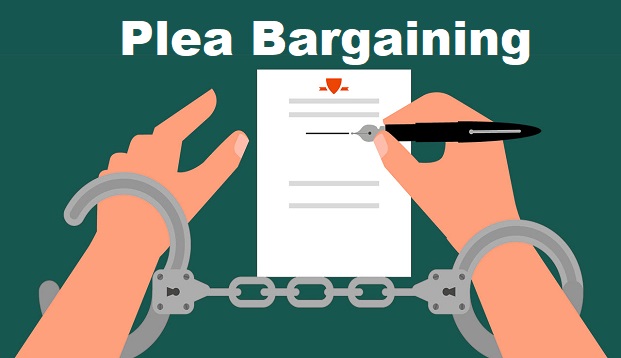
Plea bargaining is basically a negotiation that happens in the pre-trial period between the prosecution and the accused. In this type of negotiation where, in exchange of certain concessions given by the prosecution, the accused pleads guilty. In other words, the accused pleads guilty to a lesser charge. However, it is important to note that plea bargaining is not available for all types of offences and crimes.A person cannot claim plea bargaining for grievous offences such as murder and homicide or offences punishable with death sentence or life imprisonment.
In India, the concept of plea bargaining was brought about by way of the Criminal Law (Amendment) Act, 2005 which introduced Chapter XXI A in the Code of Criminal Procedure, 1973. The Act was made enforceable from 5th July 2006. The concept of plea bargaining has been borrowed from the Constitution of the United States of America. It was first suggested by the 142nd Report[1] of the Law Commission of India as an alternative step to tackle huge arrears and loopholes of the criminal cases in the courts.
Under the NDA government, a committee was established which was headed by Justice V.S. Malimath, former Chief Justice of the Hon’ble High Court of Kerala and Karnataka, to resolve the issue of the escalating criminal cases stacking up. The Malimath Committee in its Report in 2003 also recommended the plea-bargaining system as an amicable solution for quick disposal of criminal cases. The Committee also took its reference from the successful and well-established practice of plea bargaining prevalent in the United States. [2]The Committee in its Report stated,
“Taking into account the advantages of plea-bargaining, the recommendations of the Law Commission contained in the 142nd report and the 154th report may be incorporated so that a large number of cases can be resolved and early disposals can be achieved. By no stretch of imagination can the taint of legalising a crime will attach to it.”
The Committee pointed out that Probation of Offenders Act already gives the court the power to pass a probation order. In addition to that, the power of executive pardon and power of re-mission of sentences only lessen the length of imprisonment and do not condone the crime committed. It pointed out the advantages of plea bargaining by stating that it will serve the community interest as it will facilitate an earlier resolution of a criminal case, thus reducing the burden of the court. It was of the view, that there was a possibility that number of acquittals will also be reduced by this concept. It further stated that the Committee was in agreement of the views of the Law Commission of India in its 142nd and 154th reports wherein it thoroughly examined the subject of plea-bargaining/compounding/settlement without trial and made detailed recommendations to promote settlement of criminal cases without trial. [3]
Historically, in the jury system, there was no necessity for plea bargaining as there was no legal representation. It was only after the 1960s that the necessity was felt, when legal representation was introduced. Previously, plea bargaining was used by the judges to encourage confessions. With the evolution of criminal justice system, plea bargaining is now used for the faster disposal of criminal cases and to lessen the burden on the courts.
Under Chapter XXIA of the Code of Criminal Procedure, 1973, section 265A to 265L deal with the concept of plea bargaining. Plea Bargaining in India is allowed in cases wherein:
- The maximum period of imprisonment is of seven years
- The offence does not have an impact on the socio-economic condition of the country.
- The offence is not committed against a child or a woman.
The Criminal Law (Amendment) Act, 2005 essentially unfolded the following key issues in the criminal justice system:
- Witness Turning Hostile
- Plea Bargaining
- Compounding the offence under Section 498A, IPC
The legal provisions introduced by the Criminal Law (Amendment) Act, 2005 are as follows:
- Section 265 A- According to this Section, plea bargaining should be applicable to an accused who has not committed an offence for which the law provides the punishment of death or life imprisonment or imprisonment for more than seven years.
It also provides that Chapter XXIA of the Code of Criminal Procedure,1973 will not apply to offences which affect the socio-economic condition of the country or have been committed against a woman, or a child below fourteen years of age.
The offences which affect the socio-economic conditions of the country have been determined by the Central Government by way of S.O. 1042(E) dated 11th July, 2006.
Hence, Chapter XXIA of Code of Criminal Procedure, 1973 is not applicable to the following
Dowry Prohibition Act, 1961.
The Commission of Sati Prevention Act, 1987.
The Indecent Representation of Women (Prohibition) Act, 1986
The Immoral Traffic (Prevention) Act, 1956.
The Protection of Women from Domestic Violence Act, 2005
The Infant Milk Substitutes, Feeding Bottles and Infant Foods (Regulation of Production, Supply and Distribution) Act, 1992.
Provisions of Fruit Products Order, 1955 (issued under the Essential Services Commodities Act, 1955).
Provisions of Meat Food Products Orders, 1973) (issued under the Essential Commodities Act, 1955).
Offences with respect to animals that find place in Schedule I and Part II of the Schedule II as well as offences related to altering of Page 3 boundaries of protected areas under the Wildlife (Protection) Act, 1972.
The Scheduled Castes and Scheduled Tribes (Prevention of Atrocities) Act, 1989.
Offences mentioned in the Protection of Civil Rights Act, 1955.
Offences listed in sections 23 to 28 of the Juvenile Justice (Care and Protection of Children) Act, 2000.
The Army Act, 1950.
The Air Force Act, 1950.
The Navy Act, 1957.
Offences specified in sections 59 to 81 of the Delhi Metro Railway (Operation and Maintenance) Act, 2002.
The Explosives Act, 1884.
Offences specified in sections 11 to 18 of the Cable Television Networks (Regulation) Act, 1995.
The Cinematograph Act, 1952.
- Section 265B- An accused who wishes to file application for plea bargaining may do so by providing an affidavit in support stating that he is filing the application voluntarily, he understands the nature and extent of punishment and he is not a prior convict for the same offence.
On receipt of application and affidavit, the Court shall issue notice to Public Prosecutor and to the accused to appear on the date fixed.
The Court shall examine the accused in camera and the other party should not be present. If the Court is satisfied that the application has been filed voluntarily by the accused, it will give time to the parties to work out a mutual settlement.
Whereas, if Court finds that application has been filed involuntarily by the accused or that he is a prior convict of the same offence, the application will be rejected and case will be sent back to regular trial.
- Section 265C- This Section provides for guidelines for mutual satisfaction disposition.
- In a case instituted on a police report- The Court shall issue notice to Public Prosecutor, police officer who has investigated the case, the accused and the victim to participate in working out a satisfactory disposition of the case. The Court shall ensure the process is completed voluntarily by the parties. Pleader of the accused may also participate in the process if the same is desired by the accused.
- In a case instituted other than on a police report- The Court shall issue notice to the accused and victim to participate in working out a satisfactory disposition of the case. The Court shall ensure the process is completed voluntarily by the parties. Pleader of the accused may also participate in the process if the same is desired by the accused.
- Section 265D- Where a satisfactory disposition of the case has been worked out, the Court shall prepare a report of the same to be signed by the presiding Officer of the Court and all other persons who participated in the process. If no such disposition was workd out, the Court shall record such observation and proceed further in accordance with the provisions of this Code from the stage the application under sub-section (1) of section 265-B has been filed in such case.
- Section 265E- Where a satisfactory disposition of the case has been worked out, the Court shall dispose the case in the following manner, the Court shall award compensation to the victim in accordance with the disposition and hear the parties on quantum of punishment and releasing of the accused on probation of good conduct or after admonition under section 360.
The Court can either release the accused on probation under the provisions of Section 360 of the Code or under the Probation of Offenders Act, 1958 or under any other legal provisions in force or punish the accused, passing the sentence. While punishing the accused, the Court, at its discretion, can pass sentence of minimum punishment, if the law provides such minimum punishment for the offenses committed by the accused or if such minimum punishment is not provided, can pass a sentence of one-fourth of the punishment provided for such offense.
- Section 265F- The Court shall deliver its judgement in open court.
- Section 265G- The judgement delivered by the Court shall be final and no appeal shall lie in any Court against such judgement (except special leave petition under Article 136 and writ petition under Article 226 and 227 of the Constitution).
- Section 265H- A Court shall have all powers vested in respect of bail, trial of offences and other matters relating to disposal of case.
- Section 265I- Section 428 is applicable for setting off the period of detention undergone by the accused against the sentence imposed on him.
- Section 256J- Savings.
- Section 256K- The statements or facts stated by accused in a n application of plea bargaining shall not be used for any other purpose except for those provided in this Chapter.
- Section 265L- This Chapter will not be applicable to any juvenile or child as defined in the Juvenile Justice (Care and Protection of Children) Act, 2000.
The accused has access to three kinds of plea bargain. The accused can make an application for charge bargain, wherein the prosecution allows the accused to plead guilty to a lesser charge or only to some charges imposed against him. Secondly, a sentence bargain can be applied for wherein the accused is told in advance the sentence he will be given if he pleads guilty. Lastly, there is fact bargaining under which the defendant agrees to stipulate to certain facts to make sure that other facts are not brought into the picture to be taken as an evidence, it is not used in courts as it is believed to go against the Criminal Justice System. In India, the accused can only make an application for a sentence bargain.
In India, the Supreme Court of India has criticized the concept of plea bargaining through its various judgements.
The Hon’ble Supreme Court in the case of Murlidhar Meghraj Loya v. State of Maharashtra held that,
“if the dispute…finds itself in the field of criminal law, “Law Enforcement” repudiates the idea of compromise as immoral, or at best a necessary evil. The “State” can never compromise. It must “enforce the law”.”[4]
In Kachhia Patel Shantilal Koderlal v. State of Gujarat and Anr., the Supreme Court held that, the practice of plea bargaining is unconstitutional, illegal and could encourage corruption and collusion. [5]
Similarly, in Kasambhai v. State of Gujarat, the Court expressed its apprehension on the concept of plea bargaining as in its view it was likely to be abused.[6]
The courts have time and again claimed that the concept of plea bargaining went against the public policy of India as an accused cannot bargain for the offences he committed.
It has also been debated that the practice of plea bargaining could go against Article 21 of the Constitution of India. In the case of Thippaswamy v. State of Karnataka, the Court said that the act of inducing and leading the accused to plead guilty under an assurance or a promise will violate Article 21 of the Constitution of India.[7]
In State of Uttar Pradesh vs Chandrika, the Court deprecated the concept of plea bargaining and held the concept as unconstitutional. The Court was of the opinion that the concept of plea bargaining cannot form the basis for disposal of cases that are of criminal nature. Such cases should be only decided on the merit. It also opined that a sentence given to the accused should be as per what the specific statute or law says.[8]
However, there are cases where the benefits of plea bargaining were acknowledged and applauded by the courts. One such case is, State Of Gujarat v. Natwar Harchandji Thakor , where the Court recognised the importance of plea bargaining. It stretched on the fact that every “plea of guilty” which is done in the statutory procedure of the criminal trial, should not be regarded as “Plea Bargaining”. It has to be decided on a case to case basis. Taking into account the increasing problems in the criminal justice system, the Court was of the opinion that the purpose of the law makers is to create laws that help in providing easy, expeditious and cheap justice.[9]
Unlike in the United States of America where plea bargaining is available for all kinds of offences, in India there is a limitation on the offences for which accused can use the concept of plea bargaining. Furthermore, according to the Code of Criminal Procedure,1973, it is the accused who plays an active role in the procedure of plea bargaining as it is a completely voluntary process. In contrast, in America, the prosecutor plays an important role as it is the State/Prosecution who offers a plea to the accused.
Plea Bargaining indisputably helps in the fast disposal of cases and reduces the burden on the courts. It helps draw mutual understanding between the prosecutor and the defendant. It can be seen as a form of alternative dispute resolution and a rehabilitative approach to criminals. According to some studies, victim’s participation in plea bargain negotiations has been shown to contain their vengeful instincts, decrease their assessment of the system being too lenient on criminals and inculcate feeling of fairness in the whole process. Increased victim satisfaction will, in effect, enhance the efficiency of the criminal justice system by ensuring his future support to the system.[10]
At the same time, the concept of plea bargaining in India is a voluntary process, but the legal provisions do not provide anything if the mutual disposition reached by the parties in plea bargaining are contrary to the provisions of law. It is also imperative to note that the investigating officer is an important party in the process of reaching at a mutual settlement. The involvement of the police often attracts criticism as custodial torture inflicted on accused by the police is a penetrating issue in India. Moreover, it may lead to unjust sentencing of the accused as it makes room for corruption.
In light of the various pronouncements given by the Courts in India, it can be said that the concept of Plea Bargaining in India definitely has two sides of interpretations and perceptions. However, the criminal justice system has reformed over time and has made plea bargaining conducive to the legal and society standards. With the tremendous number of criminal cases stacking up the courts, the concept of Plea Bargaining is imperative as it provides for the fast and expeditious means of disposing cases.
[1] 142nd Law Commission of India Report, Concessional Treatment for Offenders who on their own initiative choose to plead guilty without any bargaining (1991), available at http://lawcommissionofindia.nic.in/101-169/Report142.pdf
[2] Justice Malimath Committee on Reforms of Criminal Justice System, Parliament of India, Report of the Committee on Reforms of Criminal Justice System,2003.
[3] Ibid.
[4] Murlidhar Meghraj Loya v. State of Maharashtra, AIR 1976 SC 1929
[5] Kachhia Patel Shantilal Koderlal v. State of Gujarat and Anr., 1980 CriLJ 553
[6] Kasambhai v. State of Gujarat, AIR 1980 SC 854
[7] Thippaswamy v. State of Karnataka, (1983) 1 SCC 194
[8] State of Uttar Pradesh v. Chandrika, 2000 Cr.L.J. 384(386)
[9] State of Gujarat vs Natwar Harchandji Thakor, (2005) 1 GLR 709
[10] Justice Malimath Committee on Reforms of Criminal Justice System, Parliament of India, Report of the Committee on Reforms of Criminal Justice System,2003.