April 12,2019:
The Author, Komal Parnami, is a 1st year student of Rajiv Gandhi National University of Law, Punjab. She is currently interning with LatestLaws.com.
Introduction
The Indian Passport Act enacted in 1920 was renamed as “The Passport ( entry into India) Act, 1920” and is still in operation requiring mandatory possession of passports by persons entering India. This act is administered by the Ministry of Home Affairs.It was held in the case of Satwant Singh Sawhney v. D. Ramarathnam Assistant Passport Officer that right to travel and go abroad is a fundamental right under article 21 which guarantees right to life and personal liberty. The Hon’ble Supreme Court held that there should be an act to govern the issue of passports to avoid arbitrariness. Following this, the passports act was enacted in 1967.
The passport rules were issued in 1980 and were amended in 2006. The Central Passport organisation is a subordinate office of the Ministry of External Affairs headed by Joint Secretary and Chief Passport Officer.
Q1. What are the classes of passports and travel documents?
There are three classes of passports:
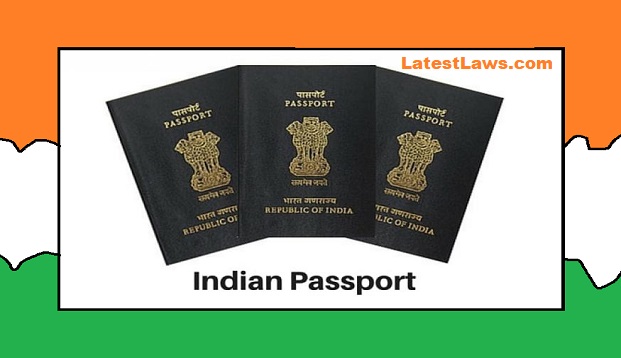
- Regular passport: it has a navy blue cover. It is also called ordinary passport as it is issued for ordinary travel purposes such as vacations and business trips. It is a type ‘P’ passport where P denotes personal.
- Diplomatic passport: it has a maroon cover. It is issued to people holding diplomatic status or deputed by the government of India for official duty abroad. It is a type ‘D’ passport where D denotes diplomatic. Diplomatic passports are generally issued to IFS officers and officers of the ministry of external affairs.
- Official passport: it has a white cover and is issued to individuals representing the Indian government on official business. It is generally issued to officials of RBI, officials of ministries in the government etc. It is a type ‘S’ passport where S denotes ‘Service’.
A travel document is an identity document issued by a government or international treaty organisation. The classes of travel documents are:
- emergency certificate authorising a person to enter India
- certificate of identity for the purpose of establishing the identity of person
- such other certificate or document as maybe prescribed
Q2. What are the documents required for application for issuance of passport?
If a person is an adult and is a citizen of India by birth then proof of present address, DOB proof and documentary proof for any one of the non ECR categories is required.
If a person is a citizen of India by descent then either birth registration certificate issued by embassy/ high commissioner/ consulate of India or old passport in original or passport of parents with new name in original is required to be submitted, in addition to the previously mentioned documents.
If a person is a citizen of India by registration then citizenship certificate issued by ministry of home affairs is required in addition to the previously mentioned documents.
If citizen is a minor then the present address proof of parent(s) and original and self-attested copies of parents passport, if parents possess passport are also required.
The documents acceptable as proof of address are water/ electricity/ telephone bill, proof of gas connection, aadhar card, rent agreement. Documents acceptable as proof of DOB are birth certificate , matriculation certificate, aadhar card, PAN card, driving license.
Q3. What is the process for application of new passport?
Application for passport is online on this portal https://portal2.passportindia.gov.in/AppOnlineProject/online/procFormSubOnl
Firstly, one has to register online then login with the registered id. The user has to choose either application for fresh passport or reissue of passport. After submitting the form online payment has to be made. Then generated application receipt carrying appointment number has to be showed at the passport seva kendra along with original documents on the date of appointment.
Q4. On what grounds can the passport authority refuse an application or existing passport?
The passport authorities may refuse to issue passports
- if the applicant may, or is likely to, engage in such country in activities prejudicial to the sovereignty and integrity of India,
- or if the presence of the applicant in such country may, or is likely to, be detrimental to the security of India,
- or if the presence of the applicant in such country may, or is likely to, prejudice the friendly relations of India with that or any other country,
- or if in the opinion of the Central Government the presence of the applicant in such country is not in the public interest.
Q5. What is the duration of passport or travel document issued?
The passport or travel document is valid for the prescribed period of the category it falls under. However, it may be issued for a shorter period than prescribed if the person to whom it is issued so desires. Extension beyond the prescribed period is not allowed.
Q6. Whom does a passport belong to?
A passport or travel document issued under this Act is the property of the Central Government of India.
Q7. Can a passport holder travel to all countries?
No, a passport or travel document for visiting such a country
- which is committing external aggression against India;
- or is assisting the country committing external aggression against India;
- or where armed hostilities are in progress;
- or a country to which travel must be restricted in the public interest
shall cease to be valid for such travel or visit unless in any case a special endorsement in that behalf is made in the prescribed form by the prescribed authority.
Q8. On what grounds can a passport holder’s passport be impounded or revoked?
The passport authority may require the holder of a passport or a travel document, by notice in writing, to deliver up the passport or travel document to it within such time as may be specified in the notice and the holder shall comply with such notice. Conditions for impounding or revocation of passport are:
- If the holder of the passport is in wrongful possession thereof;
- or if the passport was obtained by concealing material information or providing wrong information;
- or if the passport authority deems it necessary so to do in the interests of the sovereignty and integrity of India, the security of India, friendly relations of India with any foreign country, or in the interests of the general public;
- or if the holder of the passport or travel document has, at any time after the issue of the passport or travel document, been convicted by a court in India for any offence involving moral turpitude and sentenced in respect thereof to imprisonment for not less than two years;
- or if proceedings in respect of an offence alleged to have been committed by the holder of the passport or travel document are pending before a criminal court in India
- or if any of the conditions of the passport or travel document has been contravened.
Q9. What is the penalty for disregarding the provisions of the act?
The punishment for various offences stated is imprisonment for a term which may extend upto two years or fine which may extend upto five thousand rupees or both. The penalty imposed on a non citizen is imprisonment for a term not less than one year which may extend upto five years and fine shall not be less than ten thousand rupees and it may extend to fifty thousand rupees.
If a person convicted of an offence under this act is convicted again then he shall be punishable with double the penalty provided.
Q 10. Who has the power to arrest/ seize a person against whom a reasonable restriction exists?
Any officer of customs empowered by a general or special order of the Central Government in this behalf and any officer of police or emigration officer not below the rank of a sub-inspector may arrest without warrant and search any place or seize any passport of any person against whom a reasonable suspicion exists that he has committed any offence punishable under section 12. The person should be informed the grounds of his arrest and should be produced before a magistrate as soon as possible.