









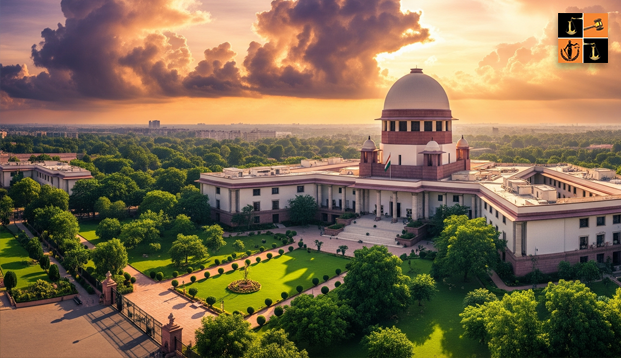
The Supreme Court has stayed the operation of a 2018 notification issued by the Uttarakhand Government that excluded candidates with blindness, visual impairment, and locomotor disabilities from competing for posts in the State Judicial Services. The Court noted that the notification not only removed them from reservation under the Persons with Benchmark Disabilities (PwBD) quota but also barred their participation in the general category, thereby rendering them ineligible altogether.
A Bench comprising Justice J.B. Pardiwala and Justice K.V. Viswanathan was hearing a writ petition filed by a visually impaired candidate challenging her exclusion from the Uttarakhand Judicial Services Examination. She argued that the notification and subsequent advertisement for recruitment violated both constitutional guarantees and statutory protections under the Rights of Persons with Disabilities Act, 2016 (RPwD Act).
The petitioner contended that the notification arbitrarily restricts reservation only to specific categories, leprosy cured, acid attack victims, and muscular dystrophy, while excluding other benchmark disabilities such as blindness and locomotor disability, contrary to Section 34 of the RPwD Act. This provision mandates four percent reservation in public employment, with one percent earmarked each for blindness/low vision and locomotor disability.
The Court observed that the denial of eligibility to persons with such disabilities to apply either under the PwBD quota or in the general category was “absurd” and contrary to the purpose of the law. Justice Pardiwala remarked that such a rule cannot withstand judicial scrutiny and assured that it would be struck down.
In an interim direction, the Court ordered that all candidates with benchmark disabilities, even if excluded from the PwBD quota, must be allowed to appear in the upcoming preliminary test scheduled for August 31. They would be entitled to apply under the general, SC, ST, or OBC categories as applicable, and must also be provided with reasonable accommodation including a scribe and additional time of twenty minutes per hour.
The Bench directed that applications from such candidates be accepted until 5 p.m. on Friday, either physically or through email. While reserving judgment on the larger constitutional issues, including domicile requirements under the State Act, the Court made it clear that blanket exclusion of visually impaired and locomotor disability candidates is prima facie unsustainable.
The plea, supported by Advocate-on-Record Vikram Hegde, challenges the constitutional validity of the recruitment advertisement and the 2018 notification on three main grounds: violation of Articles 14, 19(1)(g), and 21 of the Constitution, inconsistency with Section 34 of the RPwD Act, and disregard of the Supreme Court’s earlier ruling in Re: Recruitment of Visually Impaired in Judicial Services v. Registrar General, High Court of Madhya Pradesh. In that case, the Court had categorically held that visually impaired and low-vision candidates are entitled to participate in judicial service recruitment.
During the proceedings, amicus curiae Senior Advocate Gaurav Agarwal highlighted that both the State and the Uttarakhand Public Service Commission (UKPSC) had conceded that the law, as interpreted by the Supreme Court, requires inclusion of visually impaired and low-vision candidates. However, the present rules continued to exclude them. Advocates Vanshaja Shukla (for the State), Ashutosh Kumar (for UKPSC), and Sudarshan Singh Rawat (for the High Court) also appeared before the Bench.
The Court has reserved judgment on the larger challenge but has ensured immediate relief by allowing all excluded candidates to sit for the forthcoming examination under the general or reserved categories, with appropriate exam accommodations.
Picture Source :




















