









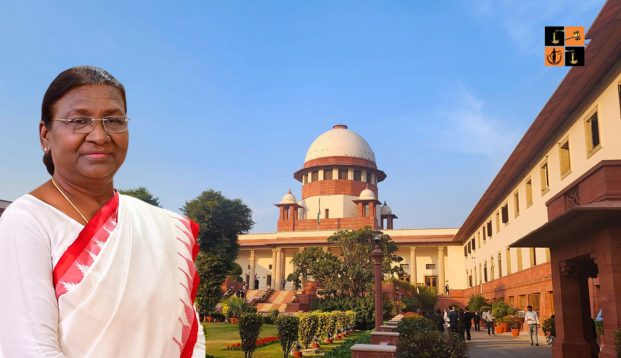
The Supreme Court, while examining a Presidential Reference under Article 143, observed that prescribing fixed timelines for Governors and the President to act on Bills under Article 200 and Article 201 requires a constitutional amendment, not judicial fiat. The reference followed the Court’s April 2025 ruling in State of Tamil Nadu v. Governor of Tamil Nadu & Anr., where a two-judge bench had directed the President to decide on reserved Bills within three months.
The matter arose amid concerns that Governors were indefinitely withholding assent to Bills, creating a constitutional deadlock. Seeking clarity, the President questioned whether courts could mandate timelines when the Constitution itself uses the phrase “as soon as possible.” A five-judge Constitution Bench led by Chief Justice BR Gavai, with Justice Surya Kant, Justice Vikram Nath, Justice PS Narasimha, and Justice AS Chandurkar, took up the issue.
Senior Advocate Dr. Abhishek Manu Singhvi, for Tamil Nadu, contended that prolonged delays undermine legislative supremacy and pressed for a uniform timeline, with deemed assent in case of inaction. He relied on precedents like the Perarivalan case and NCT of Delhi v. Union of India. Senior Advocate Kapil Sibal, appearing for West Bengal, submitted that Governors cannot act as “super Chief Ministers” and stressed that Article 163 confines their discretion. The Attorney General, however, cautioned that prescribing timelines would amount to judicially amending the Constitution.
The Bench expressed doubts on enforceability. Justice Vikram Nath noted that prescribing timelines would effectively alter constitutional text, while Justice Narasimha emphasized that Article 200 and Article 201 were framed with flexibility, permitting intervention only in extreme cases under Articles 142 or 226. The judges also raised concerns on consequences of non-compliance, questioning whether Governors could face contempt or whether courts would have to assume their role.
Chief Justice Gavai clarified that earlier directions, such as in the Telangana Speaker’s disqualification case, were fact-specific and not general constitutional principles.
Concluding, the Court observed that indefinite delays by Governors undermine democratic functioning but held that “as soon as possible” under Article 200 and Article 201 cannot be judicially converted into rigid timelines. The Bench stated that any uniform rule must come through constitutional amendment, not judicial directions.
The final ruling on balancing constitutional silence with democratic accountability is awaited, and the Bench is continuing to hear the matter.
Picture Source :




















