









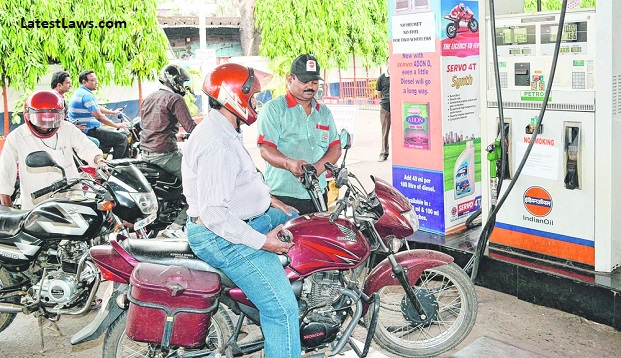
On Tuesday, the Govt said any entity with a net worth of at least Rs 500 crore is eligible for obtaining the liberalised licence to sell petrol & diesel to retail & bulk consumers.
Clarifying on the Nov 2019 liberalised fuel licensing regime, the Ministry of Petroleum & Natural Gas said any entity with a net worth of Rs 250 crore can get a licence to retail petrol & diesel to either bulk or retail consumers.
For those seeking authorisation for both retail & bulk should have a minimum net worth of Rs 500 crore at the time of application, it said in a statement.
In 2019, the Govt had relaxed norms for retailing of auto fuels, allowing non-oil companies to venture into the business a move that could help private & foreign firms to enter the world's fastest-growing market.
Prior to that, a company had to invest Rs 2,000 crore in either hydrocarbon exploration & production, refining, pipelines or liquefied natural gas (LNG) terminals to obtain a fuel retailing licence in India.
In the statement, the ministry said the Govt had on Nov 8, 2019, notified simplified guidelines for grant of authorisation for bulk & retail marketing of motor spirit (petrol) & high-speed diesel (diesel).
It said that "The simplified guidelines aim at increasing private sector participation in the marketing of petrol & diesel".
"An entity desirous of seeking authorisation for either retail or bulk must have a minimum net worth of Rs 250 crore at the time of making an application Rs 500 crore in case of authorisation for both retail & bulk." Applications, it said, may be submitted in the prescribed form directly to the ministry.
"For retail authorisation, the entity is required to set up at least 100 retail outlets," the statement said adding that the new policy has opened up the marketing sector of petroleum products by removing the strict conditions applicable earlier.
The other requirements as per the Nov 2019 notification include the need for companies to install facilities for marketing of at least one new generation alternative fuel, such as CNG, LNG & biofuels, or electric vehicle charging within three years of the start of operations.
The retailers will necessarily have to set up 5% of the total outlets in rural areas within 5 years.
The new policy liberalises fuel retailing by increasing private sector participation, including foreign players.
The statement added that "It will also encourage dispensing of alternate fuels & augmentation of retail network in remote areas & ensure higher levels of customer service".
The Govt had last set fuel marketing conditions in 2002 & the Nov 2019 change was based on the recommendation of a high-level expert committee.
The move will facilitate entry of global giants such as Total SA of France, Saudi Arabia's Aramco, BP Plc of the UK, & Trafigura's downstream arm Puma Energy.
Total in partnership with Adani Group had in Nov 2018 applied for a licence to retail petrol & diesel through 1,500 outlets.
BP too has formed a partnership with Reliance Industries to set up petrol pumps. While Puma Energy had applied for a retail licence, Aramco was in talks to enter the sector.
State-owned oil marketing companies Indian Oil Corp (IOC), Bharat Petroleum Corp Ltd (BPCL) & Hindustan Petroleum Corp Ltd (HPCL) currently own most of the 69,924 petrol pumps in the country.
Reliance Industries, Nayara Energy (formerly Essar Oil), & Royal Dutch Shell are the private players in the market but with limited presence. Reliance, which operates the world's largest oil refining complex, has 1,400 outlets.
Nayara has 5,756 pumps, while Shell has just 194. Currently, IOC is the market leader with 29,368 petrol pumps in the country, followed by HPCL with 16,707 outlets, & BPCL with 16,492 fuel stations.
Source Link
Picture Source :




















