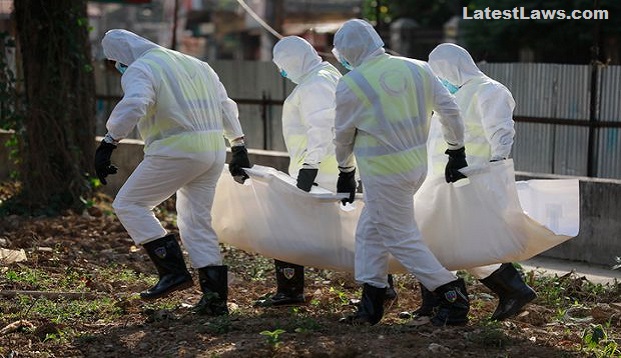
On Friday, the AAP Government informed the Delhi High Court that it was taking urgent steps, including extending the timings of crematoriums, to tackle the issue of cremating those who have died due to COVID-19 and the piling up of bodies at mortuaries.
The Delhi Government told the court that 28 such bodies were cremated on Thursday and the last rites of the remaining 35 will be performed by Saturday.
Only those bodies will be retained where post mortem and investigations are to be carried out, it said.
A bench comprising of Chief Justice D.N. Patel and Justice Sangita Dhingra Sehgal, conducting the hearing via video conferencing, directed that this situation should not be repeated and no bodies should be returned.
The Court asked the Delhi government and the three municipal corporations to file a detailed status report and listed the matter for further hearing on June 2.
Anguished by lack of facilities to cremate those who died due to COVID-19 and the bodies piling up in the mortuaries, the high court on Thursday had initiated on its own a PIL to deal with the issue, saying if this was the correct situation then it was "highly dissatisfactory and violative of the rights of the dead".
The bench had said that as citizens of Delhi they were pained at the state of affairs as reported in newspapers on Thursday.
It had noted that according to the news reports, inside the COVID-19 mortuary of Lok Nayak Jai Prakash Narayan (LNJP) Hospital in Delhi, there are 108 bodies of which 28 are piled on floor on top of each other as there are only 80 storage racks.
During the Friday's hearing, Delhi government additional standing counsel Sanjoy Ghose informed the court that urgent steps were taken to remedy the situation, including that LNJP Hospital being authorised to divert bodies to crematoriums at Panchkuian and Punjab Bagh, as opposed to only Nigambodh Ghat.
He said the government has now authorised wood fired traditional cremations, in addition to electric and CNG furnaces, providing personal protection (PPE) kits for all workers at crematorium and bodies and the working hours of crematoriums are extended to 7a.m. - 10p.m. from existing 9a.m. - 4p.m.
Mr. Ghose said the situation, based on which the court had initiated the suo motu proceedings, was a result of unavoidable circumstances like reduced capacity of Nigambodh Ghat to handle bodies on account of snags in furnaces, workers at crematorium refusing to handle COVID-19 deceased, sudden spike in coronavirus cases and related deaths in Delhi and relatives refusing to come forward to claim bodies.
The authorities assured the court that all steps are being taken to avoid such circumstances in the future.
Read Order Here:
Source Link
Share this Document :Picture Source :