









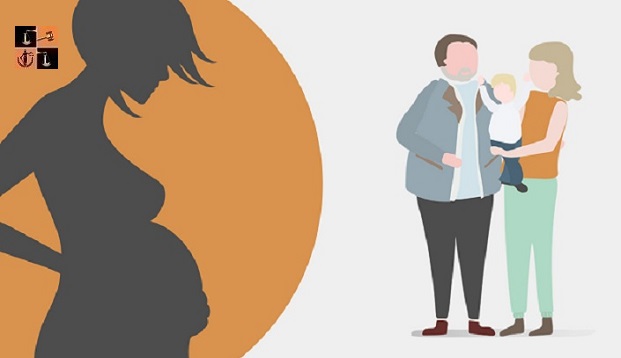
The Supreme Court agreed to examine the constitutional validity of Section 2(1)(s) of the Surrogacy (Regulation) Act, 2021, which excludes divorced men from accessing surrogacy. The petition, filed by a 45-year-old divorced man, challenges this provision as a violation of fundamental rights under Articles 14, 19, and 21. The Court will also address the broader issue of age limits in surrogacy regulations.
A writ petition was filed by a 45-year-old divorced man, challenging the provisions of the Surrogacy (Regulation) Act, 2021, which allow only widowed or divorced women between the ages of 35 and 45 to avail of surrogacy services. The petitioner, who is a single, divorced man, contends that the Act discriminates against him by denying him the right to surrogacy solely due to his gender and marital status.
The petitioner's counsel argued that the provision is a blatant violation of the constitutional principles of equality, liberty, and autonomy. The exclusion of single and divorced men, they claim, constitutes discriminatory classification without any rational basis, which is unconstitutional under Articles 14, 19, and 21. The counsel emphasized that the legislation fails to recognize reproductive autonomy as a fundamental right, citing landmark judgments like K.S. Puttaswamy v. Union of India (Right to Privacy) and Suchita Srivastava v. Chandigarh Administration (Reproductive autonomy).
The petition also referenced the judgment in Shayara Bano v. Union of India, where the Court held that laws which are manifestly arbitrary and violate the principles of equality must be struck down. Furthermore, the plea argues that the Act’s provision is rooted in outdated, patriarchal assumptions about gender roles and parenthood, which do not align with progressive constitutional principles. The petitioner highlighted that laws like Juvenile Justice (Care and Protection of Children) Act, 2015, and Hindu Adoption and Maintenance Act, 1956, allow single men to adopt children, contradicting the exclusion in surrogacy rights.
While issuing notice in the matter, the Apex Court took note of the petitioner’s argument regarding the exclusionary nature of the surrogacy provision. The Court observed that the matter raised substantial constitutional questions about gender discrimination and the right to reproductive autonomy, which require careful examination. The Bench, comprising Justice BV Nagarathna and Justice KV Vishwanathan, referred to the petitioner's claims regarding violations of Articles 14, 15, and 21, recognising the need for judicial scrutiny of such gendered exclusions.
The Court also acknowledged the evolving societal understanding of parenthood and reproductive rights, noting that the issue involves complex considerations regarding the intersection of personal autonomy and state regulation.
The Top Court has agreed to hear the petition in July and will consider whether the exclusion of divorced men from surrogacy is a violation of their fundamental rights. The matter has significant implications for reproductive rights, gender equality, and the evolving norms of family structures under the Indian Constitution.
The petitioner has sought the following reliefs:
-
A writ in the nature of mandamus to declare the exclusion of single/divorced men from surrogacy under the Surrogacy (Regulation) Act, 2021, unconstitutional.
-
To read down Section 2(1)(s) of the Surrogacy (Regulation) Act, 2021 to include divorced men for access to surrogacy.
-
Costs of the petition and any further directions the Court may deem fit.
The petition has been listed for a detailed hearing in July, where the Court will address the matter comprehensively, ensuring a progressive interpretation of reproductive rights within the Indian constitutional framework.
Picture Source :



















