









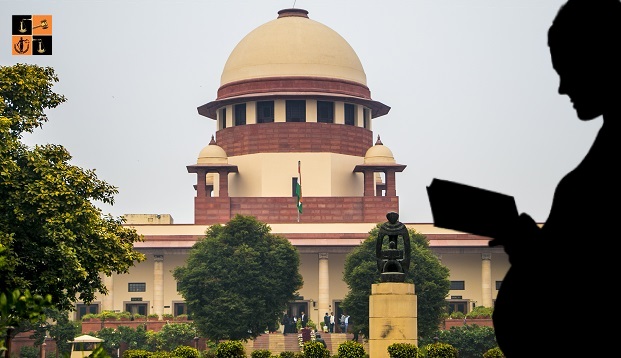
The Supreme Court recently comprising of a bench of Justices L Nageswara Rao and S Ravindra Bhat refused to stay the decision of National Law School of India University (NLSIU) Bangalore to horizontally reserve 25% of its seats for students domiciled in Karnataka from 2021-22 academic year. (State of Karnataka vs Master Balachandar Krishnan and others)
The university earlier this week had announced that it would implement the domicile reservation from the academic year 2021-22, as part of its Inclusion and Expansion Plan approved in April/May this year.
The bench refused to stay the revised admission notification issued by the National Law School of India University(NLSIU), Bengaluru, providing 25% horizontal reservation for Karnataka students.
The bench allowed the Common Law Admission Test(CLAT) to go on, as scheduled on July 23, refusing interference with the NLSIU's revised admission notification.
Facts of the case
The Karnataka government had earlier moved the top court challenging the High Court judgment which had struck down the 25% domicile reservation introduced at the university.
Senior Advocate Gopal Sankaranarayanan, appearing of a candidate, sought a stay on the NLSIU notification giving effect to the reservation policy.
The Karnataka High Court, in September last year, had quashed the NLSIU Amendment Act, 2020, through which 25% reservation was introduced for students domiciled in the state.
The High Court had held that the NLSIU Amendment Act was ultra vires and contrary to the provisions of the parent NLSIU Act. The court had said that the state government did not have the power to introduce domicile reservations at the university.
The state government has challenged this High Court judgment in the top court, claiming that the High Court erred in observing that NLSIU is not a state institution and that it is not within its control.
Contention of the Parties.
In response, Senior Advocate Gopal Shankaranarayanan submitted that there are other points in the case apart from the competence issue. The High Court also pointed out that the state had not done any study on backwardness to provide reservations for Karnataka students. The same problem, Shankaranarayanan argued, exists with the latest notification issued by the NLSIU.
He further argued that the University cannot be permitted to make "last-minute changes" in the admission criteria. In this regard, he referred to last year's Supreme Court judgment against the NLAT proposed by the NLSIU, where the Court had frowned upon the last-minute changes made by the University. "The University cannot change the rules of the game at the last hour", Shankaranarayanan argued, urging the bench to pass an interim order.
The senior counsel also highlighted that the NLSIU had a unique national character and the Bar Council of India was also involved in its establishment.
Courts Observation and Judgment
However, the bench was not persuaded to pass any interim order. The bench also turned down the prayer made by Shankaranarayanan for a posting before the date of CLAT, July 23.
The bench posted the matter to August.
The bench said, "There is no interim order. List the matter in August. The exams will go on".
When Shankaranarayan said that the issue will become infructuous by then, the bench disagreed. It said that the issue will be open to judicial examination.
Judgment will be attached as soon as it's available
Picture Source :




















