









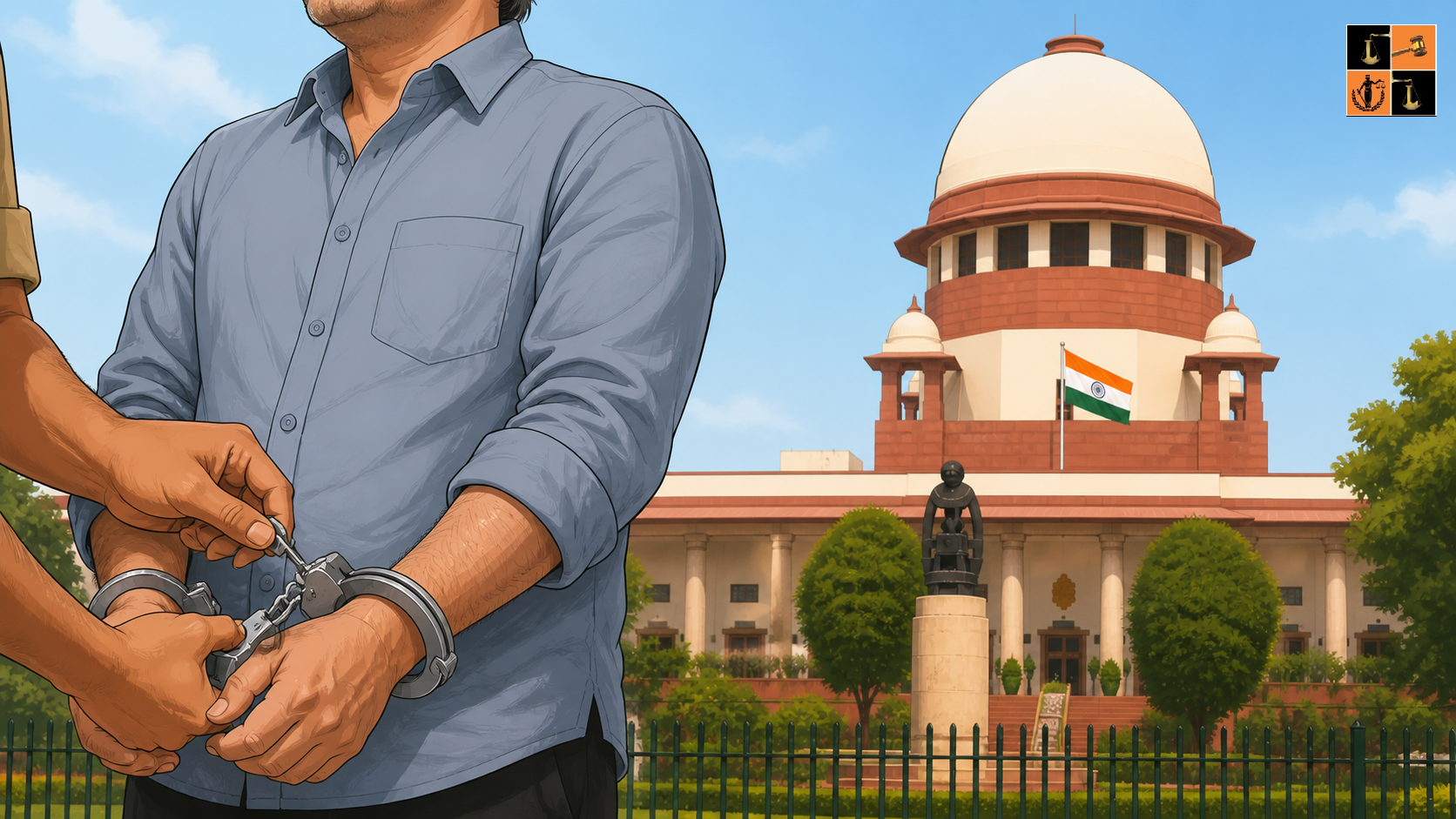
On Monday, the Supreme Court criticised its January 5 judgment denying bail to former JNU student Umar Khalid and activist Sharjeel Imam in the alleged larger conspiracy case linked to the 2020 Delhi riots, and emphatically held that “bail is the rule and jail is an exception” even in prosecutions under the Unlawful Activities (Prevention) Act (UAPA).
Apex Court underlined that the January 5 verdict failed to correctly apply the binding principles laid down by a larger three-judge bench.
Apex Court Bench of Justice BV Nagarathna and Justice Ujjal Bhuyan, while granting bail to Jammu and Kashmir resident Syed Iftikhar Andrabi in a narco-terror case investigated by the National Investigation Agency (NIA), expressed “serious reservations” about the reasoning adopted earlier this year by another two-judge bench comprising Justice Aravind Kumar and Justice NV Anjaria in the Delhi riots conspiracy case.
SC Bench stated that the January 5 verdict failed to correctly apply the binding principles laid down by a larger three-judge bench in Union of India Vs KA Najeeb (2021), which recognised that prolonged incarceration and delay in trial can override the statutory restrictions on bail under Section 43D(5) of the UAPA.
Justice Bhuyan expounded that, “Bail is not an empty statutory slogan. It is a constitutional principle flowing from Article 21, and the presumption of innocence is the cornerstone of any civilised society governed by the rule of law.”
Bench further added that, “Even under UAPA, bail is the rule and jail an exception. Bail can only be denied in a particular case depending on the facts of that particular case.”
The SC Bench of Justice Nagarathna and Justice Bhuyan held that subsequent rulings by smaller benches had progressively diluted the constitutional safeguards articulated in KA Najeeb.
Bench added that, “This case raises an important question concerning the interface between Section 43D(5) of the UAPA and the constitutional guarantee of personal liberty under Article 21...More particularly, the issue concerns the propriety of smaller benches progressively hollowing out the constitutional force of a larger bench decision without ever expressly disagreeing with it”.
Apex Court Bench referred to the Supreme Court’s 2024 ruling in Gurwinder Singh Vs State of Punjab and the January 2026 judgment in Gulfisha Fatima and connected Delhi riots cases, observing that both had taken “a somewhat divergent view” from the constitutional trajectory adopted in
The observations of Apex Court came in the course of granting bail to Andrabi, who has been in custody since 2020 in a narco-terror case registered by the NIA in Jammu and Kashmir. While the Jammu and Kashmir and Ladakh High Court had denied him bail in August 2025, citing the seriousness of the allegations and alleged links with cross-border terror operatives, the Supreme Court noted that no contraband had been directly recovered from him and that he had already undergone nearly five years of incarceration.
Source PTI
Picture Source :




















