









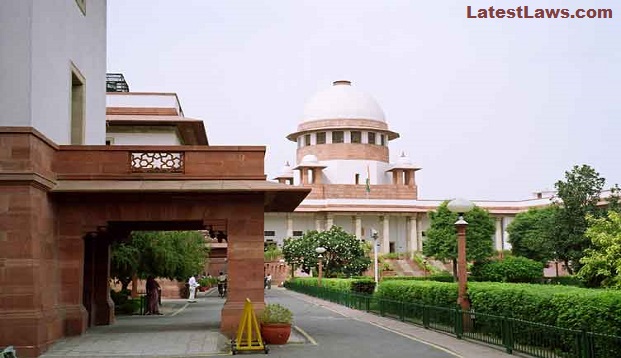
The bench comprising of Justice R.F.Nariman, Justice Aniruddha Bose and Justice V. Ramasurbramanian passed a judgement in case titled as Keisham Meghachandra Singh v. The Hon’ble Speaker Manipur Legislative assembly & Ors.
Facts of the case were that the election for the 11th Manipur Legislative Assembly was conducted in March 2017. The said Assembly election produced an inconclusive result as none of the political parties were able to secure a majority i.e. 31 seats in the Legislative Assembly of 60 seats in order to form the Government. Thirteen applications for the disqualification of respondent were filed before the Speaker of the Manipur Legislative Assembly stating that Respondent was disqualified under paragraph 2(1)(a) of the Tenth Schedule.
The Supreme Court stated that the Speaker, in acting as a Tribunal under the Tenth Schedule, is bound to decide disqualification petitions within a reasonable period.
“What is reasonable will depend on the facts of each case, but absent exceptional circumstances for which there is good reason, a period of three months from the date on which the petition is filed is the outer limit within which disqualification petitions filed before the Speaker must be decided if the constitutional objective of disqualifying persons who have infarcted the Tenth Schedule is to be adhered to.” the Court remarked.
Further the Supreme Court stated that this period has been fixed keeping in mind the fact that ordinarily the life of the Lok Sabha and the Legislative Assembly of the States is 5 years and the fact that persons who have incurred such disqualification do not deserve to be MPs/MLAs even for a single day.
The Supreme Court held that,
“It is time that Parliament have a rethink on whether disqualification petitions ought to be entrusted to a Speaker as a quasi-judicial authority when such Speaker continues to belong to a particular political party either de jure or de facto. Parliament may seriously consider amending the Constitution to substitute the Speaker of the Lok Sabha and Legislative Assemblies as arbiter of disputes concerning disqualification which arise under the Tenth Schedule with a permanent Tribunal headed by a retired Supreme Court Judge or a retired Chief Justice of a High Court, or some other outside independent mechanism to ensure that such disputes are decided both swiftly and impartially, thus giving real teeth to the provisions contained in the Tenth Schedule, which are so vital in the proper functioning of our democracy.”
The Court observed it is clear from a reading of the judgment in Rajendra Singh Rana and, in particular, the underlined portions of paragraphs 40 and 41 that the very question referred by the Two Judge Bench in S.A. Sampath Kumar has clearly been answered stating that a failure to exercise jurisdiction vested in a Speaker cannot be covered by the shield contained in paragraph 6 of the Tenth Schedule, and that when a Speaker refrains from deciding a petition within a reasonable time, there was clearly an error which attracted the jurisdiction of the High Court in the exercise of the power of judicial review.
The Court declined to decide the disqualification issue observing that the same should be first decided by the Speaker.
Read the Judgement:
Share this Document :Picture Source :




















