









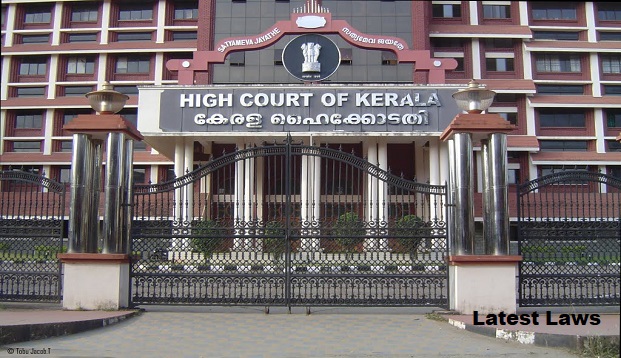
The Kerala High Court on Tuesday(02/02/2021) comprising of a bench of Chief Justice S Manikumar and Justice Shaji P Chaly quashed a state government order sanctioning two days’ leave to its employees, including teachers, who participated in a nationwide strike in January 2019.[ Balagopalan Vs. State Of Kerala]
Acting upon a public interest litigation filed by G. Balagopalan, former Director, Police Fingerprint Bureau, State Crime Records Bureau (SCRB), Thiruvananthapuram, challenging the government order. He contended that allowing the employees who took part in the strike to take leave was illegal and an abuse of power., the bench said the government order was illegal and arbitrary. The general strike was held on January 8 and 9 of 2019 in protest against policies of the Union government
The court also directed the heads of departments to scrutinise the attendance registers, and take action, in accordance with law, within two months from the date of receipt of a certified copy of the judgment.
Facts of the case
Petitioner, a practicing advocate, has filed the instant public interest writ petition challenging G.O.(P) No.1/2019/GAD dated 31.01.2019, whereby permission was accorded to grant eligible/casual leave to the Government employees and teachers, who had not attended duties during nation-wide general strike. He has sought for the following reliefs:
i. “To issue a writ of certiorari or other appropriate writ, order or direction, quashing Exhibit-P1 Order - G.O(P) No.1/2019/GAD dated 31.01.2019.
ii. To declare that permitting casual leave or other eligible leave to the State Government employees and teachers and to disburse salary after absent from service of a general strike against the Central Government is illegal and unconstitutional.
iii. To issue a writ of mandamus or other appropriate writs, order or direction, commanding the respondents 1 to 3 to not to extend any kind of leave to the employees and teachers, who took part in the general strike by absenting themselves from duties by the issuance of Exhibit-P1 or other similar orders.”
Contention of the parties
Petitioner has submitted that respondent No.2 has issued Exhibit-P1 order dated 31.01.2019, allowing the Government employees and teachers to avail casual leave or other eligible leave for 8th and 9th of January, 2019, the days on which they were absent from duty, without availing leave as a part of National General Strike.
Petitioner has further submitted that the Joint Committee of trade unions, including INTUC, AITUC, HMS, CITU, AIUTUC, TUCC, AICCTU, SEWA, LPF and UTUC, except BMS, have called for a General Strike/Bharath Bandh against the policies of the Central Government for two days from 8th to 9 th January, 2019. Pursuant thereto, the organised trade unions blocked the rail and road. Petitioner has contended that those who opposed the general strike in Government service, made their signatures in the attendance register and enjoyed eligible salary in the month of January
Learned Senior Government Pleader has relied on the decision in Directorate of Film Festivals and Ors. v. Gaurav Ashwin Jain and Ors. [(2007) 4 SCC 737] to contend that no contentions were raised in the writ petition to the effect that Exhibit-P1 violates any of the constitutional or statutory provisions.
Learned Senior Government Pleader further submitted that petitioner has not placed any material before this Court to show that there was a strike called by the Government employees except the fact that trade unions had called for the strike. Therefore, the court cannot proceed with a presumption that there was a strike called by the Government employees and that the employees had participated in the strike called by the trade unions.
Courts Observation and Judgment.
Referring to Kerala Service Rules and other conduct rules, the bench noted that if any Government servant indulges in strike, he is liable to proceed in accordance with the provisions of the said rules.
However, quite contrary to the provisions of law, Government have issued Exhibit-P1 notification absolutely protecting the interests of the Government employees, who had struck work. It is not reflected in the said Government order, as to whether the Government have made necessary inquiries on the basis of the appropriate Government orders, as stated in the counter affidavit of the 2nd respondent. It is not spelt out in Exhibit-P1 Government order that leave would be granted to eligible persons alone, but on the other hand, it clearly specifies that orders are being issued for permitting grant of eligible leave, including casual leave to the Government employees and teachers, who have not attended the offices, in relation to the WP(C):5752/2019 56 national general strike on 8th and 9th of January, 20.
it can be deduced from the statutory provisions dealing with the prohibition of Government servants participating in strike, and the decisions cited supra, that the Government servants had struck work in violation of the rules/notifications/ circulars issued by the State Government affecting the normal life of the public and public exchequer, and it is also clear from the proposition of law laid down by the Hon'ble Apex Court that even hough right to form association is a right guaranteed under Article 19(1)(c) of the Constitution of India, there is no legal right for the workers/ such associations, to call for a general strike or instigate the employees to strike, in the guise of the said fundamental right. Apparently, consequent to the strike of the Government servants and others, the offices came to a standstill for two days and the public had suffered substantially on account of the same.
The bench also rejected the submission that the grant of leave to the employees, who had not attended for duty on the day of strike called by trade unions is a policy decision of the Government and that no writ is maintainable challenging the said policy. In this regard, the court said:
"We do not think that Government are at liberty to take any policy decision in absolute violation of the rules in vogue and the proposition of law laid down by the Hon'ble Apex Court in regard to the illegal strike of the Government servant...The government cannot take shelter under the guise of a policy decision taken by them. Moreover, it is not an absolute rule that Court cannot interfere with the policy decisions taken by them. Moreover, it is not an absolute rule that Court cannot interfere with the policy decisions of the Government. Even if it is a policy decision, Court can look into the legality, correctness or arbitrariness of the same, and interfere, by exercising the power under Article 226 of the Constitution of India, if such a policy is against the statutory provisions."
Read Judgment @Latestlaws.com
Share this Document :Picture Source :



















