









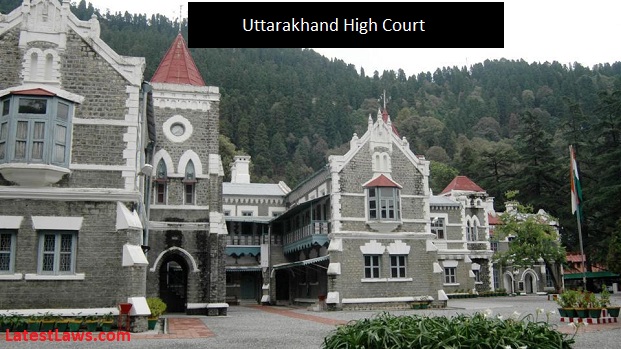
Recently, the Uttarakhand High Court confronted allegations arising from a near-lynching incident where a social-media broadcast allegedly fuelled communal tension under the pretext of cow protection. The Bench, led by Chief Justice G. Narendar and Justice Subhash Upadhyay, examined the petitioner’s plea to quash the FIR and shield him from arrest, ultimately refusing to intervene after finding that his conduct and subsequent evasiveness disentitled him to relief. The Court’s remarks, particularly its censure of the petitioner’s social-media post declaring that he would start a “Kranti”, formed a central part of its reasoning.
The case arose from a challenge to an FIR registered under Section 109 and Section 190 of the Bharatiya Nyaya Sanhita, 2023, concerning a mob attack on a vehicle transporting buffalo meat. The police had received an emergency call reporting that activists were assaulting the driver; officers reached the spot without delay and prevented an attempted lynching. Although the victim’s documents confirmed the meat to be buffalo meat, the petitioner was alleged to have circulated unverified claims suggesting cow slaughter and streamed the incident live on Facebook, which purportedly prompted a large mob to assemble.
The case further stemmed from the petitioner’s repeated non-cooperation with the investigation. Despite the investigating officer issuing several notices calling upon him to join the probe, he failed to appear, resulting in the issuance of a Non-Bailable Warrant and the initiation of proceedings under Section 84 BNSS to declare him an absconder.
The Petitioner submitted that he was an animal lover who had only informed authorities about suspected illegal transportation of meat and had attempted to calm the crowd. He claimed the FIR was motivated and based on hearsay, asserting that the complainant, the wife of the injured driver, was not an eyewitness. He further argued that his live broadcast showed him trying to pacify the mob, not instigate it, and maintained that naming him in the FIR was a malicious act linked to local political rivalry.
The State opposed the petition, asserting that the petitioner was instrumental in inflaming the situation through “false and unverified claims” during the Facebook Live broadcast. It stressed that he had deliberately evaded investigation despite repeated summons and the NBW issued by the Magistrate. The State placed on record detailed reports of the Circle Officer, which documented the petitioner’s role and noted that his videos had circulated widely, drawing large crowds from both communities to the police station.
It was further submitted that 16 individuals had been identified in the case, 13 arrested, and three, including the petitioner, continued to evade arrest.
After reviewing the record and the Circle Officer’s reports, the Court found no basis to interfere with the FIR or halt the investigation. It noted that the petitioner admitted being present at the scene and admitted the Facebook Live broadcast. Photographs on record showed “bleeding injuries on the head and other parts of the body of victim,” making the allegations serious enough to warrant a full investigation.
The Bench emphasised that at the FIR stage, it would be improper to test the correctness of the allegations, stating that “the provisions of Section 35 of the BNSS, 2023 clearly enumerate as to when a person can be arrested. In the event of any violation he can certainly approach the courts immediately. It would be preempting the fair investigation if the hands of the police are tied down, more so, when the petitioner himself admits his presence in the place of occurrence.”
The Court also took note of a Facebook post produced by the complainant, where the petitioner declared that he was going to start a “Kranti,” observing that “In other words he is deriding popular & democratically elected governments and the same is condemnable.”
Lastly, finding no grounds to quash the FIR or grant interim protection from arrest, the Bench dismissed the writ petition. It held that the petitioner’s conduct, including evading investigation and the subsisting NBW, barred him from any discretionary relief. Concluding the matter, the Court ruled that "the petition does not merit consideration and is, accordingly, rejected.”
Case Title: Madan Mohan Joshi Vs. State of Uttarakhand and Ors.
Case No: Writ Petition (CRL) No. 1389 Of 2025
Coram: Hon’ble Chief Justice G. Narendar and Hon’ble Justice Subhash Upadhyay
Advocate for the Petitioner: Adv. Lalit Sharma, Adv. Anmol Sandhu
Advocate for the Respondent: DAG J.S. Virk, Advs. R.K. Joshi, Ayush Gaur and Mrinal Kanwar
Read Judgment @Latestlaws.com
Picture Source :




















