









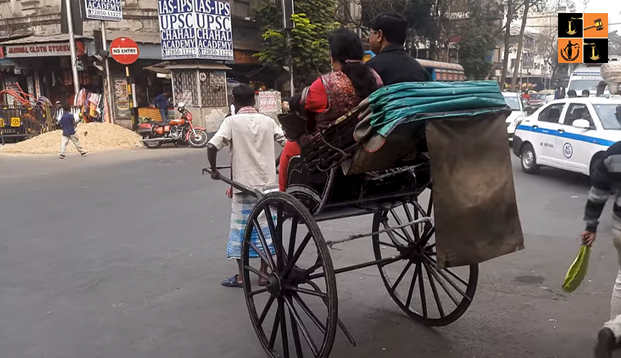
On Wednesday, in a significant ruling that affirms the constitutional promise of dignity and social justice, the Supreme Court directed the Maharashtra government to phase out the use of hand-pulled rickshaws in the eco-sensitive hill town of Matheran, branding the practice as inhuman and incompatible with the values of a modern, democratic society.
A bench comprising Chief Justice D.Y. Chandrachud, Justice K. Vinod Chandran and Justice N.V. Anjaria observed that permitting such a regressive form of human labour “belittles the constitutional promises of social and economic justice.” The Bench took a stern view of the continuation of manual rickshaw pulling nearly eight decades after India’s independence. While referring its earlier judgment in Azad Rickshaw Pullers Union v. State of Punjab, the Court criticised the fact that “it is really unfortunate that 45 years after the observation made... the practice of a human being pulling another human being is still prevalent in the town of Matheran.”
The issue of hand-pulled rickshaws in Matheran has been under legal examination since 2022, when the State was first permitted to test the feasibility of introducing e-rickshaws within the hill station’s eco-sensitive zone. This prompted resistance from certain local groups, including horsemen associations, who opposed mechanisation, fearing loss of employment and ecological harm. Over the course of hearings, the Apex Court had issued several interim orders, allowing pilot e-rickshaw projects, limiting their numbers to 20, and directing that licenses be reserved for original cart pullers.
In its latest ruling, the Court has taken a decisive step in striking down a relic of colonial-era transport practices and replacing it with a humane, environment-friendly, and constitutionally sound alternative.
In a strongly worded observation, the Court emphasised, “To continue such human practice even after 78 years of independence and after 75 years of the Constitution being enacted and promising social and economic justice to its citizens... would be betraying the promise given by the people of India to themselves.” The Bench held that manual rickshaw pulling is not just outdated but a “violation of the right to dignity” and must be abolished immediately.
While acknowledging concerns over the livelihoods of existing rickshaw pullers, the Court directed the State of Maharashtra to adopt a policy modelled on Gujarat’s Kevadia e-rickshaw scheme, under which the government would purchase e-rickshaws and provide them on hire to genuine hand-pull cart workers. The Bench made it clear that financial constraints could not justify inaction, stating, “Non-availability of funds cannot be an excuse for non-implementation of the aforesaid scheme. We earnestly hope that the state would tender necessary assistance in stopping such an inhumane practice.” The Court also emphasized that the ecological sensitivity of Matheran must be preserved, noting that automobiles are already prohibited in the region, except in emergencies. It observed that e-rickshaws, being environmentally friendly, offered the most suitable alternative.
In its directions, the Court ordered a complete ban on hand-pulled rickshaws within six months of the judgment and mandated the adoption of an e-rickshaw scheme on the lines of Kevadia, Gujarat. It permitted the laying of paver blocks only up to the Shivaji Statue from Dasturi Naka (bus stand), prohibiting their use on internal or trading routes. A Monitoring Committee headed by the Matheran Collector has been tasked with identifying genuine rickshaw pullers and determining the number of e-rickshaws required, with any remaining vehicles to be allotted to tribal women and others to promote livelihood opportunities. The Court further directed that existing concrete blocks be replaced with paver blocks.
Picture Source :




















