









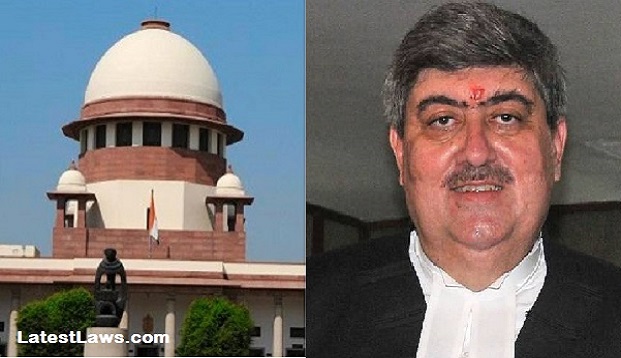
On Sunday, Supreme Court Judge, Justice Sanjay Kishan Kaul spoke on the peril of Fake News and its derivatives at an online lecture organised by Madras Bar Association.
Opening the lecture, Justice Kaul remarked:
Adressing the Fake News issue, Justice Kaul stated that fake news propagation & misinformation can be attributed to the advancement of platforms due to technological advances. He added that the challenge of fake news has intensified in times of the pandemic.
"Fake news is more dangerous than the Coronavirus itself. Its ramifications are manifold" , Justice Kaul said.
While highlighting the relevant need to inculcate "tolerance", Justice Kaul stated that "a section which calls another intolerant becomes intolerant themselves".
He commented:
"In the last number of years, the tolerance levels in various sections have started going down."
He said that labels such as 'Urban Naxals' and 'Modi-Bhakts' are used to categorize people holding on to different view points. He believed that such tendencies was killing the space for free discussion of ideas.
"We have to understand and appreciate another's point of view without agreeing with it. What is perceived as the middle path becomes a casualty. The shades of grey suffer. You get into only blacks and whites." , said Justice Kaul.
Justice Kaul, who has authored judgments upholding the right of artistic freedom in the cases of M F Hussain (in Delhi HC) and Perumal Murugan (as judge of Madras HC), quoted "If you do not like a book, throw it away,"
Next,Justice Kaul went on to clarify that Constitution-makers never envisaged the propensity of Fake News futuristically as been caused by the new-age media in the present times.
He said that mindless forwarding of whatsapp messages, without verifying or application of mind has led to a state of affairs where no responsibility can be bestowed for such dissemination.
He then emphasised on the difference between the responsibilities of the press and social media, Justice Kaul stated that while the press can be held accountable for dissemination of misinformation, the same may not be possible with social media.
He stressed:
The need for regulatory legislations was pointed out by Justice Kaul to handle platforms. He said that he was not in favour of Government centric regulations to deal with misinformation on social media platforms.
Justice Kaul made space to speak on the issue of Trolling on Social Media and the rising demands for 'Instant Justice'.
He said:
He higlighted that Hate-speech is also a cause of concern and then went on to state that the trend seems to be of calling out the Government for every measure being taken.
Justice Kaul while answering a question on the thin line of difference between criticism of the Government and sedition, said that calling out the Government for its policies doesn't amount to sedition.
He remarked:
"Thin line starts when concerted groups get into a campaign of spreading misinformation. A calls B intolerant. Truth is A is equally intolerant."
He also left some advise to people to apply rationale before responding or sending out any information.
"If possible count to 10 before you respond to anything. More thinking and responsible citizens should help in this process.When thinking and educated people don't apply their mind and go to extremes, the problems arise" he said.
Talking aboute the criticism of judiciary, Justice Kaul also said that when imputation and gradings are made with respect to the judiciary, it will damage the institution.
He said:
"Criticism of a view point, of a judgment is okay, there is no problem. But when imputations and gradings are made, I think we damage the very institution. That will be a case of 'after me deluge' thinking."
Picture Source :


















