









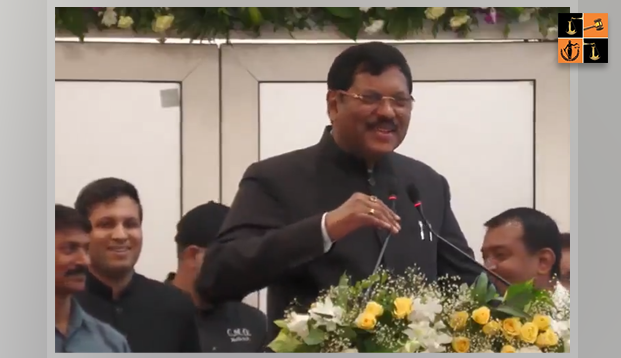
Delivering a forthright address at the 22nd Convocation of NALSAR University of Law, Hyderabad, Chief Justice of India Justice Bhushan Ramkrishna Gavai issued a powerful call for mental health awareness, urging new entrants to the legal profession to embrace vulnerability, seek support, and reject the pressure to appear invulnerable in a profession that is both intellectually demanding and emotionally exacting.
Justice Gavai described the law as “a noble profession” but cautioned the graduating batch that it is “never easy” and offers “no straight path or guaranteed returns.” He emphasised that young lawyers will find themselves in a constant state of scrutiny, externally and internally. “You will be measured constantly, not just by judges and clients, but often by your own inner voice. You will question your path. You will be questioned. You will be overlooked. You will feel invisible. And yet, you will keep showing up,” he said.
With rare frankness for a ceremonial address, the Chief Justice turned the spotlight on the profession’s emotional toll. “This profession can be isolating and emotionally taxing. The hours are long. The expectations, high. The culture, sometimes ruthless. You will feel pressure not just to succeed, but to appear successful,” he said.
Calling on students to reject silence, he added, “Many hide their struggles. I urge you not to. Find your community.” He advised the fresh graduates that “self-care is not a luxury. It is a strategy.”
To reinforce the importance of emotional well-being, Justice Gavai drew on diverse literary and philosophical sources. He quoted Bell Hooks and said, “Rarely, if ever, are any of us healed in isolation. Healing is an act of communion.” He further invoked Audre Lorde and stated, “Caring for myself is not self-indulgence, it is self-preservation, and that is an act of political warfare.” Further. referencing Sigmund Freud, he warned, “Unexpressed emotions will never die. They are buried alive and will come forth later in uglier ways.”
Justice Gavai urged students to challenge rigid expectations of what a lawyer ought to be. “Strength is not always measured in decibels. It lies in clarity, in insight, in depth… There is no single mould for what a lawyer should be. Make room for your own rhythm. There is enough space in this profession for many ways of being,” he said. He also cited Susan Cain’s advice to introverts that “Spend your free time the way you like, not the way you think you're supposed to.”
Turning to structural challenges within the legal profession, Justice Gavai addressed entrenched inequalities that shape career trajectories. Referring to the 2023 study The Making of Lawyers’ Careers: Inequality and Opportunity in the American Legal Profession, he drew parallels with Indian legal practice. “A student from a National Law School in a metro city may be seen as 'better placed' than one from a smaller university, not necessarily because of skill, but because of perception. This is unfair. But it is real. We need to confront it, not accept it,” he stated.
The CJI stressed the indispensable value of mastering legal fundamentals. “There is no shortcut to knowing the law. The Constitution, the Contract Act, the Code of Civil Procedure, the criminal law, and other core subjects are not optional subjects,” he said, urging consistency in learning, especially in the face of technological disruptions like artificial intelligence and data privacy.
Justice Gavai placed particular emphasis on mentorship as a structural necessity in legal education and practice. “Mentorship is not a favour. It is a responsibility,” he said. Recounting his own experience, he added, “Someone opened a door for me, someone who saw something in me before I could see it in myself. That act of belief, of support, of sharing wisdom changed my life.”
He urged graduating lawyers to not only seek mentors for their integrity, but also become mentors themselves. He stated, “That is how we build not just careers, but a community of care within the profession, one that uplifts, not one that intimidates.”
The Chief Justice also addressed the aspirational trend of pursuing foreign LL.M. degrees, cautioning against peer pressure and unsustainable educational debt. “Do not put yourself or your family under the burden of loans amounting to 50–70 lakhs just for a foreign degree,” he said. He encouraged students to base such decisions on clarity, not compulsion. “Do not mistake urgency for progress… There is no age bar to learn.”
He linked this issue to the broader need for institutional reform. “Many who study abroad come back with renewed passion and fresh perspectives, but when they return, they often find our institutions unwelcoming, under-resourced or closed to new ideas,” he noted. According to the Chief Justice, the way forward lies in cultivating “nurturing academic environments, transparent and merit-based opportunities, and ethical workplaces.”
Justice Gavai highlighted the need for investment in mentorship programmes, research fellowships, policy labs, and legal innovation ecosystems. “We need to invest not only in institutions but in imagination,” he said. Referring to Judge Jed S. Rakoff’s book Why the Innocent Plead Guilty and the Guilty Go Free, Justice Gavai remarked, “Even though I conclude that our legal system is in bad need of fixing, I remain cautiously optimistic that my fellow citizens will rise to the challenge.”
He concluded the address with deeply personal guidance. He stated, “Never ignore the five things in life: friends and family, books, hobbies, health, and imagination.” Stressing that health requires sustained attention, he quoted psychologist Dr. Rajiv Mehta and said, “The idea of regular medical check-ups has still not become a routine part of our daily lives.” Finally, Justice Gavai reminded the audience that law is not a sterile profession. “It is a living, evolving space of ideas, emotions, and hope.”
Picture Source :




















