









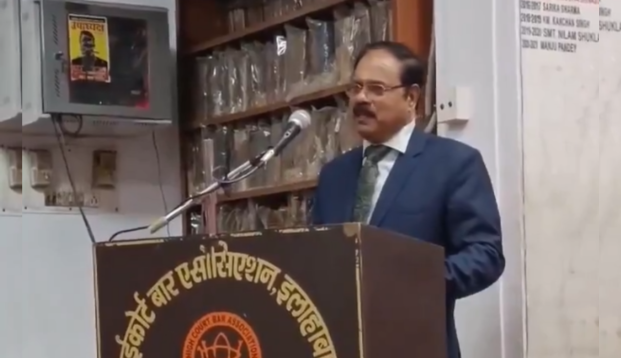
In a firm defense of his controversial statements made during a Vishwa Hindu Parishad (VHP) event, Justice Shekhar Kumar Yadav of the Allahabad High Court has denied allegations of violating judicial conduct. His comments, which sparked national attention and parliamentary uproar, were made during a speech at the VHP's legal cell on December 8, 2023. In response to concerns raised, including complaints to the Supreme Court and the Allahabad High Court, Justice Yadav has reiterated that his remarks were aligned with constitutional values.
Addressing the Chief Justice of the Allahabad High Court in a letter, Justice Yadav stated that his speech was a personal expression of thoughts on societal issues and emphasized that it was not intended to foster hatred toward any community. He said, “My speech was an expression of my thoughts on societal issues consistent with values enshrined in the Constitution, and not to create hatred towards any community.”
Justice Yadav, who was summoned by the Supreme Court collegium last month, rejected claims that he had breached judicial conduct. He accused those criticizing him of distorting his words for vested interests. Notably, in his letter, he pointed out that judges, who cannot publicly defend themselves, need to be shielded by senior colleagues, suggesting a need for institutional support.
The controversy originated from a speech in which Justice Yadav addressed the issue of the Uniform Civil Code (UCC), describing it as a "Hindu versus Muslim" debate, wherein he criticized certain Muslim practices, particularly polygamy. "You have a misconception that if a law (UCC) is brought in, it will be against your Shariyat, your Islam and your Quran," he remarked. "But I want to say one more thing. Whether it is your personal law, our Hindu law, your Quran or whether it is our Gita, as I said, we have addressed the ills (buraaiyan) in our practices… kamiyan thi, durust kar liye hain (the shortcomings have been addressed)."
The remarks, which involved sensitive religious topics, led to complaints about their potential to stoke communal tensions. Furthermore, one of his orders related to cow protection also attracted scrutiny, with critics questioning his position on the issue. Justice Yadav responded to these concerns, stating that cow protection represents cultural values deeply embedded in society and acknowledged by law. He emphasized that supporting this cause does not breach the principles of justice, fairness, or impartiality. "Supporting legitimate and rightful sentiment in favour of cow protection cannot be read as violating the principles of justice, fairness, integrity and impartiality," he explained.
While Justice Yadav’s position has sparked political discourse, legal experts note that the Supreme Court Collegium does not possess the power to directly influence the non-judicial actions of a High Court judge. Former Law Secretary P.K. Malhotra remarked that while the SC Collegium can withdraw a judge from active cases, it has no authority over their personal statements.
Supreme Court and High Court judges have constitutional protection, which requires a lengthy and complex procedure for removal, as outlined under Article 124(4) of the Constitution. This provision mandates that judges can only be removed on grounds of proven misconduct, through a parliamentary process supported by a significant majority.
In this case, Justice Yadav’s remarks do not appear to involve allegations of corruption, which distinguishes his situation from previous instances where judicial removal motions were pursued.
Picture Source :




















