









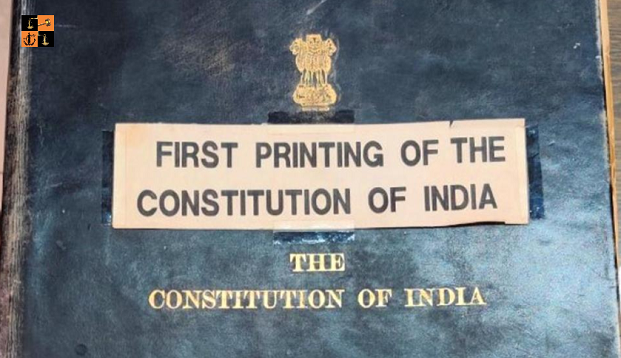
The Dehradun-based Survey of India which printed 1,000 initial photolithographic reproductions of the handcrafted Constitution has preserved one of those copies, but it sold the 2 machines that produced those in 2019. As scrap. For Rs 1.5 lakh.
Survey of India (SoI) officials said, as for the lithographic plates, they were also “auctioned to scrap dealers long ago".
The 2 printing machines, the Sovereign & Monarch models manufactured by UK’s RW Crabtree & Sons, used to print the initial copies of the Indian Constitution, were dismantled & sold in 2019, the officials added. A visit to the facility could only unearth a lubrication schedule for the Monarch on one of the walls.
The 1,000 copies were printed in SoI’s Northern Printing Group office located in Hathibarkala area of Dehradun, from the 2 original handwritten copies, using lithograph printing. Calligrapher Prem Behari Narain Raizada (Saxena) wrote the Constitution in English & Vasant Krishna Vaidya wrote it in Hindi. The handwritten copies were illustrated by artists Nandalal Bose, Beohar Rammanohar Sinha, & other artists from Santiniketan.
The 1st printed copy was hardbound & is safe in a cupboard of the Northern Printing Division.
However, Lt Gen Girish Kumar (retd), Surveyor General of India, said that the cost of maintaining the 2 lithographic printing machines was very high & the technology was outdated. He added that the machines were dismantled & auctioned at scrap value. The news agency couldn't access the details of the buyers.
Lt Gen Girish Kumar said, “Nowadays with this [current] technology you just cannot use those machines because they are very expensive in working… We definitely take pride in being the premier institution to have printed the first thousand copies of the Indian Constitution, & understand the historical importance of it, but these machines were very big & occupied a lot of space. Also, they were old & conventional, & it took a lot of time to work on".
Kumar added that the Survey of India has “completed 252 years”, which means “ we have a lot of historical legacy & if we start preserving everything like this, the entire department will have a lot of old things”.
To be sure, he added, “we take pride in doing such historically relevant things but then we have to move on…”
However, Survey of India is now working on a museum for the printing division where artifacts, replicas of the machines, & photographs of historically relevant events will be kept, according to Lt Gen Kumar.
Gen Kumar added that “We will be displaying similar printing machines on which Constitution was printed. Printing is not done on one specific machine, it can be done on two-three machines also. So similar machines will be on display & we will give the information along with [details of ] how the Constitution was printed using such kinds of machines".
The Survey of India reprinted copies of the Constitution using the latest technology in 2003-04 & 2018, following requests from the Central Govt, he explained.
Describing how Survey of India, Dehradun, was selected for the honour of printing the Constitution, Pankaj Mishra, the superintending surveyor (technical secretary), Survey of India , said that the project was given to the Dehradun branch because the latest printing equipment was available there in those days.
Mishra said that “Our Eastern Printing Group or Kolkata branch is the oldest one in the history of Survey of India; it was established sometime in the 1840s. It published India’s first postal stamp. When the matter of printing the Constitution came up, the latest printing equipment was available with the Northern Printing Group here. So, it was suggested by then senior officials that it should be printed here".
Madhukar Tiwari, manager at the Northern Printing Group, said that when it came to the actual printing, eight pages were printed in one go in the lithographic printing machine & that this was then cut into single pages & stitched together.
He added, the plates used were “auctioned to scrap dealers long ago".
Tiwari said that “We have some of the lithographic plates made of zinc & aluminium that were used for making different types of maps, but none of the plates that were used in printing Constitution are available now. Those plates were auctioned long ago…".
Seema Bhattacharya, a senior reprographer with the Northern Printing Group, said: “The image & written material on the lithographic plate would anyway not be visible now, because being metal, the plate gets oxidised over the years due to atmospheric effects like humidity or if it comes in contact with moisture.”
Source Link
Picture Source :



















