









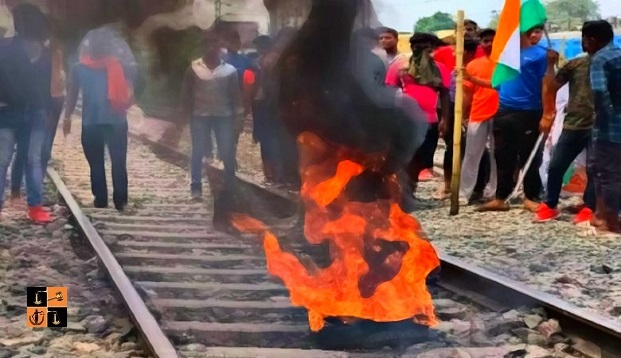
The Calcutta High Court Bench of Justice Shampa Sarkar while dealing with the plea of one Vineet Ruia, who is the president of an organization known as Bharat Bachao Sangathan who wished to hold protests against the private unaided schools that are charging exorbitant fees, ordered that Right to Protest can neither be asserted nor practiced in the vacuum.
Background and submissions:
In the present Plea Petitioner alleged police inaction.
The petitioner claims to be the president of an organization known as Bharat Bachao Sangathan. According to the petitioner, the private unaided schools are committing robbery in broad daylight by charging exorbitant fees. The petitioner had approached the Chief Minister of the State of West Bengal with a request that regulatory steps against the private unaided schools, be taken.
As a protest, the petitioner wishes to assemble along with some parents in front of the metro channel at Dharmatala.
Petitioner stated that a prayer was made before the Officer-in-Charge, Hare Street Police Station, for the necessary permission. The petitioner wanted to undertake the protest for 30 days, beginning from June 24, 2022, with a further option to extend the period.
Submissions by Police Authorities:
The police authorities submitted that assembly near the metro channel could not be allowed as it would hamper the smooth movement of the vehicles. The area is extremely populated and is busy. It is also the business hub.
It was next submitted that a crowd of 40,000 to 50,000 protestors cannot be handled for 30 days or more by the police authorities, and as such permission cannot be granted.
Observation of the Court:
The court considered the petitioner’s primary question with regard to the fees and the non-compliance of statutory obligation by the private schools. It was observed that a vague statement that a protest for 30 days or more having an assembly of 200 to 50,000 people would be organized, cannot be the basis for issuance of a writ of mandamus upon the police.
The order stated that,
"How the petitioner is interested in such an issue, who are the persons whose cause he is espousing, and whether such protest would be in the aid of securing social justice or not, is neither pleaded nor urged.
The right to protest has been accepted as a part of the right to freedom of speech and expression, but the Court is not convinced about the intention of the petitioner. Such right can neither be asserted nor practiced in a vacuum. There Has to be a social cause and not a personal agenda."
It was highlighted by the Court that It is evident from the pleadings, whether the petitioner is protesting on behalf of a certain class of parents or students.
These Vague and insufficient pleadings do not impress the court. Moreover, it is well settled that the authority can impose regulatory measures and the police authorities are of the view that Dharmatala, Metro Channel cannot be the location for a protest which would carry on for more than a month, with an expected crowd between 200 to 50,000 persons.
Moreover, when the schools are not before the Court, passing an order of such nature would amount to permitting negative demonstration against the parties, who have not been able to justify their stand before the Court.
Lastly, the Court relied on the Supreme Court's decision in Amit Sahni Versus Commissioner of Police and Ors. reported in (2020) and held that it is within the domain of the administration to take a decision to regulate and impose reasonable restrictions on the request of the petitioner to hold the protest on a public street. Harassment to the commuters and the businessmen operating from the area in question, cannot be permitted nor can the petitioner paralyze the activities in the main business area of the city, in the name of a protest.
Accordingly, the writ petition is disposed of.
Case Title - Vineet Ruia VS The State of West Bengal & Ors.
Picture Source :



















