









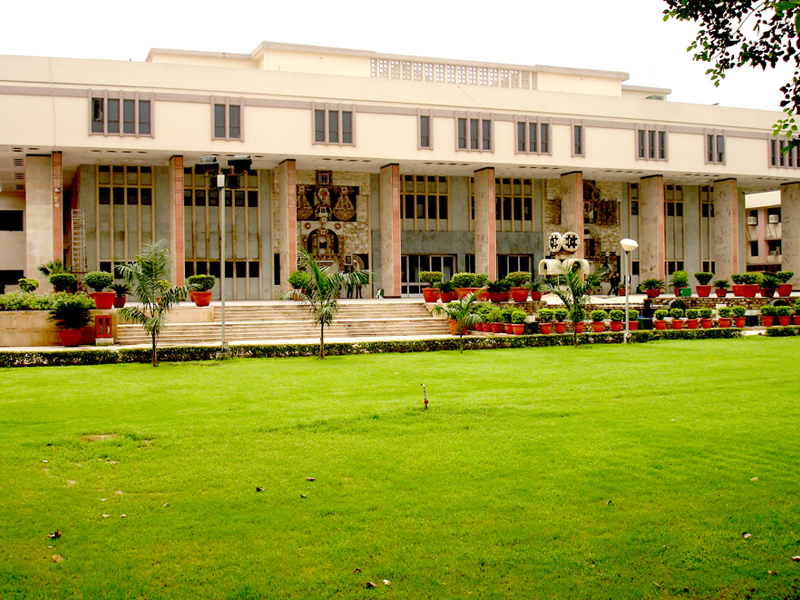
The Single Bench of the Delhi High Court in the case of Apurv Shankar vs Union of India & Ors. consisting of Justice V. Kameswar Rao observed that the petitioners/appellants who have a medical qualification from an institute which is recognised u/s 12 and included in the second Schedule of the Indian Medical Council Act, 1956 (“the Act”) can be subjected to the Screening Test postulated by the sub-section 4A of the Section 13 of the Act.
Facts
An email was sent by the respondent No.2, (National Medical Commission (“NMC”)), via which it rejected the application of the petitioner seeking permission to appear in the Screening Test conducted by the respondent No.3 (National Board of Examinations in Medical Sciences). The primary reason for the rejection was that the petitioner had obtained only 47.83% marks in Physics, Chemistry and Biology taken together in the 10+2 examination and as such could not have been granted the Eligibility Certificate for the Screening Test, in view of the provisions of the Act read with the statutory regulations made there under.
Contentions Made
Appellant: The institution from which the petitioner pursued an MBBS course came u/s 12 read with second Schedule of the Act. The MCI vide Press Note clarified that the requirement of Eligibility Certificate as well as Screening Test would “henceforth” be applicable to all the colleges, whether recognised u/s 12 or 13 of the Act. The petitioner secured the admission much before the Press Note was released, before which, it was only those persons from institutions falling under third Schedule read with Section 13 of the Act who were required to appear in the Screening Test. The eligibility criteria for admission in MBBS course in India stipulated certain percentage of marks in Physics, Chemistry and Biology in aggregate, excluding Mathematics, English or any other subject or any other eligibility criteria for persons from the colleges in a foreign country is arbitrary and irrational as well as ultra vires the constitutional provisions. The action of the Regulatory Body in India in imposing the above said conditions is unconstitutional, being hit by extra-territorial operation of the regulations, apart being hit by the vires of Section 12 of the Act as well as Articles 14 and 19 of Constitution of India.
Respondent: The petitioner had only obtained 47.83% marks in Physics, Chemistry and Biology taken together in 10+2 examination and not 50 % marks as required under the statutory regulations, and as such, could not be considered eligible for admission to MBBS course in India. Due to such lack of eligibility, the petitioner could not have been issued the Eligibility Certificate to sit in the Screening Test.
Observations of the Court
The Bench observed that the MCI is empowered to enter into negotiations with the authority in any country outside India which by law of such country is entrusted with the maintenance of a register of medical practitioners, for settling a scheme of reciprocity for the recognition of medical qualifications. Once such a scheme is settled, the Central Government is authorised to amend the Second Schedule to include therein the medical qualification which the Council has decided should be recognised.
Seeing the serious aberrations in the standards of medical education available in some of the foreign countries, it was decided to make a provision in the Act to enable the MCI to conduct a screening test to satisfy itself regarding the adequacy of knowledge and skills acquired by citizens of India who obtain medical qualifications from universities or medical institutions outside India before they are granted registration to practise medicine in India.
Judgment
So, the petitioner was necessarily required to be eligible for admission to an MBBS course in India, i.e., he should have possessed 50% marks in Physics, Chemistry and Biology taken together for him to be issued the Eligibility Certificate to sit in the Screening Test. The petitioner, admittedly having only 47.83% marks in the three subjects, was ineligible for admission to an MBBS course in India, and as such, could not have been issued the Eligibility Certificate to enable him to sit in the Screening Test. The present petition, being devoid of merit, was dismissed.
Case Name: Apurv Shankar vs Union of India & Ors.
Citation: W.P.(C) 8069/2021
Bench: Justice V. Kameswar Rao
Decided on: 20th April 2022
Read Judgment @Latestlaws.com
Picture Source :



















