









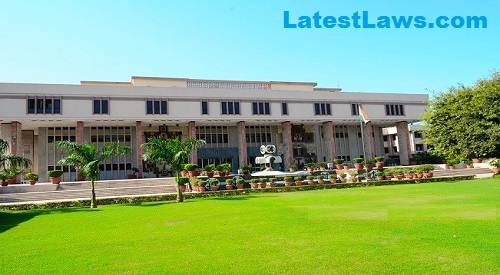
High Court of Delhi was dealing with petition filed by the plaintiffs under Order XII Rule 6 CPC seeking judgment on admissions against the defendants and the application filed by the plaintiffs under Order VII Rule 14 read with Section 151 CPC for filing additional documents.
Brief Facts:
The plaintiffs have filed the suit seeking recovery of possession, mesne profits, permanent and mandatory injunction against the defendants in respect of a property. The suit property was originally owned by late Sudhir Kumar Tyagi, who was expired. It was claimed that the suit property had come into the share of Sudhir Kumar Tyagi on the basis of a partition. The defendants requested Sudhir Kumar Tyagi to allow them to open a gym in the hall of the suit property and he agreed. The defendants at times have paid some amount but there was no regular payment. Thus, the defendants are in possession of the suit property only as the licensee of late Sudhir Kumar Tyagi and now the plaintiffs. The plaintiffs had asked the defendants to vacate the suit property but the defendants refused to vacate the same. Despite the occupation of the suit property by defendants, Sudhir Kumar Tyagi had retained in his possession an office/room, latrine, kitchen and a storage room near the northern side of the suit property towards the MCD Primary School which he used for his personal purposes and which was placed under his lock and key and contained his old business records. A promise was made by the defendants that they would vacate the suit property by February or March, 2020 but till date they had failed to do so taking advantage of the Covid-19 pandemic situation.
Petitioner’s Contention:
The counsel for the petitioner submitted that the essential ingredients for asserting title through adverse possession have not been even pleaded. It was submitted that no date has been given by the defendant nor the manner in which they had come into possession of the suit property has been disclosed. There is no averment that the defendants were claiming ownership rights in the suit property and there was no assertion to the world at large of their ownership and of the absence of any objections raised by the plaintiffs or their predecessor-in-interest.
It was submitted that long possession alone would not suffice to establish adverse possession. Moreover, if the initial entry into the property was legal then that would not get converted into an adverse possession by efflux of time. It was also submitted that even if the worst-case scenario as pleaded by the defendants was to be accepted, it is clear that mere abandonment of the suit property by the plaintiffs or the predecessor-in-interest would not establish acquiescence on the basis of which the defendants could claim title by adverse possession.
Respondent’s Contention:
Learned Counsel for the respondent submitted that the defendants have never admitted to the long-foregone ownership and title of the suit property. He submitted that the suit property was not having any construction when the same had been taken by the defendant No.1, from the predecessor-in- interest of the plaintiffs. The suit property was bound on three sides by the property of the defendant No.1 who was running a gym from his property that was adjacent to the suit property and had taken the suit property from the late Sudhir Kumar Tyagi for expanding his gym. Over a period of time of 16 years, the defendant No.1 had carried out construction at the suit property with no interference from late Sudhir Kumar Tyagi.
It was further submitted that the defendants had clearly made out a case for adverse possession. He submitted that the Supreme Court has recognized acquisition of title by adverse possession to be used not only as a shield but also as a sword and that the defendant could assert rights against the true owner once he had perfected his title on the lapse of 12 years. In the present case, once the defendants have been able to show that they had come into possession and had asserted rights that were contrary to the rights of the true owner i.e., the predecessor-in-interest of the plaintiffs, the defendants could not be evicted.
HC’s Observations:
After hearing both the sides Court observed that the first question that must be dealt with is with regard to the identity of the suit property. The Court noted that the defendants claimed that they had broken the boundary walls to get access to the suit property but the said walls were actually constructed by the defendants. Since, initially there would have been no intention to amalgamate both the properties, as that has not been claimed by the defendant No.1. The Court stated that in these circumstances, the raising of a doubt on the number of the suit property is insufficient to deny a consideration of the application under Order XII Rule 6 CPC on merits.
The Court also found that the defendants have stated that the plaintiffs’ predecessor-in-interest used to pay the electricity and water bills and that the defendants would reimburse the same, it is a clear admission that the predecessor-in-interest had rights in the suit property which he continued to assert till his death.
HC relied upon the case of Rajeev Tandon v. Rashmi Tandon, where the Court had considered the pleas of the defendant raised in that case to find out whether it disclosed any meaningful defence or not. The absence of material particulars in the pleadings and presence of unsubstantiated pleas and vague averments were found sufficient to hold that there are admissions in the pleadings to pass a decree under Order XII Rule 6.
HC also relied upon the case of Karnataka Board of Wakf vs. Govt. of India & Ors. where SC has held that a person who claims adverse possession should show: (a) on what date he had come into possession; (b) what was the nature of his possession; (c) whether the factum of the possession was known to the other party; (d) how long his possession has continued and (e) his possession was open and undisturbed.
The Court stated that the possession which is adequate in continuity, in publicity, and in extent must be to show that the possession is adverse to the true owner. It must start with wrongful dispossession of the rightful owner and the actual physical and hostile continued possession over a statutory period. The Court found that in the entire written statement, the defendants have not stated with any definiteness as to the dates since when they had started asserting their hostile title. That alone would disclose a valid defence to the suit by asserting title by adverse possession.
HC Held:
After evaluating submissions made by both the parties the Court held that “the defendants had to specifically plead with sufficient clarity when the possession became adverse and the exact date when adverse possession commenced and whether this fact was let known to the real owner. Their only reliance is on construction activities but that fact alone does not establish hostile title, as the initial possession was permissive. A fundamental plea to submit the claim of adverse possession is missing and the burden on the defendants has not been discharged. In the light of the foregoing discussions, the application under Order XII Rule 6 CPC is allowed. The suit be decreed in favour of the plaintiff and against the defendants with respect to the possession of the suit property.”
Bench: Hon'ble Ms. Justice Asha Menon
Case Title: Monika Tyagi & Ors v. Subhash Tyagi
Case Details: CS(OS) 230/2020
Read Judgment @Latestlaws.com
Picture Source :


















