









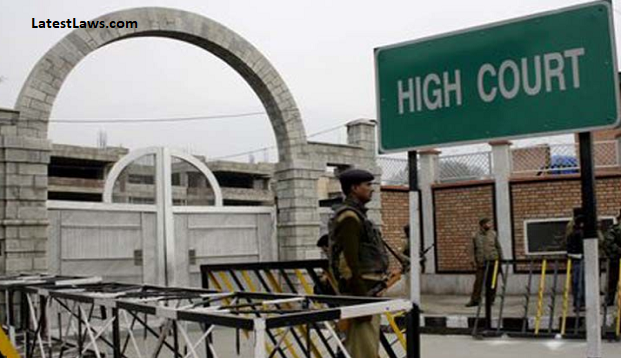
The Jammu & Kashmir High Court recently comprising of a bench of Justice Vinod Chaterji Koul observed that “Motor Vehicle” includes any mechanically propelled vehicle apt for use upon roads irrespective of it’s power source. (National Insurance Co. Ltd. versus Aijaz Ahmad Shah and ors)
The bench noted that Section 10(2)(a) to (j) specifies the classifications of vehicles that must be driven, not the precise types of vehicles within each class. If a vehicle falls into one of the categories, a person who holds a driver’s licence for that class of vehicle can operate all vehicles in that category. If the vehicle falls under one of section 10(2) specific classes, no additional endorsement is required.
Facts of the case
This order was passed when respondents 1 to 4 filed a claim petition with the Tribunal, averring that deceased Aksa Aijaz, aged 14 years, died in an accident at Manzhama K.P. Road, Anantnag, due to the rash and negligent driving of the driver of the offending vehicle which was parked on the side of the road.
Contention of the Parties
Before the Tribunal, the Appellant Insurance Company fought the claim petition. Their argument was that the driver of the offending car did not have a valid and effective driver’s licence and that the vehicle was being driven without valid and effective vehicular documentation. The accident was also said to be the result of two cars colliding, as the deceased was driving the bus when it crashed with the offending vehicle.
According to learned counsel for appellant, Insurance Company the duty to satisfy the Award has been erroneously mulcted upon appellant Insurance Company. Appellant Insurance Company was, without a doubt, the insurer of the offending car, but under the provisions of the insurance contract, appellant Insurance Company’s liability would arise only if the owner/insured did not violate the policy’s terms and conditions. The owner/insured – respondent no.6, in this case, is said to have allowed the offending car to be driven by respondent no.5, who had an invalid driver’s licence, and so liability should have been placed on the owner of the offending vehicle.
It was argued that the decision on Issue No. 3 is erroneous in law because the Tribunal failed to consider the fact that respondent No. 5 as the driver of the offending vehicle was only licenced to operate a light commercial vehicle (LMV) and not a medium passenger vehicle. The light motor vehicle is not included in the definition of a medium passenger motor vehicle, hence the driver was not authorised to drive a medium passenger motor vehicle. According to learned counsel, the Tribunal, while relying on the Supreme Court’s decision in Mukund Dewangan v. Oriental Insurance Company Limited, held that a person with a light motor vehicle licence can drive any type of light motor vehicle without a PSV endorsement.
Courts Observation & Judgment
In view of the above-reproduced excerpt of the judgment in Mukund Dewangan (supra), there is no substance in the submission of learned counsel for appellant qua validity of the driving licence of the offending vehicle. Thus, the Tribunal has rightly decided Issue no.3 against the appellant Insurance Company.
The bench also noted that the contention of learned counsel for appellant qua quantum of compensation and computation thereof that is also misconceived inasmuch as the Tribunal has been conservative in computing the compensation and also in view of the law laid down by the Supreme Court in a catena of cases including National Insurance Company v. Pranay Sethi, AIR 2017 SC 5157; Arvind Kumar Mishra v. New India Assurance Co. Ltd., (2010) 10 SCC 254; and M. R. Krishna Murthi Vs. The New India Assurance Company Ltd. & Others, (2019) 1 ACC 730 (SC).
The bench therefore noted that for the reasons discussed above, the instant Appeal is dismissed. Interim direction, if any, shall stand vacated.
Read Judgment @Latestlaws.com
Picture Source :




















