









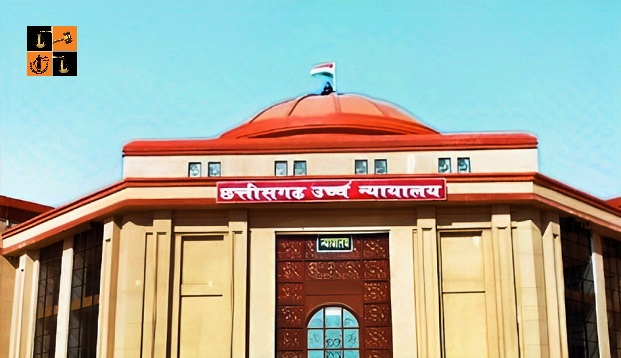
Recently, the Chhattisgarh High Court dismissed an intra-court appeal challenging conditions attached to a government employee’s promotion order, holding that the State acted within its powers in imposing such terms. The Court observed that once an employee accepts a promotion with its conditions, they cannot subsequently challenge those conditions after availing the benefits.
Brief Facts:
The appellant, a government official serving as Under Secretary in the Law and Legislative Affairs Department, was eligible for promotion to the post of Deputy Secretary. After initially being denied promotion, a review Departmental Promotion Committee (DPC) convened in 2021 recommended him for elevation. Subsequently, a promotion order was issued; however, it included two conditions: first, that the promotion would be subject to the outcome of objections concerning his earlier promotion, and second, that the decision regarding annual increments would be withheld pending resolution of a recovery of over ₹10 lakh linked to alleged financial irregularities.
Challenging these conditions as arbitrary, unconstitutional, and contrary to Article 311 of the Constitution, the appellant moved the High Court. His writ petition was dismissed by a Single Judge, prompting the present appeal before a Division Bench.
Contentions of the Petitioner:
Counsel for the appellant contended that the conditions imposed were illegal and in violation of the principles of natural justice. It was argued that no employee can be reverted or have their promotion jeopardised without being afforded an opportunity of hearing. The appellant further claimed that the review DPC had recommended his promotion without any such conditions, and that the Secretary of the Department had unilaterally inserted them afterward. He maintained that the pending objections were known to the authorities even before the DPC proceedings and could not now be used to undermine his promotion. Additionally, it was submitted that accepting the promotion order did not preclude him from challenging unlawful conditions subsequently.
Contentions of the Respondent:
Counsel for the State argued that the Single Judge’s order was well-reasoned and required no interference. It was submitted that serious objections had been raised by the office of the Accountant General regarding the appellant’s previous promotion and recovery of substantial amounts linked to financial irregularities. In view of these unresolved issues, the conditions were inserted in the promotion order to safeguard administrative and financial propriety. The State further argued that the appellant, having accepted the promotion with its conditions, could not later dispute them.
Observations of the Court:
The Division Bench, after reviewing the record, observed that although the DPC recommended the appellant’s promotion, significant objections concerning his prior promotion and financial irregularities were pending before the Accountant General. The Court noted, “In order to protect the State’s interest and avoid future complications, conditions No. 2 and 3 were lawfully inserted. The decision to impose conditions was taken at the highest level, considering the seriousness of the allegations and in the interest of administrative propriety.”
The Court further underscored the settled legal principle that a subordinate authority cannot generally impose conditions contradicting a DPC’s recommendation unless necessitated by pending disciplinary or financial issues. However, in the present case, such conditions were justified in light of pending objections and potential liabilities.
Importantly, the Bench held that, “The appellant, having accepted the promotion order, cannot now challenge its conditions after availing the benefits.”
The decision of the Court:
Concluding that the insertion of conditions was neither arbitrary nor unconstitutional, the Court upheld the Single Judge’s decision. It held that the State acted within its administrative powers and in accordance with legal principles while imposing conditions linked to unresolved financial and service-related issues. Accordingly, the appeal was dismissed, and the conditions attached to the appellant’s promotion were affirmed. No order as to costs was made.
Case Title: Anil Sinha vs. State of Chhattisgarh
Case No.: WA No. 671 of 2025
Coram: Chief Justice Ramesh Sinha, Justice Bibhu Datta Guru
Advocate for Petitioner: Adv. Santosh Kumar Pandey
Advocate for Respondent: Adv. Y.S. Thakur
Picture Source :




















