









The Author, Adhivaryu Agrawal is a 3rd Year Law student at Dr. Ram Manohar Lohia National Law University, Lucknow.
INTRODUCTION
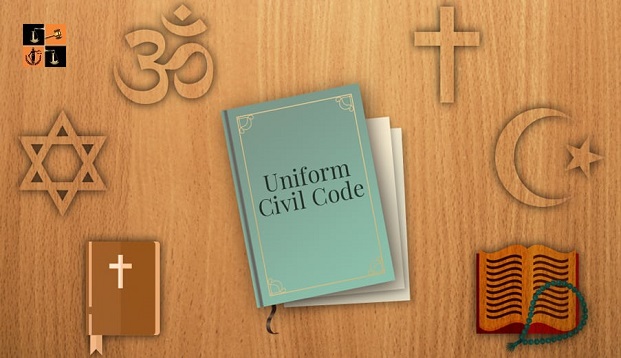
People belonging to different religious communities have the right to follow different sets of laws as prescribed by tenets of their religions in the matters of marriage, divorce, maintenance, adoption and succession, etc., these set of laws are known as their personal laws.
This system was introduced by the Britishers as the matters associated with religion were always very close to the Indians hence interfering in the matters of religion could have been fatal to their trade. When the Indian constitution was being developed in the Constituent Assembly, long deliberations took place but there was no clear solution on whether to implement it or not. So, it was decided, that time was not appropriate for the implementation of Uniform Civil Code and system of Personal Laws continued. Aspirations of the supporters of Uniform Civil Code were given a place in the Constitution of India in the form of Article 44 in Directive Principles of State Policy.
Even after almost 75 years of independence not much has been done regarding the implementation of Uniform Civil Code. The government in power has been lackadaisical with regard to this issue but the judiciary has been absolutely vocal about its cause.
In the cases such as Shah Bano case, Sarla Mudgal case, etc., the Hon’ble Supreme Court of India and various High Courts have referred to Article 44 and emphasised on the implementation of Uniform Civil Code in India for both protection of the oppressed and promotion of national unity and integrity (Surya and Pande).
The Law Commission of India said in its Consultation Papers on Reform of Family Law gave a contrasting view about Uniform Civil Code that it “is neither necessary nor desirable at this stage” in the country. The best way forward may be to preserve the diversity of personal laws but at the same time ensure that they do not contradict fundamental rights (Law Commission of India).
It is true that several portions of the personal laws belonging to different religions are not in consonance with ideals of the constitution but still they are followed to this date which causes grave injustice to some members of the society specially women. It is the auspicious duty of the government to give effects to vision of the constitution to establish rule of law in the country.
Minorities specially the Muslim community have been reluctant when it comes to bringing reforms in their personal laws as they consider it taking away of their religious customs but this might be untrue as Goa which is the only Indian state which follows Uniform Civil Code is a successful example.
With time, reforms are necessary. Hindu law was reformed by abolition of evil customs such as Sati, Child marriage, polygamy, etc and positive steps were taken such as widow remarriage, etc. This was the need of the time back then now time may be right for Uniform Civil Code.
HISTORICAL BACKGROUND
The question for implementation of Uniform Civil Code originated in India during the colonial times. British had built a uniform Criminal Justice System. They could not do the same with regard to Civil laws as they feared that it won’t be favourable to their trade. Matters of religion has always been very close to the Indians hence British didn’t want themselves to be seen as common enemy of the Indians so they let the system of Personal laws to continue which had been there from the medieval period. At least in 18th and 19th century very few major reforms in religious practices took place.
Later in the 20th century, demand for Uniform Civil Code arose mainly for ending gender-based discrimination, religious discrimination and ensuring equality among the people in general. So, several enactments were made for Hindus to bring reforms in their religion. But other communities such as the Muslims were more conservative about their religious beliefs so the British didn’t interfere as much as they did in the case of Hindus (Outlines of Indian Legal History).
Then, during the development of the Indian Constitution in the Constituent Assembly, the issue of Uniform Civil Code was fiercely debated but no clear solution came out. Ultimately it was put in the Directive Principles of the State Policy as a goal for future government whenever the time may be right.
Though through Hindu Code Bill, laws for Hindus, Jains, Sikhs and Buddhists were codified but laws of Muslims, Christians, Parsis, etc. remained untouched by the Government of Independent India.
Uniform Civil Code attained limelight during the Shah Bano case in 1985 and its overturning by Rajiv Gandhi government to appease Muslim Fundamentalists.
PERSONAL LAWS OF HINDUS, MUSLIMS & OTHERS
Religious communities derive their personal laws from their religious tenets about marriage, divorce, adoption, succession and inheritance, etc. matters concerning their lives.
Hindu Personal Law
All the communities living in India including Jains, Buddhists, Sikhs and excluding Muslims, Christians, Jews, Parsis come under the aegis of term ‘Hindu’. Hindu Personal law was codified by the Parliament in four acts- the Hindu Marriage Act, Hindu Succession Act, Hindu Minority and Guardianship Act, and Hindu Adoptions and Maintenance Act.
Under the Hindu Personal Law, gender discrimination has been an issue related to women’s right to inherit property of their father, adoption of a child, being natural guardian of her child during the husband’s lifetime, etc (Sadhna and Bhuvaneshwari). Before passing of Hindu Code Bill even polygamy was legal among the Hindus. So, it is the need of the hour to end these gender-based inequalities.
Muslim Personal Law
Muslims in India follow Sharia Law as prescribed by the Islamic texts and interpreted by their religious leaders. Their law has not been codified in India and was given recognition through Shariat Application Act and Dissolution of Muslim Marriages Act.
Among the Muslims as well, the situation with regard to women equality is grim. In Islam, polygamy is legal, women face difficulties in taking divorce, matters of succession, maintenance, considered inferior to men, etc.
Personal Laws of other communities
Christians follow Indian Christian Marriages Act and the Indian Divorce Act with regard to their marriages and divorce and Parsis follow Parsi Marriage and Divorce Act, acts for both of them are derived from their religious tenets.
The Personal laws derive their validity from Article 25 and 26 of the Constitution but many of them are in conflict with other Fundamental Rights as envisaged in Part-III of the Constitution.
NEED OF UNIFORM CIVIL CODE
Before Britishers left India, they had codified laws in various area but personal laws were not codified. Then, Constitution of India was being developed in the Constituent Assembly, our erudite and visionary Constitution makers had some goals for India to achieve in future which was reflected in the Constitution. But certain portions of personal laws go against the constitution. They could not implement Uniform Civil Code due to widespread opposition from orthodox sects. So, it became need of the time to reform personal laws so that they become just and in line with supreme law of the land i.e., Constitution of India.
National Unity
Implementation of Uniform Civil Code will foster unity among the citizens of the nation. It will bring integration in the Indian society as personal laws have created a divide among people.
Justice
While providing justice in a case where parties belong to different religions, the judges often face dilemma due to existence of different sets of personal laws and therefore sometimes they are not able to provide justice to victims.
Secularism
Constitution of India gives everyone right to follow their religion and does not discriminate among different religions. Hence promote secularism. So, to achieve secular laws, personal laws should also be uniform for all but due to existence of different personal laws it is not possible.
Gender Justice
Women are discriminated based on gender which is a violation of their right to equality in almost every religion. For e.g.- In Hindus, daughters were not given a share in their father’s property earlier and everything went to the sons. This anomaly was corrected by the government through Hindu Succession (Amendment) Act, 2005 (Act 39 of 2005).
To counter discrepancies in the Personal Laws
Personal Laws based on religious texts have always come in conflict with the modern laws which ensure justice, equity and good conscience. Certain portions have now become obsolete with the passage of time so they need to be brought in consonance with Constitutional ideals (Sapra).
Progressive Thinking
To correct the injustice caused to certain sections of the society due to existence of regressive personal laws, a progressive step is required (Byjus). Modern India focuses on inclusive growth of all and therefore everyone needs to be on the same boat.
Ultimately, Uniform Civil Code is not violation and taking away of personal laws rather it is trying to make Indian Legal System more just and efficient by removing loopholes from the system.
CHALLENGES TO UNIFORM CIVIL CODE
There are various hurdles before the implementation of the Uniform Civil Code in India.
- The lack of political consensus in the Parliament regarding this issue has been one of the main reasons for the dream of Uniform Civil Code not being realised till date.
- The irrational fear among few communities due to fear-mongering by some of the vicious elements of the society has led to protests even on the name of it (Byjus).
- Certain communities feel that implementation of the Uniform Civil Code will lead to loss of their religious identity and culture.
- Some people view Uniform Civil Code to be in violation with Article 25 and 26 of the Indian Constitution i.e., right to practice religion according to one’s own conscience (Dubey).
- The Law Commission of India in its Consultation Paper said that Uniform Civil Code is not desirable at the time. People might not welcome this move as they may consider it as an attack on their faith hence it could lead to law-and-order situation. (Law Commission of India)
ROLE OF JUDICIARY AND FAMOUS CASE LAWS
The Hon’ble Supreme Court of India along with other High Courts have stressed on the implementation of the Uniform Civil Code in India in various judgments since independence.
In the case, Mohammad Ahmed Khan v. Shah Bano Begum (AIR 1985 SC 945), the Hon’ble Supreme Court of India stressed on the implementation of Article 44 of the constitution i.e., Uniform Civil Code in the country. In that case due to the personal laws rights of the women were being violated so the Supreme Court supported Uniform Civil code in order to achieve social justice.
Then in Sarla Mudgal v. Union of India (AIR 1995 SC 1531), the Supreme Court said that different laws of marriage create anomaly and ambiguity in giving justice to people hence Uniform Civil Code is the need of the hour (Sachde).
In the case, Lily Thomas v. Union of India (2000 6 SCC 224), the Supreme Court expressed its desire for a Uniform Civil Code in India as different communities have distinct laws regarding succession.
In ABC v. The State (NCT of Delhi) (2015 SCC Online SC 609), the Supreme Court expressed its disgust on not having any uniform law with regards to guardianship of a child.
In the case of John Vallamattom v. Union of India (1995 (3) SCC 635), the Supreme Court of India stated that there is no necessary connection between religious and personal law. It is no matter of doubt that marriage, succession, and the like matters of a secular character cannot be brought within the guarantee enshrined under Articles 25 and Article 26 of the Constitution. Any legislation which brings succession and the like matters of secular character within the ambit of Articles 25 and 26 is suspect (Dubey).
The Supreme Court has often come to rescue of the victims of the existing personal laws. It has stroke down those aspects of personal laws which discriminate against certain category of people. For e.g., repealing of Tripple Talaq for Muslims, allowing women of all ages to enter the Temple which didn’t use to allow entry of certain class of women for Hindus, ensuring gender equality in matter of succession for Christians, etc.
CONCLUSION
Article 25 and 26 envisaged in Part-III Fundamental Rights guarantee ‘freedoms of conscience and free profession, practice and propagation of religion’ to all persons (Article 25 Freedom of conscience and free profession, practice and propagation of religion). i.e., religious groups have been given the right to manage their own issues. Article 44 enshrined in Part- IV Directive Principles of State Policy talks about uniform personal laws for all the communities residing in India. The Uniform Civil Code is not calling for complete eradication of all personal laws but to create a set of more just and egalitarian uniform personal laws in order to remove discrepancies in existing system of personal laws and realizing the ideals of the secular Constitution and meeting the needs of the 21st Century India. India is a secular state hence religious laws cannot dictate what law is to be formulated for the benefit of the people.
Though it won’t be appropriate to impose the code without the consent of the stakeholders i.e., the common people which was also conveyed by Erudite and visionary Father of the Indian Constitution, Dr. B.R. Ambedkar to the members of the Constituent Assembly that the citizens would be required to declare voluntarily that they want to be governed by such code or not and when enacted it won’t be imposed on the citizens against their wishes.
With the enactment of a Uniform Civil Code, the differences between various religious groups will reduce and India will emerge as a much more united and integrated nation. The problems of the minority religious groups should be properly addressed including insecurity of complete loss of identity within Indian society. It is because the Uniform Civil Code cannot be successfully implemented until and unless it gets support and acceptance from all the concerned stakeholders and communities.
Indian Judiciary has given it support and from time to time has urged the government of the day to enact such uniform civil code, this is reflected in various case laws. The Law Commission in its report said “It is urged that the legislature should first consider guaranteeing equality within communities between men and women, rather than equality between communities. This way some of the differences within personal laws which are meaningful can be preserved and inequality can be weeded out to the greatest extent possible without absolute uniformity” (LawCommissionofIndia).
Picture Source : https://twitter.com/Anirudh_Astro/status/1225442864403894272/photo/1



















