









The Author, Charishma K. S. is a student of 2nd year BA. LLB. at Dr. Ambedkar Global Law Insititute, Tirupati. She is currently interning with LatestLaws.com.
Introduction
On 2nd March 1906, the Indian coinage act was passed to amend and consolidate the laws related to coins and mint. The RBI has the sole right to issue currency under the provisions of the reserve bank of India act 1934 while the coins are minted as per the coinage act. The government of India has the right to mint coins and the coins will be supplied to RBI by GOI which circulates the coins. Coins can be issued up to Rs.1000 under the Coinage Act, 1906. The Coinage Act, 1906 has been repealed by the government after the implementation of the coinage act 2011.
Q1. When was the Coinage Act originally formulated?
Ans. The law related to coins and mint originally formulated in the Coinage Act, 1870. It has been materially amended by two Acts, namely, the Indian Coinage and Paper Currency Act, 1893(8 of 1893), which abolished obligatory free coinage, and the Indian Coinage and Paper Currency Act, 1899 (22 of 1899), which made gold coins a legal tender. To reproduce the provisions, and to provide an introduction of nickel one-anna piece and of a bronze coinage the coinage act 1906 repeals the main act 1870. Further, the 1906 act is repealed by the coinage act 2011. The enactment of the 2011 act let outs the do and don’ts related to the coins in the circulation and it applies to the whole of India including Jammu and Kashmir.
Q2. What were the objectives and reasons for the Indian Coinage Act, 1906?
- The coinage act provides for the applicability, denomination, dimension, design, and composition of coins, the standard weight of the coins, and the limit up to which a coin is a legal tender.
- It grants power to the central government to establish and abolish the mint and to call in coins
- It also empowers certain persons to counterfeit or to cut diminished or defaced.
- And provides the procedure to cut coins or coins liable to be cut.
- It includes the saving provision that enables the government of other authorities beyond the limit of India for making of other coins for issue as money.
- It provides "the temporary concerning certain Hyderabad coins which should be continued as a legal tender in that State as it used to be before the commencement of this Act".
Q3. What was the maximum denomination of coin given in the Coinage Act, 1906?
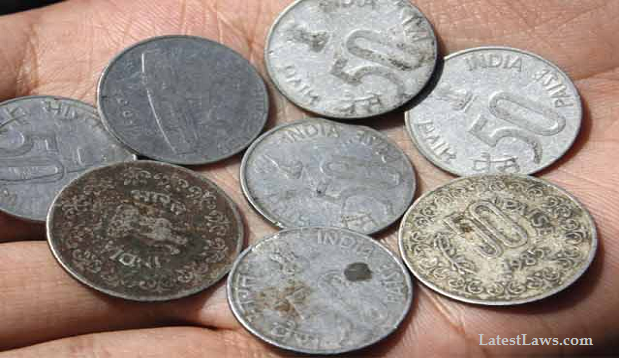
Ans. As per section 6 of the India Coinage Act, 1906, the GOI has the authority to mint coins and issue them to RBI for circulation. Coins can be issued up to the denomination of rs.1000. Currently in India coins are issued in the denomination of 50 paise, one rupee, 5 rupees, and ten rupees. On June 30, 2011, the coins in denominations of 1 paise, 2 paise, 3 paise, 5 paise, 10 paise, 20 paise, and 25 paise have been removed from the circulation and ar, has no legal tender.
Q4. What is legal tender? When a coin is a legal tender in India?
Ans. The coins or banknote that are legally tenderable for discharge of payment or debt is known as legal tender. In India, Coins function as restricted legal tender. Under section 6 of The coins issued by GOI, shall have legal tender in payment or on the account given that a coin has not been lost weight less than such weight ( 176.4 grains troy in the case of a rupee coin, 88.2 grain troy in the case of a half rupee coin) and has not been defaced as may be prescribed in its case. Any Denomination coin not lower than one rupee shall be legal tender for any sum not exceeding 1000 rupees. The half rupee (50 paise) coin shall be legal tender for not sum exceeding 10 rupees. In the case o,f quarter rupee shall be legal tender for not exceeding one rupee. .The one-rupee notes included in the expression rupee coins for all the purposes of the RBI act, 1934 that issued under the currency ordinance, 1940 have a legal tender. The rupee coins issued by the Government constitute the liabilities of the government. Whether the 10 rupee coin "without rupee symbol" a legal tender? Yes, the 10 rupee coins are presently in circulation and all coins of 10 rupee denomination minted from time to time by the GOI of India are legal tender.
Q5. How many mints are there in India?
Ans. There are four mints in India located at
- Mumbai, Maharashtra which is established in 1929 by the British government.
- The Alipore, West Bengal which is established in 1929 by the British government
- Saifabad and cherlapally (Hyderabad), Telangana which is established in 1903 by the government of the erstwhile Nizam of Hyderabad and came under the control of the Indian Government in 1950 and started minting in 1953.
- Noida, utter Pradesh which is established in 1986 and began minting terrific stainless steel coins from 1988.
Q6. How are the coins distributed?
Ans. After receiving coins from the mint, it is issued into circulation through its Regional offices/Sub offices of the Reserve Bank and a wide network of coins and currency chests regulated by banks and Government treasuries circulate across the country. These offices distribute coins directly to the public through their counters and also send coin remittances to the currency chests and small coin depots. There are 4075 currency chests and 3,746 bank branches that act as small coin depots to stock small coins all over the country.
Q7. What is the decimal system of coinage?
Ans. As per section 14 of the Indian Coinage Act, 1906, the rupee is divided into 100 units, the new coin representing such unit shall be designated by the central government, by notification, under such name it thinks fit. All references in any enactment, rule, order or notification, or in any contract, deed or other instrument to referred to in sub-section (1) converted thereto at the rate of sixteen anna, sixty-four paise or one hundred and ninety-two pies to one hundred units referred to in subsection (1).
(3) All references in any enactment or in any notification, rule or order under any enactment or in any contract, deed or other instrument to any value in naya paisa or naye paise shall be construed as references to that value expressed respectively in units referred to in sub-section (1).
Q8. Who has the power to cut diminished or fraudulently defaced silver coins and what is the procedure?
Ans. Under section 2(a) the term "deface" is defined as, with its grammatical variations and cognate expressions, includes clipping, clipping, filing, stamping, or such other alteration of the surface or share of the coin as is readily distinguishable from the effects of reasonable water. section 16 of the Indian coinage act 1906, where any silver coin has been coined and distributed under the authority of the central government is tendered to any person authorized by the central government to act and the person has to believe the coin has been diminished in weight than the standard weight and has been defaced. The following procedure to cut the coin regarding section 16(a) and section 16(b),
If the weight of the coin diminished more or less than the standard weight prescribed, he shall return the pieces to the person tendering the coin who shall bear the loss of cutting or breaking or the person shall pay for the coin as per such rates prescribed. If such a person has a reason to believe that coin has or has not been fraudulently defaced, he shall return the pieces to the person who shall bear the loss for cutting or he shall receive and pay for the coin its nominal value.
Q9. Who has the power to make rules?
Ans. The central government has the power to make rules to carry out the purposes and objectives of the act. Every rule shall be published in the official gazette which will be made before each house of the parliament, both houses agree to any modification in the rule. If both houses disagree with the rule made, then the rule shall not be amended.
Picture Source :



















