










Delivering a lecture at the United Kingdom Supreme Court, the Chief Justice of India, DY Chandrachud remarked that Arbitration is no longer an 'alternative' but has become a 'preferred' method of seeking commercial justice.
The topic of the lecture was "Law and Practice of commercial arbitration: Shared understandings and developments in UK and India".
The CJI established that arbitration has always been a popular form of dispute resolution in India and has been encouraged even by the founding parents of the Indian Constitution through Article 51 which exhorts the State to “encourage settlement of international disputes by arbitration.”
"India had a culture of arbitration and mediation for centuries. Then, it was primarily a system of dispute settlement by village elders. How did this system evolve to take the shape of international commercial arbitration we see today?" , he said in his opening remarks.
He said that the pros of the process show why commercial arbitration is still, certainly more relevant today as it was five centuries ago.
"The courts in India are overburdened despite the High Courts disposing of 2.15 million cases and the District Courts disposing of 44.70 million cases in 2023. These figures show the trust that the people of India have in their judiciary. Our judiciary functions on the mantra that no case is small or big. Every aggrieved person who approaches the doors of the judiciary has the right to a just remedy. In attending to these grievances, the courts in India perform their plain constitutional duty. The width of our jurisdiction was designed to ensure the widest access to justice. But surely every case need not find a remedy before a court, with emerging forms of dispute resolution such as arbitration and mediation gaining acceptance", he said.
The CJI detailed the three stages of arbitration and its jurisprudential foundation thoroughly in his lecture. He also stressed the 'doctrine of competence-competence' stating it as intricately connected to the presumption of the separability of an arbitration agreement.
"The separability presumption ensures that an arbitration agreement survives even if the underlying contract is void.28 In practice, this ensures that the arbitral tribunal continues to exercise jurisdiction on the substantive rights and obligations of the parties to the underlying contract, even when it is no longer valid", he emphasized.
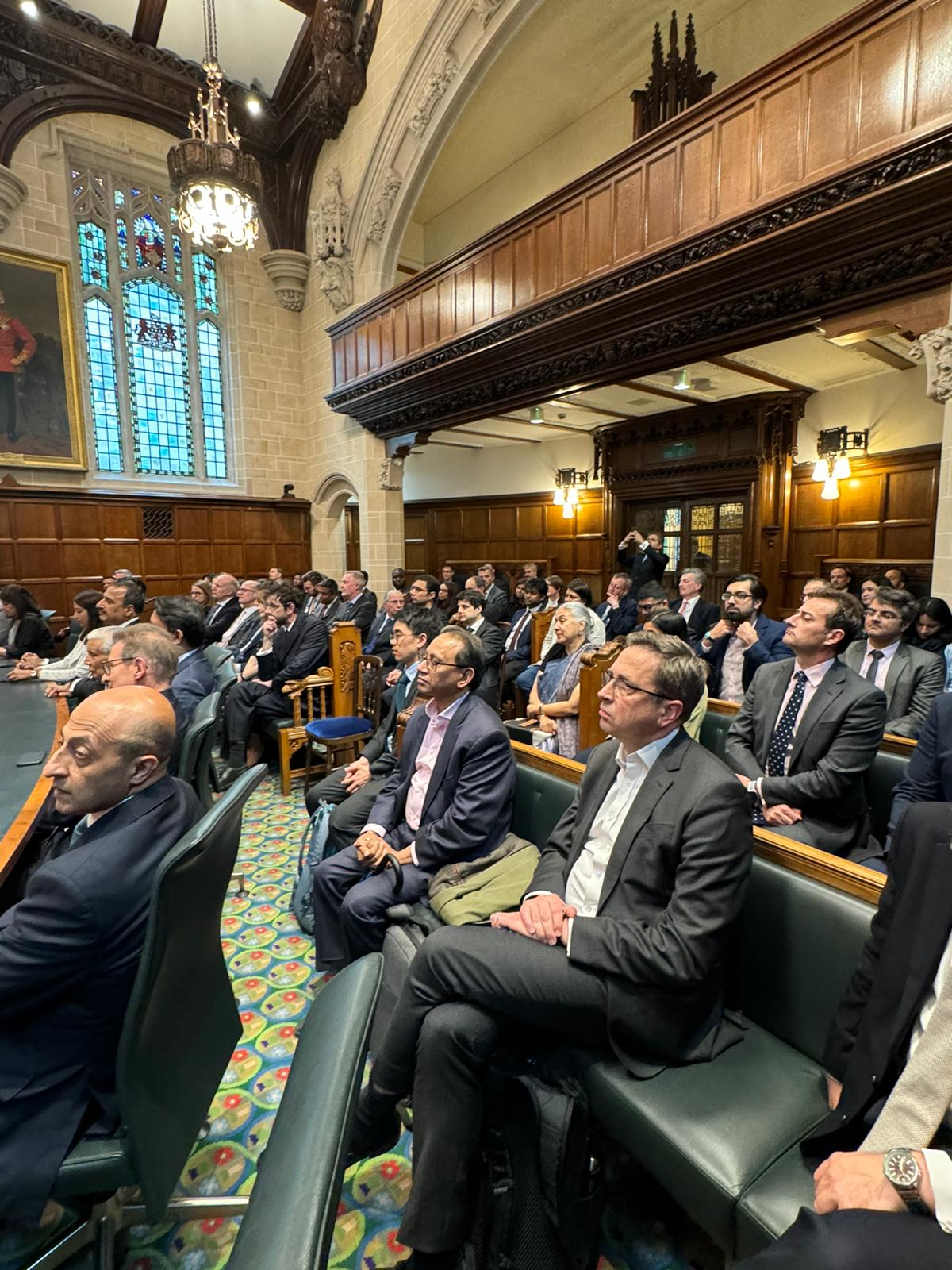
He also extensively discussed the role of arbitrators in running and establishing faith in the arbitration proceedings. In this regard, he talked about the scrutinization of the Arbitrators in both India and the UK.
"The nature and role of arbitrators has received immense scrutiny in both our jurisdictions, but more so in the United Kingdom in recent years. In the decision of the UK Supreme Court in Jivraj v. Hashwani, 32 Lord Phillips observed that the arbitrator is independent of the parties and that the “functions and duties require him to rise above the partisan interests of the parties.”, he said.
The CJI went on to add that the Indian law incorporates the philosophy that an arbitrator should not merely be independent, but ought to be seen to be independent.
"An independent arbitrator is impartial, and an impartial arbitrator is independent. The legislature incorporated the disclosure requirements because though the arbitrators are private actors, they perform important adjudicatory functions which impact on the precepts of commercial morality and commercial justice. The statutory duty of disclosure allows parties to discern any matters which could give rise to justifiable doubts about an arbitrator’s impartiality. The disclosure enables either of the parties to challenge the appointment of arbitrators. The requirement of disclosure brings in greater transparency in the arbitral proceedings helping maintain the integrity and legitimacy of the process", he said.
In the end, he laid out his vision and how he believes that now is the time for countries such as India to step up to the occasion to create and promote a culture of commercial arbitration.
"The robust institutionalization of arbitration will further the culture of arbitration in the Global South. In recent years, institutions such as the India International Arbitration Centre and Mumbai and Delhi International Arbitration Centers have been set up and are seeing a steady flow of arbitration matters. But the mere creation of institutions is not sufficient. We have to ensure that these new institutions are not controlled by a self-perpetrating clique. These institutions must be based on the foundation of robust professionalism and
the ability to generate consistent arbitral processes.48 Transparency and accountability, values by which the work of conventional courts is assessed and critiqued, cannot be alien to the world of arbitration. Arbitral institutions are uniquely placed to co-operate with other arbitral institutions around the world to adopt best international practices and procedures. This will create a global convergence of arbitral procedures, creating more uniform institutional rules and structures. I hope the Indian arbitral institutions emulate the success of their global counterparts in the years to come. The substitution of courts should not result in the creation of opaque structures. The plea for bringing greater diversity in the world of arbitration is based on the firm belief that bringing a diversity of viewpoint to the world of arbitration, whether in terms of gender or from the Global South will make for a broad-based process", he said.
He also discussed the role of technology in furthering the expansion of arbitration as a popular and preferred dispute resolution mechanism.
"The future of arbitration is steeped in technology. Today technology plays a major role in how the arbitration proceedings are being carried out. You have instances where one party is based in Delhi, another in Bengaluru, while the arbitrators are in London, Mumbai and Singapore. Technology provides the digital environment allowing them to participate in arbitral proceedings virtually", he said.
Read the Speech in detail @LatestLaws.com:
Share this Document :Picture Source :




















