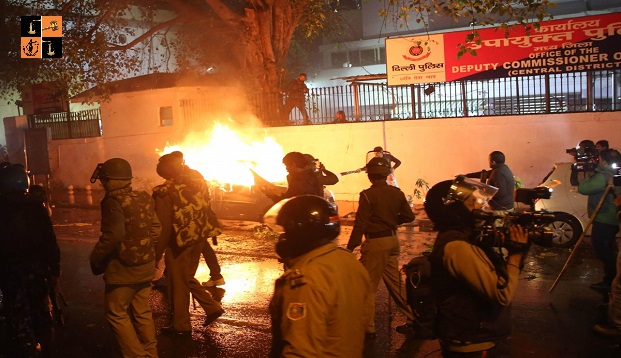
On Friday, Delhi High Court granted bail to an undertrial in concern to the Delhi Riots observing that remit of the Court is to dispense justice in accordance with law, not to send messages to society.
CASE FACTS
The applicant herein has been taken into custody in an FIR registered under Sections 147/148/149/427/436 IPC in relation the Delhi Riots. The applicants has been named in five cases arose out of the violent acts in the said event. He has sought regular bail on the ground the has neither been named in the FIR nor is there any allegation in the FIR nor any other material collected during investigation, that would identify the applicant as one of the perpetrators of the offences alleged.
COURT OBSERVATIONS
The Court analysing the material on recording and listening to the submissions of the Learned Counsel of the matter has observed the following:
1.The supplementary statement of the complainant does not appear to identify the applicant
2.According to the State itself, no CCTV footage is available of the the incident itself
3.The CCTV footage from the school on which the State relied, appears to be located at a place from where the complainant’s shop seems unlikely to be visible
4. Complainant's claim that he was present seems to be contradicted by the complainant’s statement as recorded in the FIR that the complainant was unable to contact the police and therefore, fled from the shop.
5. Co-accussed has already been admitted to bail in cases arising from the same incidents of rioting in the same area
6. Investigation in the matter is complete and chargesheet has been drawn-up and sent for approval to higher Police authorities
7. When offences are alleged to have been committed by an ‘unlawful assembly’, after concluding investigation, the State has been able to identify and name only 2 persons from amongst a crowd of some 250-300 persons.
To enhance one's understandin on the concept and fundamentals of bail, the Court cited Supreme Court judgement in Ash Mohammad vs. Shiv Raj Singh & Anr.
The Court in view of the Additional Status report the State that says, "Granting of bail at this early stage may send an adverse message in the society and such crimes should not be allowed to happen in the national capital." noted:
"This cannot be basis for denying bail, if the court is otherwise convinced that no purpose in aid of investigation and prosecution will be served by keeping the accused in judicial custody. Prison is primarily for punishing convicts ; not for detaining undertrials in order to send any ‘message’ to society. The remit of the court is to dispense justice in accordance with law, not to send messages to society."
"It is this sentiment, whereby the State demands that undertrials be kept in prison inordinately without any purpose, that leads to overcrowding of jails ; and leaves undertrials with the inevitable impression that they are being punished even before trial and therefore being treated unfairly by the system. If at the end of a protracted trial, the prosecution is unable to bring home guilt, the State cannot give back to the accused the years of valuable life lost in prison. On the other hand, an accused would of course be made to undergo his sentence after it has been awarded, after trial."
In respect to the charges imposed on the applicant, the Court observed that Section 141 IPC defines as an assembly of 5 or more persons acting with unlawful purposes as defined in that provision; while in the present case only 2 persons appear to have been charged. Out of all the charges, only the offence under Section 436 IPC is non-bailable and there is no material to support that offence.
The Court also mentioned one important factor that ordinarily it would not have entered upon any discussion on the evidence at the stage of considering bail, however the present case is a purported unlawful assembly of some 250-300 persons is alleged to have committed offences; of which the police have picked-up only two.
Therefore in this peculiar circumstance, the Court was compelled to sift the evidence only prima-facie and limited to cursorily assessing how the Police have identified the applicant from that large assembly of persons. The Court is conscious that ‘judicial custody’ is the custody of the court ; and the court will be loathe to depriving a person of his liberty, in the court’s name, on the mere ipse-dixit of the State, when it finds no substantial basis or reason for doing so.
In view of the above, regular bail has been granted to applicant subject to certain conditions.
The judgement has been delivered by Justice ANUP JAIRAM BHAMBHANI on 29-05-2020.
Read Judgement Here: