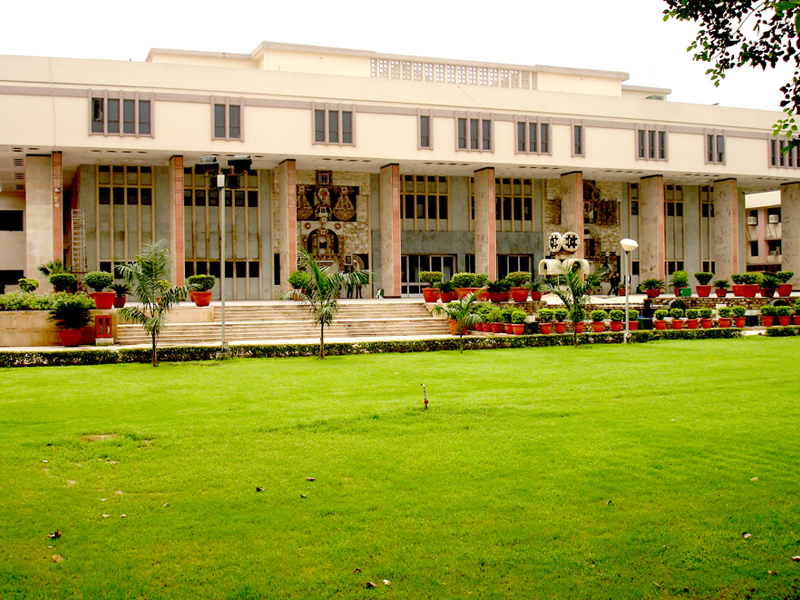
The Delhi HC in, CRSC RESEARCH AND DESIGN INSTITUTE GROUP CO. LTD v. DEDICATED FREIGHT CORRIDOR CORPORATION OF INDIA LIMITED & ORS, answered the questions vis-a-vis scope of Section 9 of A&C Act and regarding the injunction in case of invocation of bank guarantee.
Facts
The Petitioner entered into a contract(with arbitration clause) with respondents for completion of a project for Rs. 471 crores whereby various milestones were set for completion over a period of time. The contract even appointed a project management consultant (PMC). Four Advance Bank Guarantees, for ₹ 38.06 crores, and one Performance Bank Guarantee, for ₹ 23.55 crores, were furnished by the petitioner. The Advance Bank Guarantees are valid up to 1st May 2021, and the Performance Bank Guarantee is valid till 24th June 2021. On 22nd April 2020, an extension was granted for performance. But due to pandemic and order of government force majure would be applicable wherein the time would be extended again. A letter on 31st march seeking an extension for the same led to temporary incapacitation from performing its obligations under the Contract. Consequently, the respondent would invoke and encash the Bank Guarantees provided by it, the petitioner approached the court under Section 9 of the Arbitration and Conciliation Act, 1996.
Petitioner’s Contention
The Counsel contended that having extended the time for completion of the work, the respondent could not have terminated the contract on the allegation of delay/slow progress. The grant of extension, without levying of delay damages, amounted to an acknowledgment and admission of the fact that no delay was attributable to the petitioner. Respondents failed to show a difference in circumstances on 22nd April and 3rd July when the contract was terminated. Also, there was a force majure situation in the world. Furthermore, there was no proof to contend that the Engineer had recommended termination of the Contract on 11th March. Lastly, the matter was sub judice with Dispute Adjudication Board (DAB) so the invocation of guarantee can’t take place. Further, the termination was illegal. Special equities and irretrievable injustice justify the grant of an injunction, under Section 9 of the 1996 Act.
Respondent’s Contention
The respondents also relied on the contention that matter was sub judice and therefore the petitioner could not approach the court. It was said that three extensions had already been granted and the request for a fourth led to termination. Ten notices were issued to petitioners for correction. Also, termination would not prejudice any of its other rights, under the Contract or otherwise. One of the amended clauses specifically talked about the extent of damages to which the Respondent would be entitled consequent on termination under one of the clauses. Reference was made to OM of Finance ministry which clearly stated that the amnesty, did not extend to contractors who were in default before 19th February 2020. Also, non-levying of liquidated damages did not stop respondents from termination of the contract. It was also stated that enforcing the force majure clause was misdirected as the cause of termination was the failure of the petitioner to improve the obligation despite notices.
Analysis
On the scope of Section 9, the court held:
“(i) Interim measures, per definition, are granted to ensure that the proceedings were not frustrated.
(ii) While exercising power under Section 9, the Court is required to be mindful of the fact that concurrent power is vested in the Arbitral Tribunal, by Section 17. The reliefs which can be granted under Section 17, by the Arbitral Tribunal, are identical to those which can be granted by the Court under Section 9. While, therefore, exercising jurisdiction under Section 9, the Court, even at the pre-arbitration stage, should not usurp the jurisdiction which, otherwise, would vest in the arbitral tribunal, even if it is yet to be constituted. Hence, litigants would be in a position to misuse Section 9 as providing an opportunity to forum shop.
(iii) Subject to the above, the principles governing the grant of interim relief, under Section 9, are the same as those which govern the exercise of such power under Order XXXIX of the Code of Civil Procedure, 1908 (CPC), i.e., the existence of a prima facie case in favor of the applicant, the balance of convenience is in favor of the grant of such interim relief, and the likelihood of irreparable prejudice, or loss, resulting, were interim relief not to be granted. Additionally, the public interest is also a factor to be borne in mind.
(iv) Even the conjoint existence of these factors, however, would not, ipso facto, make out a case for the grant of interim protection under Section 9. Additionally, the Court has to satisfy itself that the reliefs, sought in the Section 9 petition, cannot await a Section 17 proceeding, before a duly constituted arbitral tribunal. The emergent necessity of ordering interim protection is, therefore, also a factor to be borne in mind, while exercising jurisdiction under Section 9.
(v) As a result, the criteria, which are required to be satisfied, before interim protection can be granted under Section 9 are
(a) the existence of an arbitration clause, and manifest intent, of the Section 9 petitioner, to invoke the said clause, and initiate arbitral proceedings,
(b) the existence of a prima facie case, the balance of convenience and irreparable loss, justifying such grant of interim relief to the applicant, and
(c) the existence of emergent necessity, so that, if interim protection is not granted by the Court, even before arbitral proceedings are initiated and the chance to approach the Arbitral Tribunal under Section 17 manifests itself, there is a possibility of the arbitral proceedings being frustrated or rendered futile.”
Upon the issue of invocation of bank guarantee, the court noted, “In cases of egregious fraud, irretrievable injustice, or special equities, the Court can still step in and injunct the invocation of the bank guarantee” and held the case in favor of the respondents rejecting the contentions of petitioners stating that the further course of the case would be decided by the arbitral tribunal.
Case Details
O.M.P. (I) (COMM.) 184/2020 & I.A. 5642/2020, I.A. 5643/2020
Counsel for petitioner- Mr. Rajiv Nayar, Sr. Adv. with Mr. Krishna Vijay Singh, Mr. Manish Dembla, Mr. Ankur Khandelwal, Mr. Nachiketa Goyal, Mr. Kartik Nayar, Mr. Saurabh Seth, Advs.
Counsel for respondent- Mr. Tushar Mehta, Solicitor General, assisted by Ms. Garima Prashad, Advocate-onRecord, Mr. Abhishek Kumar Tripathi, Ms. Ankita Pandey, and Mr. Imtiyaz, Advs.
Coram- HON'BLE MR. JUSTICE C. HARI SHANKAR
Read Judgment @Latestlaws.com