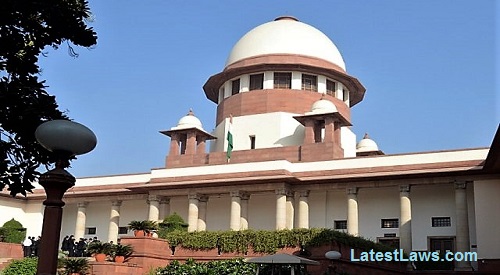
On Friday, by ruling that land acquisition proceedings under the 1894 Act won't lapse if compensation payable to the landowner has been tendered by depositing it in the treasury & not in the court or with the landowner, the Apex Court has overruled its own 2014 ruling that was considered “settled law” & was widely followed.
In 2014, a 3-Judge bench, in the case of Pune Municipal Corporation & Anr v Harakchand Misrimal Solanki & Ors, while interpreting Section 24 of the new 2013 Right to Fair Compensation & Transparency in Land Acquisition, Rehabilitation Act (LAAR), had held that land acquisition proceedings initiated under the 1894 Act would automatically lapse, & would have to be initiated again under the new 2013 law if the developer had not taken control of the land for five years, or if compensation was not paid to displaced farmers. The 2014 ruling had held that compensation would be deemed as “paid” only if it was deposited in the court, & not the treasury.
If proceedings lapsed under the old law, the acquisition process would be initiated again under the new law, allowing the owner to get higher compensation.
According to legal database Manupatra, the 2014 Pune Municipal Corporation case has been followed as a precedent in at least 999 cases — 29 SC cases & 970 cases by various High Courts across the country till questions were raised about the correctness of the case in Feb 2018 in Indore Development Authority vs Shailendra.
After Friday’s verdict, the fate of the 999 cases that relied upon the Pune Municipal Corporation ruling is once again in question.
“Resultantly, the decision rendered in Pune Municipal Corporation & Anr. (supra) is hereby overruled & all other decisions in which Pune Municipal Corporation (supra) has been followed, are also overruled,” the Constitution Bench said in its ruling.
As per the law, decisions of the court that have attained finality cannot be reopened. The doctrine of res judicata bars reopening of the same issue by the same parties once a ruling has been made. However, decisions rendered by the HC can still be challenged before the SC & decisions of the SC can be reviewed by the court itself.
“In my view, the cases have attained finality. However, if the Govt wants to reopen a particular case & challenge it before the SC, it has to explain the delay,” said Suhrith Parthasarathy, an advocate practising in the Madras HC. “For condoning the delay, it would be absurd for the state to make an argument that the interpretation of the law has changed,” he said.
For cases currently pending before HC's & the SC, the new interpretation would apply. “Normally, it is understood that a new interpretation of the law will be prospective & would not affect cases that have attained finality. However, for cases where the HC relied on the 2014 verdict & if they are currently under challenge before the SC, then the HC rulings ought to be reversed,” said a Govt Advocate who didn't wish to be identified.
The 3-Judge bench 2018 ruling in the Indore Development Authority case was, in fact, the first ruling that disagreed with the 2014 verdict, also by a 3-Judge bench that was delivered by then CJI R M Lodha, Justices Madan B Lokur & Kurian Joseph.
In a 2:1 majority ruling, a bench comprising Justices Adarsh Kumar Goel, Arun Mishra & Mohan M Shantanagoudar invalidated the 2014 judgment & declared it “per incuriam”, or lacking in regard for the law & facts. Justice Shantanagoudar wrote a dissenting opinion, although he agreed with the majority judgement’s interpretation of the law & said it was not proper for a 3-Judge bench to declare the verdict of another 3-Judge bench per incuriam & the case must be referred to a larger bench for clarity.
Source Link